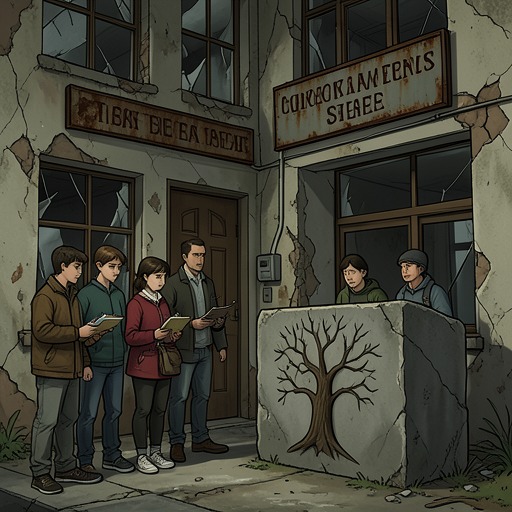
Pine Heights School redevelopment proposal and hearing
Missing YouThe Pine Heights School redevelopment proposal and hearing sets a proposed alternative high school against a luxury-condominium development for a Depression-era neighborhood school. As Douglas Mastriani and Tasha Thompkins make their case before residents and city officials, the dispute becomes both a contest over community space and a turning point in Jessica Mastriani’s understanding of her brother: the once-withdrawn boy is now leading a public campaign and earning a hearing.
Background and competing plans
Pine Heights was the elementary school attended by Jessica and her siblings. Built during the Depression by WPA workers, it stood three blocks from their home, close enough for the children to walk back for lunch. Its old-fashioned entrances, marked by scrollwork designating separate doors for boys and girls, remained as traces of an earlier era, though students no longer observed the distinction. With too few children in the neighborhood to fill the school, the school board planned to close it, and the city was considering its conversion into luxury condominiums.
Douglas and Tasha, his girlfriend and the daughter of neighbors across the street, proposed giving the building a new public purpose: an alternative high school. Their campaign opposed not simply a construction project but a particular vision of who the neighborhood was becoming. At a family meal, Douglas urged relatives to help reclaim the community from developers; Tasha explained that their proposal was for a high school, not a replacement elementary school. The distinction mattered to residents who saw little need for an elementary school in a neighborhood where many established homeowners had college-age children.
The two plans also represented sharply different claims on the school site. Randall Whitehead Sr., a developer whose son Randy Whitehead Jr. attended the hearing, envisioned a luxury complex with a gym and a coffee shop. His printed handouts presented it as suited to the growing number of double-income households without children commuting to Indianapolis. Whitehead described the homes as costing in the low to mid six figures, depending on amenities, and argued that the conversion would avoid bringing lower-income residents into the neighborhood. The existing baseball field, used intermittently by local families, would become a landscaped public area with a duck pond. The amenities offered a managed version of public benefit, while the price point made clear who the development was designed to attract.
The hearing and the arguments
The meeting took place in Pine Heights’s combined auditorium, gym, and cafeteria, a room Jessica remembered as much larger. Folding tables could be stowed in the walls, and folding chairs had been arranged in rows before a long table bearing a scale model of the school. In the model, redesigned windows and landscaping made the familiar building look like an upscale condominium complex. The room had no air-conditioning; residents sat in the evening heat and fanned themselves with Whitehead’s handouts as the city councilperson called the meeting to order.
Whitehead presented the development in the language of rising real-estate values and the town’s growing appeal as a bedroom community for workers in Indianapolis. Residents listened politely, asking about parking and the baseball field, then about mosquitoes and West Nile virus when Whitehead’s proposed duck pond came up. Meanwhile, Jessica watched Randy, who stood beside his father, passed him materials, and made little contribution to the presentation. The contrast between the polished sales pitch and the questions about the consequences of its specific features kept the hearing anchored in local concerns.
When Douglas asked how far the city council had progressed in reviewing the alternative-school proposal, the room’s response surprised Jessica. The murmuring carried approval, and a resident called out in support; another worried about teenagers roaming the neighborhood. Douglas answered that alternative education would not mean a lack of supervision: teachers would need state certification, and students could not loiter on school grounds after hours. A different resident raised a familiar objection, associating alternative schools with expelled students and troublemakers. Tasha countered that their school would set strict admissions requirements and require applicants to provide references.
The exchange exposed the social assumptions shaping the policy debate. The proposed students were discussed not only as young people needing an educational opportunity but as a possible threat to neighborhood order and property values. Douglas and Tasha responded by emphasizing oversight, selection, and the school’s potential value to the community. Their proposal did not erase residents’ concerns; it forced those concerns into the open alongside the developer’s own account of which prospective residents were desirable.
Douglas’s public emergence
For Jessica, the hearing’s most consequential development was her brother’s transformation into a public advocate. She had known Douglas as a boy who retreated into comic books and solitude, and who had once come home crying because a bigger student took his lunch money and called him a spaz. Now he was leading a neighborhood campaign, speaking to a divided room, and addressing residents who were listening to him. Jessica recognizes that he has a talent for public speaking she had not known he possessed.
Douglas framed the proposal as a response to economic and educational pressures extending beyond the empty school building. Young people, he argued, were being priced out of the community by rising housing costs; some were leaving for cities such as New York and Chicago because local work was scarce. At the same time, teachers had few openings in overcrowded public schools. An alternative high school at Pine Heights, he maintained, could create local work for teachers while giving teenagers who felt lost in the large public high school an opportunity to succeed. His argument linked the building’s reuse to the possibility of keeping both younger residents and skilled educators in the community.
Several people applauded. The response moved Jessica to tears: applause for Douglas’s words was a public recognition of a person she had once understood chiefly through his vulnerability. Yet Douglas remained dissatisfied after the meeting, believing he had swayed only a few people and that Whitehead had persuaded others with promises of rising property values. Tasha comforted him and said her father, who knew the mayor, had promised to speak on the campaign’s behalf during an election year.
Decision, aftermath, and significance
The city councilperson promised that both the alternative-school proposal and Whitehead’s condominium plan would receive a thorough review, with a decision expected by the end of the month. The hearing therefore ends without resolving the competition. Its immediate outcome is deliberation, not approval of either plan; the different futures for Pine Heights remain in play.
The proposal resurfaces later as leverage in a separate confrontation involving Jessica, Randall Whitehead Sr., Randy, and Rob Wilkins. Jessica refers to Whitehead’s interest in Pine Heights and asks him to abandon the condominium plan, support the alternative school, and make a substantial donation. In return, she says she may be able to arrange a deal that keeps him out of jail and civil court. This later bargaining connects the redevelopment dispute to the wider conflict around the Whiteheads, but the hearing evidence itself does not establish the final disposition of the school proposal or the terms of any eventual donation.
The episode’s civic conflict rests on a practical question—what should replace a school with too few children—whose answers distribute opportunity differently. The condominium plan promises amenities and a landscaped park while explicitly seeking affluent buyers; the alternative-school campaign presents the building as a resource for local teenagers and teachers. By placing those claims in the same overheated room, before the same residents and council, the hearing makes redevelopment a struggle over who belongs in the community and who gets to define its future. It also gives Douglas’s personal change a public measure: he is no longer only Jessica’s once-bullied younger brother, but a speaker whose argument can win attention and applause.