Randall Whitehead Sr.
Missing YouRandall Whitehead Sr. is a wealthy land developer whose plans for Pine Heights Elementary School make him a central opponent of a community-backed alternative high school. His public pitch presents the school site as an opportunity for luxury housing and a more affluent town; his later encounter with Jessica Mastriani exposes the limits of his control when his son’s secret recordings become the price of a confrontation over the property. The decisive reversal is not that Whitehead abandons his authority, but that he uses it to send the police after his own son.
Identity and Public Position
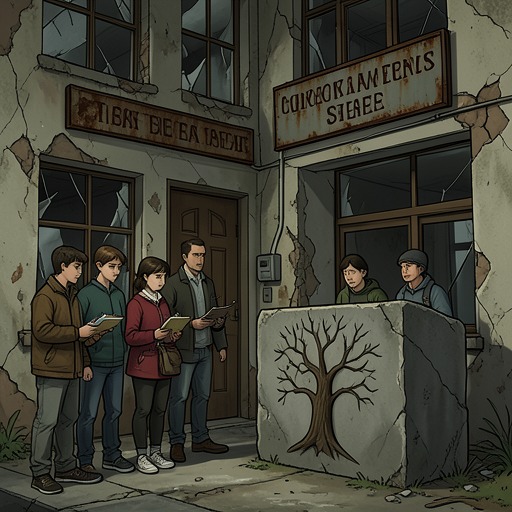
Whitehead is introduced through his proposed conversion of Pine Heights Elementary School into a luxury condominium development. The handouts distributed at a city council meeting describe a new residential complex with a gym and a first-floor coffee shop, aimed at double-income households without children commuting to Indianapolis. In the sales pitch, the town is becoming a sought-after bedroom community, and the project is presented as an accommodation to rising real-estate values and the preferences of upwardly mobile workers.
His presentation also makes its exclusions explicit. Whitehead says that units would cost in the low to mid six figures, depending on the amenities buyers chose, and assures the audience that the conversion would not bring in what he calls undesirably lower-income residents. The language frames the proposal not simply as a building project, but as a decision about who should be able to live in the community. Its vision of local prosperity rests on high-priced housing and the cultivation of an affluent population.
The development would also change existing uses of the site. Whitehead’s plan would remove the school’s baseball field, which local families still used occasionally for summer softball, and replace it with a landscaped park and duck pond open to the public. Residents’ questions about parking, mosquitoes, and West Nile virus reveal the practical concerns surrounding that promised amenity. The plan thus offers public access to a redesigned space while displacing the field’s existing, informal community use.
The School Hearing and Community Conflict
At the council meeting, Whitehead makes his presentation while his son, Randy Whitehead Jr., stands beside him in a supportive role, hands his father materials, and softly taps a pencil. Whitehead is the speaker advancing the development case; Randy’s quiet presence helps stage the proposal as a family enterprise, but the hearing gives little evidence that the son shares or articulates his father’s larger reasoning.
The competing proposal would establish an alternative high school in the former school building. Douglas Mastriani asks how far the council has progressed in reviewing it, and the response from the crowd is divided: some residents express approval, while others voice concern about teenagers in the neighborhood. A resident characterizes alternative-school students as troublemakers; Tasha Thompkins answers that the proposed school would have strict admissions policies and require references. Douglas argues that high housing costs are pricing young people out of town, that local teachers lack openings in overcrowded schools, and that students alienated by the public high school could have a chance to succeed elsewhere.
Whitehead’s condo proposal and the alternative-school plan embody competing claims on the same civic space. His plan associates the site with investment, rising property values, and higher-income residents; the school advocates argue for local employment and educational opportunity. The councilperson promises a thorough review of both proposals and a decision by the end of the month. The available scenes do not establish the council’s decision, but they show how Whitehead’s development ambitions become entangled with a broader dispute about whose needs should shape the town.
Reputation and Leverage
Whitehead is described as a powerful local figure, and Jessica’s father warns that he is rumored to have connections in Chicago. Jessica interprets the warning as a reference to the Mob, but the account establishes this as suspicion and rumor, not as a confirmed association. The scene nevertheless shapes the threat surrounding her next move: two suited men intercept her on Whitehead’s behalf, and their driver says Whitehead believes she broke into his son’s apartment and took property belonging to him. The men demand its return.
Jessica refuses to settle the matter with the intermediaries. She tells them she is already going to Whitehead’s office and insists that he meet her there, with Randy and Kristin Pine present. She offers a choice: Whitehead can recover the property in person, or she can take it to the police. The exchange reverses the initial pressure. His associates arrive to reclaim something for him, but Jessica redirects the demand toward a meeting in which the recordings and Randy’s conduct can be addressed.
Confrontation over His Son
At the office, Whitehead says that he did not understand the extent of Randy’s enterprise until Randy explained it the previous night. He recognizes that the matter concerns the younger man’s involvement with Rob Wilkins’s underage sister. Kristin denies that she and Randy made a video together; Whitehead’s acknowledgment of his son’s account and of the allegations against him does not itself resolve that dispute. The confrontation instead centers on the property Jessica has brought and the consequences its contents could carry.
Jessica distinguishes between a deal for Randy and a deal for his father. She proposes that Whitehead abandon the condominium plan for Pine Heights Elementary School and provide a sizable donation toward establishing the alternative school. In return, she says she may be able to arrange an outcome that keeps him out of jail and civil court. Whitehead narrows the discussion to the amount of the donation. His question shows that the development proposal has become bargaining leverage, though the cited scenes do not specify the donation amount or establish that the school was ultimately funded through this exchange.
The discussion also makes Whitehead’s position as a father and developer collide. His son’s behavior has exposed him to legal and public consequences, while Jessica uses the school property he wants to redevelop as leverage in negotiating a response. The scene does not portray him as unaware of power: his representatives have already come to retrieve the property, and his original proposal seeks to reshape a prominent local site. But the negotiation forces those resources into a different purpose, one tied to the community’s alternative-school campaign.
Decision and Narrative Significance
The meeting ends with Whitehead instructing his assistant, Thelma, over the intercom to send in the police for Randy Jr. Before doing so, he coughs and adjusts the collar and tie that Rob’s grip has mussed. His son springs from his seat in panic and protests, but Whitehead has already given the order. The concrete result in this scene is Randy’s impending arrest, not a fully detailed account of the case’s later legal outcome.
Whitehead’s decision complicates his role without erasing the conflict attached to his development plan. He has used intermediaries to pursue the return of property and has advanced a housing project that would exclude lower-income buyers; at the decisive moment, however, he does not shield his son from the police. His characterization therefore turns on a stark shift in authority: the developer who presents a carefully managed vision of the town is made to confront a crisis that cannot be contained by presentation or proxies. At the same time, the alternative-school proposal draws the private development dispute into a question of public responsibility, leaving Whitehead’s property, his son’s conduct, and the community’s competing futures bound together.