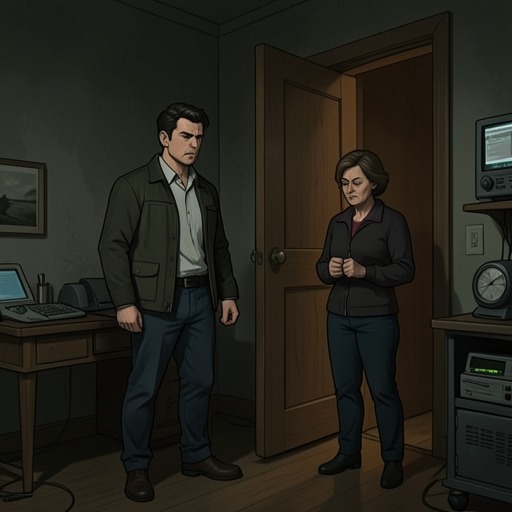
Randy’s videotapes
Missing YouRandy’s videotapes are the physical evidence that turns a suspected intrusion into a documented scheme of secret filming and distribution. Hidden cameras made private encounters into recordings without the women’s knowledge; the tapes, labeled with names and stored in multiple copies, show that the footage could be circulated beyond the bedroom. Their discovery links the concealed apparatus to the people it recorded and gives Jessica Mastriani material she can bring to the police.
Discovery and Physical Evidence
The recordings are uncovered in Randy Whitehead Jr.’s apartment after Jessica and Rob Wilkins remove a heavy mirror from the bedroom wall. Behind it, they find a section of wall cut away to conceal a video camera. The apparent mirror is two-way glass, allowing the camera to film through it. What had looked like an ordinary fixture is thus revealed as part of a deliberate viewing and recording setup.
The camera’s position is connected to a second concealment point in the walk-in closet. It had been aimed through a hole in the closet wall toward the bedroom and hidden beneath piles of men’s shoes, including Adidas and JP Tod’s driving moccasins. The recordings themselves were stored high on a closet shelf, which Jessica had to be lifted to reach. Together, the concealed camera, the altered mirror, and the tapes establish how the surveillance was arranged and hidden from the people being filmed.
The tapes are neatly labeled with names, including Carly, Jasmine, Allison, Rachel, and Beth. Jessica and Rob find multiple copies associated with each label. That duplication raises a consequential distinction: if the copies are identical, they indicate preparation for distribution rather than merely private viewing; if they contain different footage of the same woman, they represent multiple recordings. The precise contents still need to be checked, but the number and organization of the copies make the recordings evidence of a broader operation, not an isolated hidden camera.
Exposure and Legal Use
The tapes turn the hidden setup into a public accusation when Jessica confronts Randy Whitehead Jr. and his father, Randall Whitehead Sr., in an office. She tells Kristin Pine that she has seen the video of Kristin and Randy having sex and that he has been distributing it across southern Indiana and, possibly, across state lines. Kristin initially denies that any recording exists, but Jessica identifies the camera’s position behind the two-way mirror and describes details visible on the footage, including Kristin’s red tiger-stripe lingerie. The recognition breaks Kristin’s disbelief: she turns on Randy and realizes that he had also lied to her about Jasmine, whom he had claimed was his sister.
The tapes also reveal that Kristin’s recording was not the only one. Jessica names Carly, Jasmine, and Beth as other women whose videos she has seen, while the labeled collection includes Allison and Rachel as well. When Jessica explains the recordings to Randy’s younger sister, she makes clear that the material includes many underage girls and that copies were kept for distribution. The existence of those copies changes the stakes from a private violation to an ongoing threat to multiple girls; Jessica urges Randy’s sister to let her hand the tapes to the police and to testify so that he cannot repeat the scheme.
The recordings therefore function as both proof and leverage. Jessica can identify what was filmed, connect it to the concealed camera, and offer the tapes to law enforcement; Randy is in jail, and his sister’s testimony could help keep him there. Their significance extends beyond establishing what happened in one bedroom: the tapes document the means by which intimate images were made and circulated, while placing the burden of response on the people whose privacy Randy had taken.
Circulation and the Reach of Surveillance
Jessica describes Randy’s recordings as being sold over the Internet on amateur porn sites, not merely kept in his apartment. She tells Kristin that distribution may have crossed state lines, which she identifies as a felony. The tapes therefore connect the hidden camera to a route of circulation: intimate footage made without the women’s knowledge could be copied and sent beyond the place where it was recorded. Their organized storage and duplication make that wider reach a concrete concern rather than a vague possibility.
The case also places the tapes beside a different form of surveillance. After Jessica regains her ability to find missing people, federal agent Cyrus Krantz reveals that he tapped her cell phone and heard her calls to the girls and their parents. The book does not equate his monitoring with Randy’s secret filming: the recordings of the girls were made and sold without their knowledge, while Cyrus describes monitoring Jessica’s calls as part of his government work. Their juxtaposition nevertheless keeps control of private information in view. The tapes expose how recording technology can turn unknowing subjects into material for someone else’s use, while Jessica’s discovery and response make the captured images evidence against the person who controlled them.
Unauthorized Images and Public Identity
The tapes gain a further point of contrast from Jessica Mastriani’s own history of being made into a public image. After a lightning strike gave her the ability to find missing people in dreams, the press called her “Lightning Girl,” and a television show adapted her life, inventing events while using her name and story with her permission. That publicity was imperfect and sometimes uncomfortable for her family, but it was licensed and paid for. Randy Whitehead Jr.’s recordings invert that arrangement: the girls did not know they were being filmed, and the footage was allegedly sold without their consent. The difference is not simply between public attention and private exposure, but between an image a person has agreed to share and one taken from her and put into circulation by someone else.
Rob Wilkins’s scrapbook of Jessica’s press coverage and his attention to the television series show how images and stories can also become part of private attachment. Those clippings and broadcasts were known to Jessica, even as they shaped how Rob and his sister regarded her; the hidden recordings, by contrast, conceal both the act of looking and the intended audience. By uncovering the tapes and insisting that they be given to the police, Jessica helps change their function: material gathered to exploit the girls becomes evidence that can support action against the person who recorded them.