
The City's Changing Landscape
MomoThis flow traces how the built environment reflects and reinforces the city's turn toward standardized, hurried living.
increasing Bearing strength in each event
 decreasing
Bearing strength in each eventdecreasingA Ruin at the Edge
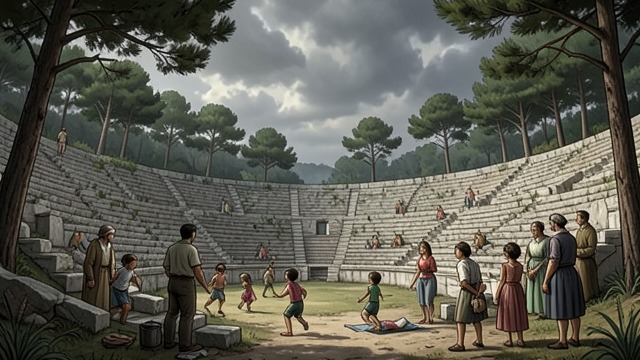
A Ruin at the Edge
An Old Place for Gathering
The Ancient Amphitheater stands among pine trees on the southern outskirts of the modern city. Nearby children play there, and neighbors use it as a meeting place despite its neglected condition.
The ruin holds a different relationship to time from the city's later development. It has outlasted its original purpose and remains available for human uses that were never planned for it.
Identical Housing
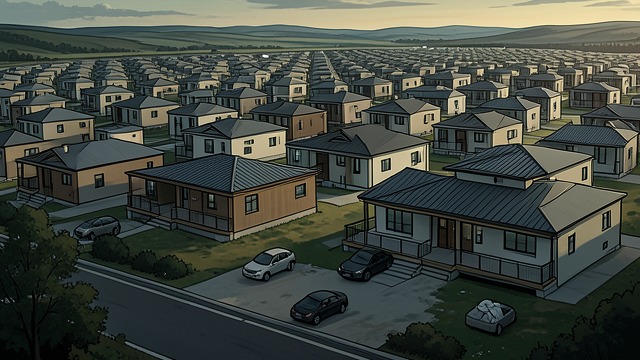
Identical Housing
Uniformity as Efficiency
Old buildings are replaced with modern structures designed for standardization rather than for the people who will live in them. A vast development of nearly identical homes spreads across the northern outskirts.
The repeated shapes turn cost-cutting into a visible environment. As individual needs disappear from architecture, residents' lives become increasingly programmed and alike.
Straight Roads to the Horizon
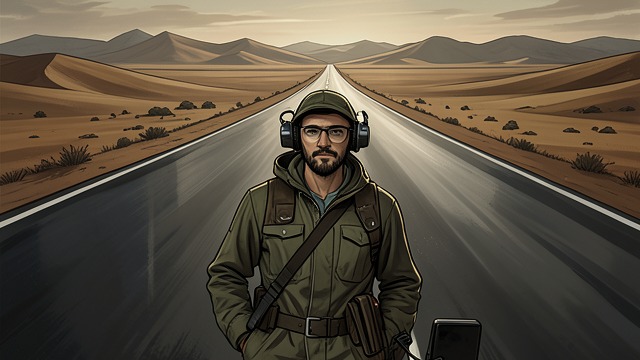
Straight Roads to the Horizon
The Landscape Disciplined
The new streets run in long, straight lines across a landscape described as a disciplined desert. Their order mirrors lives in which each movement and moment has been planned in advance.
The environment offers convenience without variety or surprise. Its visual monotony makes the city's social monotony seem almost inevitable.
Nino's New Building
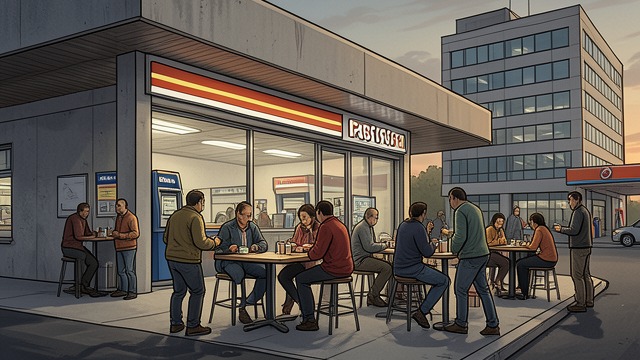
Nino's New Building
A Tavern Replaced
Momo finds Nino's old tavern replaced by a concrete fast-food establishment beside a petrol station and office block. Customers eat in haste at standing tables and complain about waiting.
The transformed restaurant makes the loss of conviviality tangible. A place once organized around conversation now channels people through a queue toward a quick meal.
A City Reopened
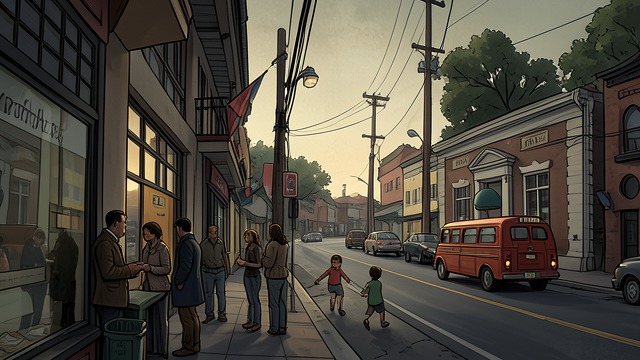
A City Reopened
Room for Human Pace
After time resumes, people stop to talk, notice window-box flowers, and care for others without the same pressure to hurry. Children play in the streets while drivers wait.
The buildings do not instantly return to an earlier form, but the city's use of time changes. The landscape no longer dictates every encounter as rigidly as before.
at the beginning of the story
as time-saving takes hold across the city
later in the city's physical transformation
one year after Momo leaves for Nowhere House
after the stolen time returns
