
The Children's Return to Play
MomoThis flow traces the children's movement from constrained institutional games back toward free and shared play.
increasing Bearing strength in each event
 decreasing
Bearing strength in each eventdecreasingPlay in the Ruins
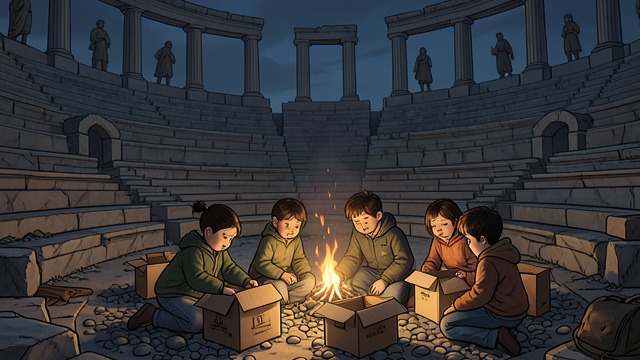
Play in the Ruins
Objects Become Worlds
At the amphitheater, children turn cardboard, cloth, pebbles, and the shape of the ruin into settings for elaborate games. Their play changes through discussion and invention.
The objects matter less than the children's ability to imagine together. Momo's presence helps them trust that a game can keep changing without a finished product.
Play in a Depot
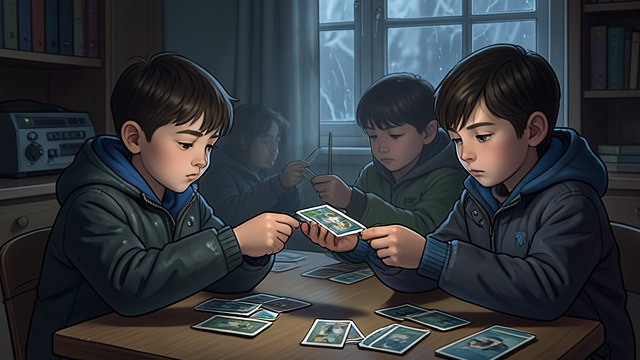
Play in a Depot
Usefulness Required
The children in depots are assigned games chosen by supervisors. They pretend to be data cards and compete to retrieve information as quickly as possible.
The activity trains concentration, but the children admit that enjoyment is not the point. Their game has been redesigned to serve an adult purpose rather than their own curiosity.
Old Friends Remember
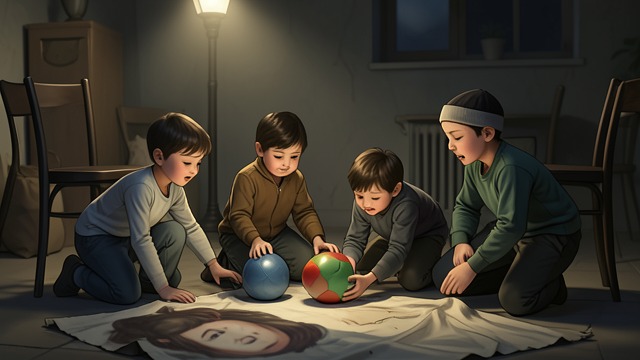
Old Friends Remember
A Lost Freedom Named
The children tell Momo that they used to enjoy inventing games with her, even though their supervisors said the games taught nothing useful. They cannot simply run away because the authorities catch them again.
Their memories preserve a standard by which they can recognize what has been taken. Momo sees that institutional control has changed their daily behavior without erasing their longing for freedom.
The Gates Close
The Gates Close
Care Used as Confinement
The children are swept into the depot's courtyard before they can answer Momo's request to join them. The gates clang shut, and a Gray Man tells Momo that letting her in would not serve the bank's interests.
The scene makes the separation physical and unmistakable. Momo's loneliness is not accidental; it is maintained by rules designed to keep her away from her friends.
Play in the Street Again
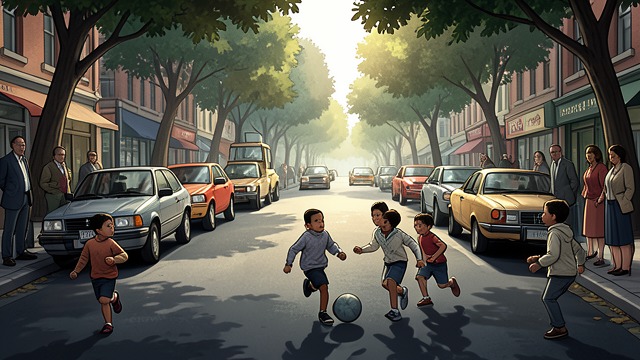
Play in the Street Again
Freedom Without Instruction
Children play in the street once time returns, and drivers wait rather than demanding that they move. Some adults join the games instead of treating them as an obstacle.
The change answers the restrictive depot policy with a public return to spontaneous play. The children no longer have to prove that their games are educational in order to have the right to play.
before the time-saving society takes hold
during Momo's absence
when Momo meets Paolo, Franco, and Maria
during Momo's visit to the Child Depot
after time resumes near the ending
