
The Gray Men Recruit a City
MomoThis flow traces the Timesaving Bank's hidden method of converting ordinary hopes into dependence and stolen time.
increasing Bearing strength in each event
 decreasing
Bearing strength in each eventdecreasingA Hidden Presence
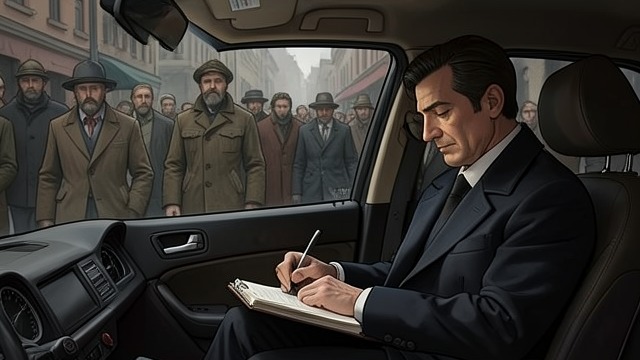
A Hidden Presence
Agents Without Notice
The Gray Men appear in limousines, restaurants, and public buildings, recording details in notebooks while remaining easy to forget. Their secrecy is not based on invisibility but on people's failure to notice them.
That unnoticed presence lets them study potential targets before making an offer. Their power begins in the everyday inattention they encourage and exploit.
A Target's Private Wish

A Target's Private Wish
Insecurity as an Opening
The Gray Men identify Mr Figaro's private belief that he is wasting his life. They repeat his own thoughts back to him, making the encounter feel like recognition rather than manipulation.
By treating affection, rest, and conversation as waste, the agent narrows the barber's idea of what counts as a successful life. Recruitment begins before the offer is formally made.
A Customer's Silent Consent
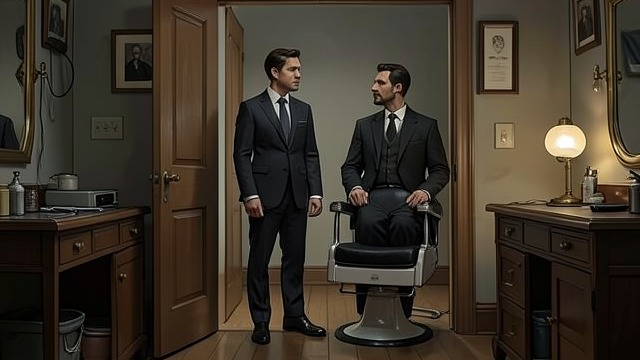
A Customer's Silent Consent
Trust Without Terms
The agent welcomes Mr Figaro into a movement but offers no written contract. He argues that time-saving depends on mutual trust, even though only the bank controls what happens to the time supposedly deposited.
Mr Figaro accepts the agent's instructions and soon forgets the visitor. He retains the damaging resolution, now mistaking the bank's program for his own independent judgment.
A Movement Becomes Normal
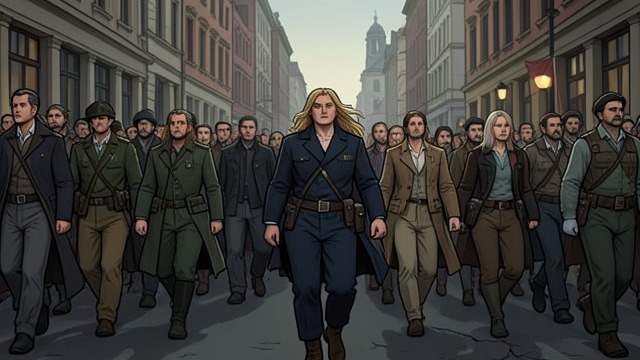
A Movement Becomes Normal
Social Pressure and Imitation
More residents adopt the new routines, and others follow because they fear being left behind. Public messages frame time-saving as modern, ambitious, and morally responsible.
Once the movement becomes a social norm, the Gray Men need fewer direct approaches. People discipline themselves and each other, doing the bank's work while believing they act freely.
A City in Their Image
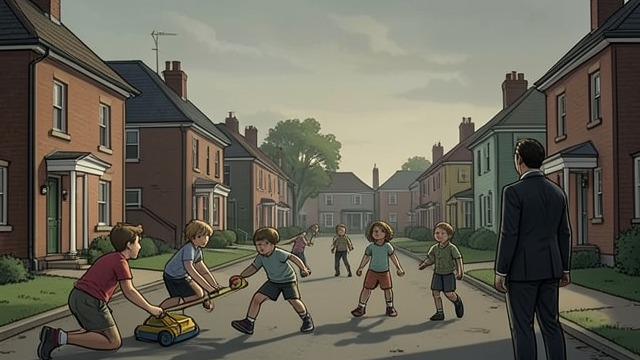
A City in Their Image
Efficiency Without Life
The Gray Men's influence changes homes, work, leisure, and childhood. Identical housing and scheduled activity replace forms of life that once depended on individual needs and unhurried attention.
People save ever more time but experience less of it as their own. The city has become a partner in the theft, even though its residents cannot see the thieves behind the system.
before the city's time-saving movement
the rainy day Mr Figaro meets an agent
at the end of Mr Figaro's first interview
as time-saving spreads through the city
later in the city's transformation
