État de jaguar-garou
Mon Loup AlphaThe État de jaguar-garou is the predatory animal form through which the book makes the conflict between Nemrod’s wolf side and Tyler’s jaguar faction visible and dangerous. A jaguar appears at Julien’s window, fights Nemrod after his transformation into a wolf, and is thrown from the balcony; later, its human identity is exposed as Sam Stanton. The state is therefore not merely an animal disguise: it carries the threat of clan conflict into Julien’s home and, through the hospital encounter, allows him to identify and confront one of Nemrod’s attackers.
Identity and Recognition
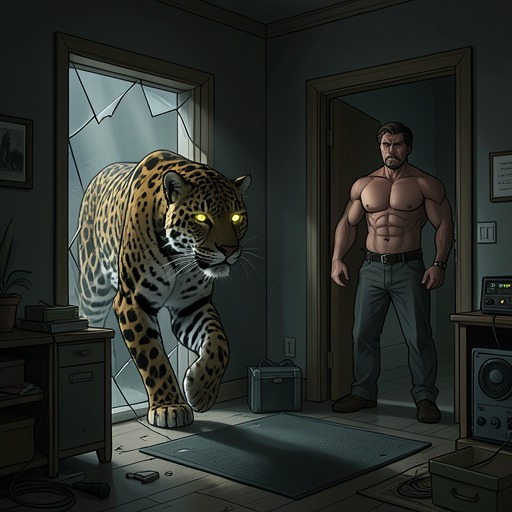
The jaguar form first becomes legible through its difference from ordinary animals. At Julien’s window is not a dog, cat, or wild wolf, but a yellow jaguar with enormous eyes, a mouth full of sharp teeth, and an agile, athletic body. Its paws keep scratching at the glass. The details establish an animal presence with its own physical force before Julien understands its connection to the conflict around Nemrod. A gust opens the curtains and lets moonlight into the room, making the intruder impossible to dismiss as an uncertain shape in the dark.
The jaguar’s appearance also completes a pattern of animal clues. Earlier, Nemrod’s lacerations seemed to Julien to have been made by a wild animal, perhaps a dog or wolf. That observation does not identify the jaguar or establish who inflicted those earlier wounds, but it places animal violence in the story before the window attack. Later, Nemrod explains that Tyler is pursuing him and that the jaguar knocked from the building was one of Tyler’s henchmen. The attack thus gains a political identity after first registering as a startling encounter with a powerful animal.
The narrative sets the jaguar’s body against Nemrod’s wolf body rather than treating the change as a vague supernatural effect. Nemrod growls, transforms under the full moon, and lands on all fours as a wolf; the jaguar answers his howl with a roar. For a moment, the two animals hold their ground without yielding. Their opposing calls and stances make the species difference audible and visible, while the ensuing fight gives that difference immediate consequences.
The Balcony Fight
The attack begins at Julien’s window during an intimate encounter with Nemrod. Once the jaguar is revealed, Nemrod leaps toward the window, which shatters, and the confrontation moves from the room to the balcony. The abrupt breach turns a private space into the setting for a fight and makes the danger to Julien immediate: the attacker has reached the place where he and Nemrod are together.
The struggle is initially balanced. Julien watches with conflicting responses: he is excited by the battle, worried for Nemrod, and stirred by the sight of his companion fighting to protect him. He reads Nemrod’s violence as the action of an alpha defending Julien’s safety and honor. That response makes the fight more than a contest between animals in the scene’s emotional logic; it also becomes an expression of the protective and possessive bond between the men. The jaguar, however, is not simply an emblem in Julien’s response. It can overpower Nemrod: at one point it pins him down with its paws at his throat.
Julien searches desperately for something with which to knock the jaguar unconscious, but does not have to intervene. Nemrod escapes the hold and, with a skillful move, throws the animal over the edge of the balcony. The fall is serious but not presented as fatal: the building is not high enough for the jaguar to have died, though it is probably injured. Julien locks his door and goes out onto the balcony, a practical reaction that marks the attack’s immediate aftermath without suggesting that the danger has been resolved.
Human Identity and the Continuing Threat
The jaguar’s human identity is confirmed through a chain of physical evidence rather than an immediate recognition at the balcony. At the hospital, Julien is sent to a patient in room 639 who needs morphine. The blond man is dressed in a blue hospital gown and has bites and bruises across his arms and legs. On his right forearm is a tattoo of a jaguar rearing on two legs. Julien recognizes it as the same design associated with Nemrod, except that the patient’s tattoo depicts only the jaguar, while Nemrod’s includes both a jaguar and a wolf.
The tattoo prompts Julien to keep his guard up. The patient’s medical file identifies him as Sam Stanton, aged 27, found in the street with superficial injuries and suspected of having fallen one storey; he has not confirmed what happened. The combination of the matching jaguar symbol, the injuries, and the earlier fall allows Julien to realize that Sam is the animal Nemrod threw from the balcony. The shift from animal body back to an injured man makes the state’s connection to human identity concrete, while leaving the jaguar attack’s factional allegiance intact: Nemrod has already identified the attacker as one of Tyler’s henchmen.
Julien acts on that recognition by replacing the intended syringe with one filled with potassium chloride, which he knows can stop the body if too much enters the system. He wakes Sam by throwing water in his face and threatens him with the syringe unless he reveals where Nemrod has gone. Sam gives him the location of Nemrod’s den. The scene does not turn the jaguar state into a medical explanation; instead, it shows how the exposed human identity lets Julien use his hospital knowledge to pursue information from the person who attacked his companion.
Faction, Body, and Narrative Function
The jaguar form belongs to a wider struggle over leadership. Nemrod explains that Tyler is pursuing him and that he is fighting to become the leader of a united pack of werewolves and jaguar-garous. The jaguar attack therefore carries the succession conflict into a direct physical encounter. Nemrod’s attacker is both a threatening animal at the window and a subordinate participant in the contest that Nemrod describes; the two aspects are joined when the injured animal is recognized as Sam.
The form also sharpens the contrast between animal behavior and human politics without separating them. The jaguar scratches at a window, roars back at a wolf, pins Nemrod by the throat, and is thrown from the balcony. Later, a tattoo and a medical record connect that body to an identifiable man and an organized faction. The shift in recognition runs from animal presence, to combatant, to wounded patient, to political informant. Across those stages, the jaguar’s physical actions remain consequential rather than ornamental: they threaten Julien, nearly place Nemrod at the jaguar’s mercy, and then lead Julien to information he can act upon.
The book’s stated interest in departing from conventional gay werewolf-romance rules is consistent with this encounter’s use of animal transformation as a source of both erotic charge and concrete danger. Julien finds Nemrod’s fight exciting because he sees it as protection, but the jaguar’s attack is also an assault that leaves its attacker injured and draws Julien into the clan struggle. By the end of the episode, Julien decides to help Nemrod win that war. The jaguar state thus helps move the conflict from Nemrod’s explanation into Julien’s own decision to take part.