Empoisonnement de Nemrod
Mon Loup AlphaNemrod’s poisoning turns an initially visible injury into a strange crisis that Julien can neither diagnose nor treat by ordinary nursing methods. Green blood seeps from Nemrod’s wounded flanks, and later Nemrod identifies poison in his veins and asks Julien to help expel it through an intimate bodily process. The episode appears to save Nemrod’s life, but the book leaves the poison’s source, substance, and underlying mechanism unexplained; its effects are conveyed through color, coughing, and the sudden need for a remedy.
Manifestation and Initial Uncertainty
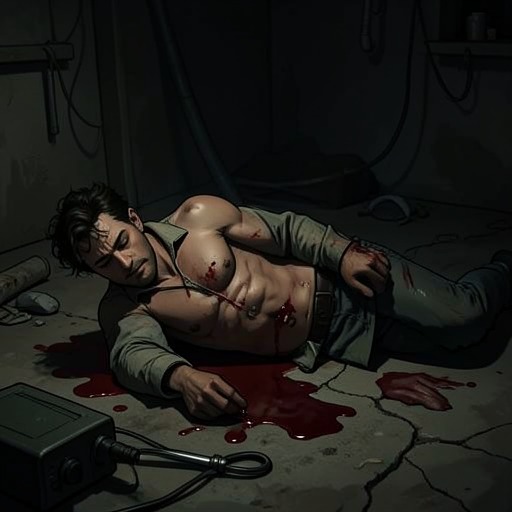
When Nemrod appears on Julien’s rooftop, Julien is so absorbed by the stranger’s powerful build that he initially overlooks the blood running from his sides. Nemrod steps forward with a low growl, and green liquid drips from his torso onto the roof. The striking color is the first concrete sign that his condition does not fit Julien’s ordinary expectations of injury. When Julien asks what it is, Nemrod identifies it simply as blood, without explaining why it is green.
The wounds suggest that Nemrod has recently been in a fight. Under brighter light, Julien notices the injuries more clearly and reads them as evidence of combat; the scars on Nemrod’s face later reinforce his impression that this is a man accustomed to fighting. Yet the visible injuries and the green blood do not establish the cause of the later poisoning. The narrative places them together in the same encounter, but does not say that the wounds introduced the poison, identify an attacker responsible for it, or show how the toxin entered Nemrod’s body.
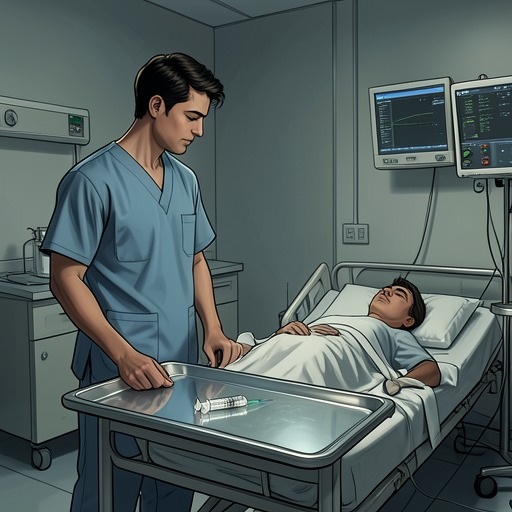
Julien’s nursing background shapes his first response. He thinks in practical terms: clean the wound with disinfectant and stitch it if it is deep. At the same time, his attraction to Nemrod competes with that clinical attention. The story makes the missed detail explicit: Julien has been so captivated by Nemrod’s appearance that he fails at first to see the bleeding. His initial care therefore begins at the intersection of professional impulse, concern for an injured stranger, and desire—not with a reliable understanding of what is wrong.
Recognition and the Proposed Remedy
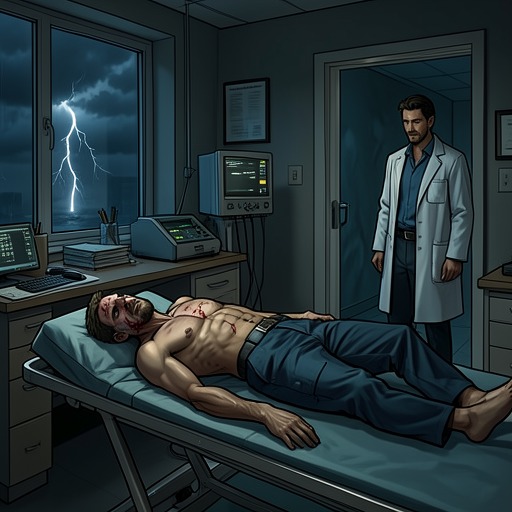
The poisoning becomes an explicit diagnosis only after Nemrod wakes and abruptly coughs, clutching his massive bare chest. He says he thinks he has been poisoned. When Julien asks who did it, Nemrod points toward his groin rather than naming a person or explaining an attack. He then says someone must get rid of the poison and indicates that it is moving through his veins. His account presents the requested act as the only way to remove it, but does not supply a name for the poison or a more general rule that would let Julien verify the claim.
For Julien, this changes the encounter’s terms. Until then, the immediate problem has seemed to be Nemrod’s bleeding wounds; now Nemrod describes an internal threat that requires an unexpected form of help. Julien is startled, while Nemrod treats the request without embarrassment and asks for assistance. The mismatch between Julien’s nursing expectations and Nemrod’s confident explanation gives the scene its central uncertainty: Nemrod knows what he believes will work, but Julien has no independent medical basis for assessing the diagnosis or the proposed treatment.
The remedy is followed by an unusual physical sign. After Nemrod ejaculates, the semen is violet rather than translucent. Julien wonders whether the color is due to the poison, and Nemrod thanks him, saying that Julien has saved his life. When Julien asks whether the violet discharge means all the poison has been evacuated, Nemrod confirms that he feels better. The sequence supports the conclusion that the release is presented as a successful cure in this instance. It does not establish that violet semen is a universal sign of poisoning, explain why the process works, or show that the poison was chemically measured or otherwise tested.
Limits of What Is Known
The book offers bodily evidence but little medical explanation. Green blood marks Nemrod’s external injuries; coughing and clutching his chest mark the later crisis; violet semen accompanies the claimed expulsion of the poison. These colors make an otherwise invisible condition visible to Julien and the reader, but they do not provide a diagnosis beyond Nemrod’s own statement. Julien can observe what happens, ask whether the poison is gone, and hear Nemrod report improvement. He cannot identify the substance, trace its origin, or independently confirm that every trace has left Nemrod’s body.
That gap matters because Julien’s ordinary care and Nemrod’s account operate through different kinds of knowledge. Julien initially relies on familiar nursing actions—disinfecting and possibly stitching a wound—while Nemrod presents a remedy that Julien would not infer from the visible injuries. The narration does not resolve this tension by supplying a clinical explanation. Instead, it lets Nemrod’s certainty and the immediate reported improvement stand alongside Julien’s unanswered questions. The cure is consequential within the scene without becoming a fully explained medical procedure.
Other details make Nemrod’s danger broader than this single symptom, but do not settle the poison’s cause. While asleep, he murmurs a warning about Paimon; Julien takes this as evidence that Nemrod has been pursued and involved in some kind of fight. Later, Nemrod explains that Tyler is pursuing him and that he is struggling to become leader of a united pack of Loup-garou and Jaguar-garou. This political conflict supplies a context of violence and pursuit, not proof that Tyler, Paimon, or a particular enemy poisoned him. The narrative keeps those connections suggestive rather than confirmed.
Recurrence and Consequences
Nemrod’s recovery from the immediate crisis is not a lasting resolution of his physical vulnerability. After Julien has helped him, Nemrod later clutches his chest and begins coughing again. Julien remains worried and offers to tend his wounds. The renewed coughing does not prove that the poisoning has returned: the book does not identify it as a relapse or connect it explicitly to the earlier toxin. It does, however, prevent the first apparent cure from making Nemrod’s condition seem entirely settled. His injuries and bodily distress continue to demand attention.
The episode also shapes what Julien knows—and what he does not know—about the man he has taken in. Nemrod thanks him for saving his life, giving Julien a direct acknowledgment of the stakes of his help. But the key questions remain open: Julien still wonders how Nemrod was injured and why green blood came from his flanks. Nemrod’s later account of his political struggle explains why he faces danger, while leaving the poisoning itself unexplained. In this way, the cure resolves an immediate emergency while preserving the larger mystery surrounding Nemrod’s body and the forces threatening him.
Nemrod’s poisoning thus occupies an uneasy space between injury, supernatural difference, and intimate care. Julien begins with the familiar intention to clean and possibly stitch a wound, but the decisive intervention follows a bodily rule Nemrod alone supplies. The green blood, violet discharge, and recurring cough make the crisis concrete without making its biology transparent. Its significance lies partly in that contrast: Nemrod’s condition is serious enough that he says his life is at stake, yet Julien can help only by trusting a remedy whose mechanism remains outside his medical understanding.