Julien
Mon Loup AlphaJulien is a 25-year-old nurse whose move to Montréal turns a hoped-for fresh start into an encounter with acute loneliness, and then into a bond that redirects his life. Repeated romantic rejection leaves him on a rooftop contemplating suicide; after he rescues the wounded Nemrod, the attraction and companionship he finds with him become reasons to act, belong, and enter a conflict far larger than his original search for love.
Identity and Background
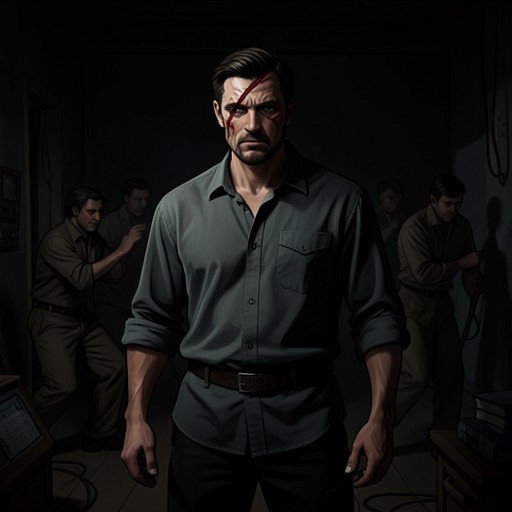
Originally from Florida, Julien recently moved to Montréal to break with the routine of an underpaid nursing job and begin again. He is single, gay, and eager for a relationship, but arrives without a local support network. His French is limited: he has completed only two semesters of intermediate courses, a shortfall that makes the city’s official language another source of distance. Montréal offers the possibility of reinvention, yet in his first days there Julien experiences it as a place where he has little connection to anyone.
His nursing experience is one of the few forms of competence he can rely on. When he encounters an injured stranger, he sets aside his immediate attraction long enough to recognize that a man’s life may be in danger. He later draws on his training to assess and clean the wound, using supplies from his own medical kit and considering whether it needs stitches. That professional identity continues to shape his actions even as his personal involvement with Nemrod begins to overtake it.
Loneliness and the Rooftop Crisis
The immediate crisis grows out of a familiar pattern for Julien: he has gone on another date and been rejected, and cannot understand why his appearance, personality, or behavior do not seem to lead to mutual interest. He has been in Montréal for only a week when he meets Tyler, a literature student at Université Concordia, through a gay dating site. Their messages feel candid and easy, so Julien asks Tyler to show him around the city. They talk and laugh during their meeting, but when Julien takes Tyler’s arm in the cold, Tyler does not respond. Julien reads the gesture as evidence that the attraction is not mutual. A date planned to last until five ends at two, with Tyler giving a work-related excuse; afterward, the silence between them hurts in its own way.
Julien’s disappointment is intensified by the mismatch between what he seeks and what he encounters. On his first night in the city, he passes clubs in the Village but does not want to party; he wants affection and a boyfriend, not simply a night out. At a gay strip club, a dancer offers him a three-minute lap dance for twenty dollars, which he declines. The men who contact him online are generally not men he desires, and he avoids replying rather than encourage them. These experiences do not amount to a lack of opportunity so much as a painful lack of the kind of intimacy he wants.
On a cold winter night, this loneliness culminates on the roof of his building. Looking toward the traffic below, Julien imagines jumping, but the pain he expects to suffer is what stops him from acting immediately. Snow and freezing wind sharpen the scene’s physical discomfort, while his limited French and social isolation give that discomfort a wider setting: he feels alone in a city where he has not yet found a place. The encounter with Nemrod that follows does not erase the crisis, but it interrupts the path on which Julien has been trapped.
Rescuing Nemrod and Becoming His Companion
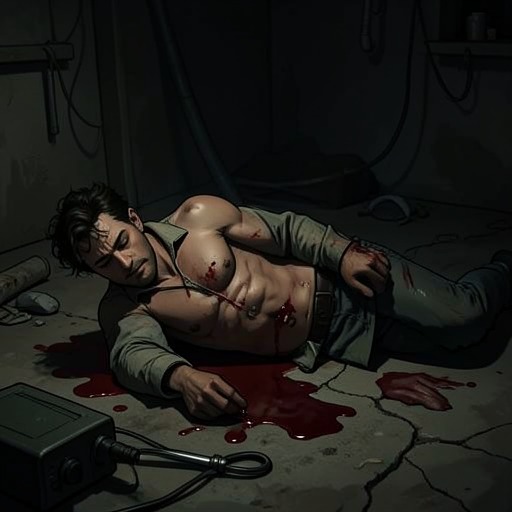
Julien finds Nemrod injured and brings him inside, laying him on his bed. Nemrod’s claim that his green blood is blood leaves Julien suspicious, but not uncertain about what to do next. He gathers sterile gauze and compresses, and his nursing training supplies a practical response to an extraordinary injury. At the same time, his attraction to the handsome, muscular stranger complicates the scene: Julien has to pull his attention away from fantasy and focus on his duty to care for a patient.
After Nemrod recovers enough to move toward him, the physical intimacy between the two becomes a turning point. Nemrod draws Julien close, and later uses semen from Julien’s chest to penetrate him with a finger. Julien understands this act as a territorial claim and welcomes the idea of belonging to Nemrod. Nemrod also smells him, and Julien returns the gesture, registering Nemrod’s citrus-and-spice scent as something that will remain in his memory. Touch and scent make the emerging bond bodily, while Nemrod gives it an explicit name: he tells Julien that he is now his companion. Julien does not yet know everything that designation means, but is ready to accept it.
Commitment and Conflict
The companion bond quickly becomes more than a private romance. Nemrod acknowledges that he is involved in a political conflict and has put Julien in danger. Julien responds with determination that, as Nemrod’s companion, the conflict concerns him too. His choice is bound to a deeper need: after feeling unwanted and alone, he wants to be part of someone’s life, and he treats sharing Nemrod’s battles as a way of making that belonging real. The decision is not merely a declaration of attraction; it brings Julien into the consequences of Nemrod’s position and ambitions.
When Julien wakes and finds Nemrod gone, he refuses to remain behind waiting for him or for him to become a leader. Instead, he resolves to find and support him. At the hospital where Julien works, he is sent to a patient who needs morphine. He recognizes the blond patient’s jaguar tattoo as a counterpart to the combined jaguar-and-wolf tattoo on Nemrod, then realizes that the injured man is Sam Stanton, the jaguar-garou Nemrod threw from a balcony, now back in human form. Julien exchanges the syringe for one containing potassium chloride and uses the threat of a potentially fatal injection to force Sam to reveal Nemrod’s usual whereabouts: an alpha den in a park. The episode shows Julien’s professional knowledge serving a purpose opposite to care. He does not inject Sam, but he turns medical trust and access to lethal medication into instruments of coercion, acting from anger at the attack on his companion.
Change and Narrative Role
Julien’s trajectory moves from isolation toward chosen allegiance. At first, he measures the possibility of connection through dating: a promising conversation, a physical gesture, and the hope that someone will want him back. Nemrod’s arrival changes the terms. The intimacy between them offers Julien an immediate sense of being claimed, but it also binds that intimacy to danger and conflict. Julien responds not by retreating to safety but by taking increasingly consequential action, from caring for Nemrod to threatening Sam and deciding to join Nemrod’s clan war.
The ending keeps this transformation in motion rather than resolving it. Seeing lovers walk hand in hand, Julien settles on support as the meaning of love and decides to go to Nemrod and help him win the war. He has not yet reached Nemrod, and the story closes on his intention rather than on the outcome of the conflict. That open ending marks both the force and the risk of his change: the man who once wanted simply to be wanted now understands belonging as participation in another person’s battles.