Métamorphe
Mon Loup AlphaMétamorphe is the shape-changing condition that allows Nemrod to move between human and wolf forms. Its significance in the novel reaches beyond physical transformation: the change makes visible an identity already bound to animal instincts, a companion relationship with Julien, and a violent political struggle involving both wolves and jaguars.
Identity and Acquisition
Nemrod tells Julien that he has been a Métamorphe for five years, since a Loup-garou bit him one night while he was walking. The account establishes transformation as an acquired condition rather than something Nemrod was simply born displaying. The text does not explain the bite’s broader effects or give a general account of how the condition passes between people; its concrete history is Nemrod’s own.
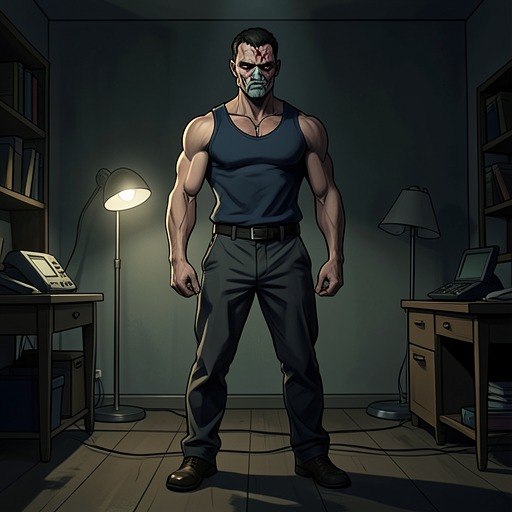
Before Julien knows what Nemrod is, the wounded man’s injuries offer an unsettling clue. His lacerations look as though they were made by a wild animal, such as a dog or wolf. Nemrod then murmurs the name Paimon in his sleep and warns the figure not to approach. Julien, who does not yet understand the supernatural context, concludes that Nemrod has been in a fight and was pursued. The early uncertainty makes Nemrod’s eventual transformation a revelation that reorganizes the meaning of both his injuries and his danger.
Bodily Transformation
Julien sees Nemrod change during the confrontation with a jaguar outside the window. Under the full moon, Nemrod’s human body becomes unmistakably lupine: his limbs become wolf legs, his hands and feet become paws, his body stretches until he lands on all fours, his mouth forms an animal muzzle, and his eyes become those of a wild wolf. A tail grows behind him. The sequence makes the change a bodily process rather than a hidden switch in appearance; Nemrod’s familiar human shape is replaced piece by piece by an animal form.
The transformation is accompanied by sound and movement. Nemrod growls from his throat, then howls, while the jaguar answers with a roar. The two animals hold their ground before Nemrod springs at the window and breaks through it. After the fight, he gradually returns to human form. His eyes have regained their hazel color when Julien examines him. The reversible change thus has a visible aftermath as well as a dramatic entrance: the wolf body recedes, but Nemrod remains injured and must be cared for.
Capabilities and Limits
When Julien asks whether Nemrod can become a wolf and return to human shape whenever he chooses, Nemrod indicates that he generally can. This establishes a substantial degree of control, while the qualification leaves room for limits that the account does not specify. The fight scene shows Nemrod in wolf form, and his return to human shape afterward confirms that shifting works in both directions; it does not establish that every transformation has the same circumstances or cost.
Nor does the ability make Nemrod invulnerable. The jaguar gains the advantage and pins him down with its paws at his throat. Nemrod escapes the hold and throws the attacker over the balcony, but he ends the encounter lying on the ground, coughing and in need of wound care. His altered body enables him to meet the threat on animal terms, yet it does not erase the physical consequences of combat. The scene holds power and vulnerability together rather than treating the wolf shape as effortless mastery.
Animal Relations and Social Stakes
The conflict is not simply between a human and a wild animal. Nemrod explains that the jaguar pursuing him is Tyler and that the animal driven over the balcony was one of Tyler’s henchmen. Nemrod is fighting to become leader of the Meute unie de loups-garous et de jaguars-garous. His ability to become a wolf therefore belongs to a larger social and political identity: the transformation places him within a struggle over leadership involving more than one shapeshifting kind.
The scene also frames animal behavior through territory and recognition. Nemrod has already made Julien his companion; when he sniffs Julien, Julien understands the gesture as another way of possessing him, and sniffs Nemrod in return. During the attack, Julien reads Nemrod’s defense of him as the forceful protection of a mate. The wolf form makes that protective, territorial dimension visible, while the exchange of scent links the nonhuman body to intimacy rather than separating the two.
Narrative Significance
The novel’s presentation of Métamorphe combines the fantastic with the immediate evidence of bodies: cuts, a changing face, paws on a throat, a broken window, and a wounded man returning to human form. Julien’s understanding develops through those particulars. At first he can only infer a struggle from Nemrod’s injuries and sleep-talk; later he witnesses a jaguar, a wolf, and the connection between the fight and Nemrod’s political ambitions. Transformation turns what seemed like unexplained violence into part of an organized supernatural conflict.
The condition also reshapes the meaning of Nemrod and Julien’s relationship. After the encounter, Julien remembers Nemrod’s sexual marking alongside the fact that his companion is a Loup-garou embroiled in a war for leadership. Desire and danger are not separate consequences of Nemrod’s identity: they converge in a relationship that involves scent, bodily claiming, protection, and exposure to political violence. An authorial note says the book departs from conventional gay werewolf romances in pursuit of a more inventive approach. In this account, the Métamorphe is accordingly not only a transformation premise, but the point where bodily change, erotic attachment, and contested collective power meet.