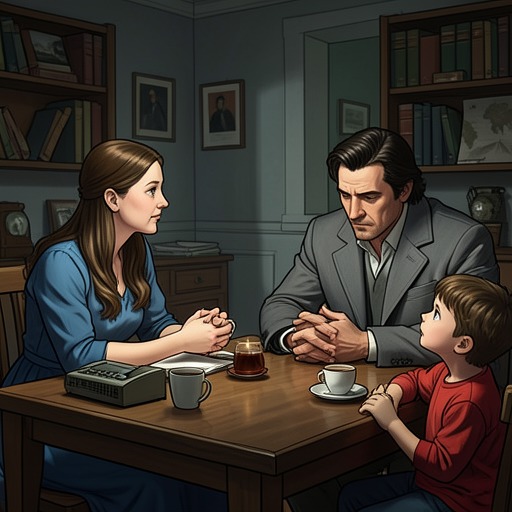
Edgar Lockett
Mothering SundayEdgar Lockett is the vicar of the Coton parish and a trusted presence in the lives of the workhouse children and the families around them. His importance rests less on a single dramatic action than on repeated acts of practical and public care: he supports Verity Lockett’s service to the children, testifies to their characters when their allegations are challenged, and ministers to families facing birth and death. In a story where authority is often used to silence vulnerable people, Edgar’s clerical standing becomes a means of making their testimony heard.
Identity and Background
Edgar is the local vicar and a prominent figure in the community. He gives religious instruction to the orphans at Sunday School, where he works alongside his fiancée, Verity. His influence is substantial enough that Miss Frost, despite her authority at the workhouse, would not risk offending him. The contrast is significant: Verity can see the mistreatment of the children but fears losing her paid position, while Edgar’s standing gives him room to support her continued involvement.
Edgar is about ten years older than Verity and has already experienced the loss of a wife, who died in childbirth. Verity, herself orphaned in her late teens, had worked as a governess before teaching the girls at the workhouse. As she approached thirty, she had begun to fear that she would remain unmarried; meeting Edgar through Sunday School changed that expectation. Their rapport was immediate, and he asked her to marry him the previous summer. His history of bereavement gives particular weight to the domestic happiness he later builds with Verity, without erasing the loss that preceded it.
Marriage and Family Life
After their marriage, Edgar and Verity make their home at the vicarage. He understands that she is attached to some of the workhouse children and agrees that she may continue volunteering for a few hours each week as the vicar’s wife. This support preserves a connection she values and gives her a role beyond the household. Their marriage therefore links the parish home to the institution whose children Verity has tried to help.
The birth of their daughter, Phoebe Mary Lockett, brings an open tenderness into their family life. Edgar and Verity had chosen names for a boy and a girl before the birth; Phoebe honours Verity’s mother, while Mary is the name of Edgar’s mother. Verity describes Edgar as eager to hold the baby, and later he is reluctant to leave when she is due a feed. The infant’s ordinary needs and loud cries are a source of amusement and affection to him, a marked contrast with the neglect and danger surrounding other children in the novel.
Ministry and Advocacy
Edgar’s ministry includes the workhouse children, not only his congregation. When Verity teaches there, his engagement to her gives her some protection from Miss Frost’s displeasure, though Verity remains conscious that her employment is precarious. Edgar’s willingness to let her keep volunteering after their marriage makes his support concrete: he does not require her to abandon the children when her social position changes.
He also responds promptly when Sunday Small brings news that Verity is in labour. Sunday finds him in the churchyard after he has conducted a funeral and tells him that his wife is on her way home in the cart. Edgar immediately sets about obtaining a midwife and doctor. The episode places his pastoral life beside urgent household responsibility: Sunday carries the news, and Edgar acts on it without delay.
His most direct public intervention comes when Lady Lavinia Huntley asks him to attend the guardians’ inquiry into Albert Pinnegar. As the girls’ statements are presented, Edgar stands and offers to testify to their good characters. His evidence does not replace their accounts; it strengthens their standing before the men deciding what should happen. The scene makes his influence ethically consequential: the vicar’s authority, which had once helped protect Verity’s position, is now used to support the credibility of the young women who accuse a powerful workhouse official.
Pastoral Care and Bereavement
Edgar’s care extends beyond formal proceedings. After Cissie Burns returns to Treetops Manor with her baby, he accompanies Verity and the child there. At the house, he sees the fragile infant Stephen Huntley and learns the name chosen for him. Edgar welcomes the child into the Church and blesses him, performing a religious rite while those around the baby fear for his survival. The ceremony offers recognition and dignity even where medicine and care cannot promise a future.
He later conducts Daisy Branning’s funeral in Chilvers Coton churchyard. The service is remembered as especially beautiful, and Tommy Branning stands beside Daisy’s grave with Sunday holding his hand. Edgar’s words and actions do not lessen the loss; the service gives the mourners a shared form in which to acknowledge it. A week after Stephen’s death, Edgar conducts the child’s funeral as well. The whole household at Treetops Manor is grieving, and Verity is particularly distressed because Phoebe had caught measles before Stephen did. Edgar’s role at both funerals makes him a steady presence across different kinds of bereavement, from the death of a young woman to that of a fragile infant.
Later Actions and Narrative Significance
Edgar also helps Sunday after she has left the Barnes household. He brings her the wages he has collected for her and tells her that Mrs Barnes has died. The money gives Sunday access to earnings she had been unable to collect herself; the news is painful but complicated, since Mrs Barnes had treated her unkindly and suffered from lung disease. Edgar delivers both facts plainly, allowing Sunday to respond without pretending to a grief she does not feel.
At the close of the novel, Edgar remains part of the community’s movement toward renewed family ties. On the day Sunday and Tom Branning intend to ask him to marry them, the congregation gathers at All Saints Church, where Edgar leads a service centred on motherhood. His words frame a love that persists through sacrifice and loss; Verity sits nearby with Phoebe. Soon afterward, Sunday approaches Lady Lavinia with violets and addresses her as her mother, and the two embrace. Edgar does not cause this reconciliation, but his church and ministry provide the setting in which it becomes public and communal. Across the novel, he is presented as a compassionate clergyman whose authority matters most when it shelters others’ choices, affirms their testimony, and gives grief and reconciliation a shared form.