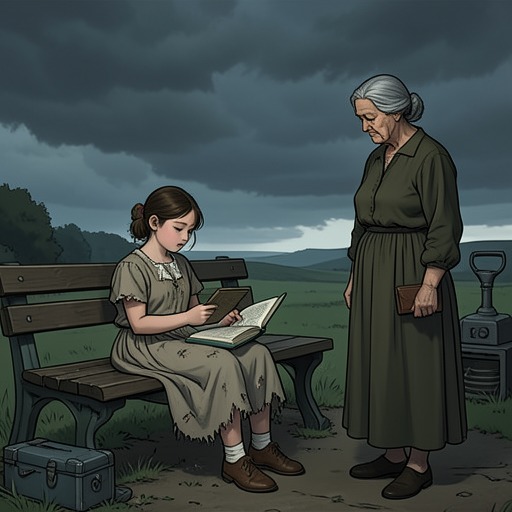
Jacob
Mothering SundayJacob is Biddy Spooner’s nephew, a young man whose romantic interest in Sunday Small develops alongside a more practical loyalty to the people around him. He offers Sunday affection without insisting she return it, and his eventual courtship of Ellie gives his story a quiet resolution distinct from Sunday’s attachment to Tom Branning.
Identity and Introduction
Jacob enters the evidence as part of the Spooner household’s circle, where Biddy notices that he has begun watching Sunday with particular attention. When she draws Annie’s attention to it, Annie is surprised at the possibility of a match; Biddy’s response is that Sunday is nearly fifteen and growing into a young woman. The exchange places Jacob’s feelings within the household’s everyday observations, rather than presenting them first as a dramatic declaration. His aunt’s awareness also becomes important later, when she tells him that Sunday plans to leave.
The novel gives Jacob a practical competence as well as a romantic role. He says he was good at boxing at school, a detail that becomes relevant when the Spooner home is threatened and Nell has been attacked. His schooling is not developed into a broader biography, but the reference establishes a capacity he is willing to put to use in defense of others.
Loyalty in Moments of Uncertainty
When Daisy disappears, Jacob joins Tommy in searching for her. He volunteers to go out rather than leave Tommy to search alone; once they set off into the cold night, the men divide their efforts, with Jacob looking around Stockingford and Tommy heading toward Hartshill in the hope that Daisy might have gone to see Cissie at Treetops Manor. Jacob’s contribution is concrete and unshowy: he shares the work of the search, taking one direction while Tommy takes another. Sunday stays behind, waiting for their return with Biddy, whose decision to sit in Tommy’s chair beside the fire underscores the household’s shared anxiety.
After the attacks connected with the Spooner home, Jacob offers further protection. He agrees that the incidents appear connected and says he will stay downstairs for several nights so Mickey can rest. He also warns that the girls should not go out alone, and arranges that Mickey accompany them when Jacob is at work. His stated readiness to confront the attackers rests partly on his boxing experience, but his broader response is organized around vigilance: taking a watch, reducing the women’s exposure, and making sure someone accompanies them. The episode presents his courage less as a boast than as a plan to make the household safer.
Courtship of Sunday
Jacob’s affection becomes explicit during an outing to the theatre. On the cab ride home, he takes Sunday’s hand and tells her that he has grown fond of her. He traces the change in his feelings to Christmas, when Rebecca had treated Sunday rudely: before then, he had regarded her as little more than a child, but that evening made him realize she was growing up. He is careful not to turn his confession into a demand. Seeing that Sunday is unsettled, he reassures her that he can wait until she feels ready and asks only whether she might someday feel something for him.
Sunday answers honestly that she likes him very much but does not know whether her feelings are romantic. She recalls that she once had a childhood crush on him when she first went to live at his aunt’s, but that feeling had passed, and much had happened since. Jacob accepts her uncertainty rather than pressing for an immediate decision. The difference between his clear declaration and her tentative response is left unresolved at this point; affection exists, but it does not make Sunday ready to choose a relationship.
Biddy later raises Jacob’s feelings again when Sunday is preparing to leave. Sunday says that she is fond of him but not ready to commit to anyone, and believes he has accepted that. She tells him herself after the meal, although Biddy has already informed him of her departure. Jacob tries to smile and wishes her well, calling her a fine young woman and saying that any man she chose to settle down with would be fortunate. Sunday gives him a quick peck on the cheek. The farewell is tender but not a promise: she leaves for a new position, while Jacob does not make his disappointment a burden she must resolve.
Later Relationship and Narrative Role
Some time later, Lady Lavinia Huntley tells Sunday that Jacob and Ellie, the young woman he has recently been courting, are becoming close and may soon become engaged. Sunday is genuinely pleased. She had cared for Jacob, but not in the way he hoped, and his new relationship eases her sense of guilt. The development confirms that Jacob’s earlier acceptance was not merely a pause in pursuit of Sunday; he forms a separate attachment and moves forward.
Jacob’s engagement is announced the evening before Sunday and Tom intend to ask Reverend Lockett to marry them. The two prospective unions are thus placed close together, but they have different histories: Jacob had offered Sunday patience, while Sunday’s eventual choice is Tom. Jacob’s role supports the novel’s contrast between affection and obligation. His steadiness matters precisely because he does not treat kindness, shared danger, or his own feelings as a claim on Sunday. His support for the household and his respectful response to rejection give his courtship a modest but complete arc, ending not in resentment but in a new relationship that Sunday can welcome without reservation.