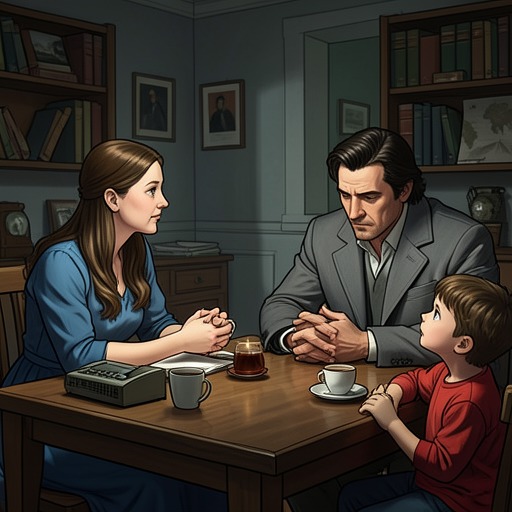
Lavinia Huntley and Verity Lockett’s friendship
Mothering SundayLavinia Huntley and Verity Lockett’s friendship turns private sympathy into public purpose. Drawn together by concern for the workhouse, they become confidantes and fellow advocates: Verity recognizes the severity of conditions that Lavinia has only begun to uncover, while Lavinia’s trust gives their shared hopes a route toward action.
A friendship formed through renewed public life
The friendship had grown over the previous year or so, after Lavinia joined the board of guardians. Before that, she had become reclusive, spending much of her time at Treetops Manor. The loss of her stillborn daughter in 1870 had left her semi-invalid and reluctant to venture away from home. Her work on the board gave her an interest beyond the house and, as the narrative observes, seemed to do her good. Verity thus met Lavinia at a moment when public engagement was helping her emerge from grief and isolation.
Their conversations disclose an ease that is more than formal acquaintance. Lavinia feels she can trust Verity; Verity, in turn, hopes to tell her what she knows about the workhouse’s harshness. Their confidence is not built on identical experience but on a growing conviction that the institution’s vulnerable residents deserve better treatment.
Shared concern for workhouse residents
Lavinia tells Verity that she wants changes at the workhouse. She objects to families being separated when poverty forces them to seek parish relief, arguing that this compounds the humiliation of dependence. She is also troubled by the prospects of foundlings: although childless couples might offer loving homes, many children are instead placed in houses and farms where they are trained to work. Lavinia admits that she herself had wanted to take in a child, but her husband had consistently refused.
Verity answers with a practical qualification: the little ones who are taken in usually go to households where they are trained for labor. Her response confirms that Lavinia’s concern is not merely theoretical; the available placements can reproduce the workhouse’s utilitarian treatment of children. The women also understand the institution through the daily arrangements that shape its residents’ lives. Men and boys may be assigned to oakum picking, bone crushing, or garden work, while women and girls sew uniforms, cook, clean, or labor in the laundry. Residents are divided by sex and rarely come together except for church on Sundays, a separation Lavinia has seen devastate families.
Lavinia is relatively new to the board and has so far held her counsel, but she tells Verity that she intends to propose changes. Her unease has a specific focus: Miss Frost seems excessively strict with the children. Verity would like to explain just how strict, but judges that the moment is not right. Even this restraint marks the trust between them: she has serious knowledge to share, and she senses that Lavinia may become someone who will work alongside her. The prospect heartens her.
Confidence expressed in care and gifts
Their friendship also takes shape in gestures of personal kindness. Lavinia visits Verity with gifts for her baby, Phoebe Mary Lockett, whose names honor the mothers of Verity and Edgar Lockett. In a parcel wrapped in brown paper, she brings a fine white woollen shawl, an embroidered lawn nightdress, and other clothes from an expensive Mayfair store in London. These garments had lain unused in the nursery at Treetops Manor for years. Lavinia explains that she has accepted she will not need them and wants them to be used.
The gifts carry both generosity and grief: they are beautiful things once kept for a child Lavinia lost, now offered to Verity’s baby. Verity recognizes the sadness in her friend’s face and responds by squeezing her hand gently. When she asks after her aunt Zillah, Lavinia brightens; Zillah, once her nanny and now her personal maid, had encouraged her to join the board. The conversation links the intimate world of friendship and household care to the public work that has given Lavinia renewed purpose.
An alliance sustained through reform
Lavinia’s later efforts to investigate the workhouse follow through on the concerns she first shared with Verity. She questions former inmate Sunday Small about the food and punishment, takes notes, and hears that the meals were poor and that Sunday had spent three days in a cellar punishment room without food or drink. This conversation is not presented as a joint inquiry by the two friends, but it gives concrete force to the institutional concerns they had already discussed: what appeared acceptable during visits could differ sharply from the inmates’ experience.
Their alliance is explicit again after Lavinia gives birth prematurely to Stephen Huntley. Verity visits and takes the baby from his adoring mother for a cuddle. She reports that conditions at the workhouse have improved: meals are better, fear and bullying have receded, and the new matron has snapped Miss Frost’s split cane and thrown it away. Verity proposes new bedding, judging the existing blankets inadequate, and looks forward to continuing the work with Lavinia once she has recovered. Their friendship has become a durable partnership, attentive both to the end of a particular regime of intimidation and to the material needs that remain.
That confidence also endures at a moment of personal upheaval. When Zillah reveals that Sunday is Lavinia’s daughter, Verity and Zillah each take one of Lavinia’s hands as she absorbs the truth. Lavinia immediately resolves to tell Sunday who she is and asks that Sunday forgive her. Verity’s presence does not replace the mother-daughter encounter, but it places the revelation within a circle of trusted support. Across grief, reform, and revelation, the friendship is shown less through declarations than through listening, practical solidarity, and the steady willingness to remain beside one another.