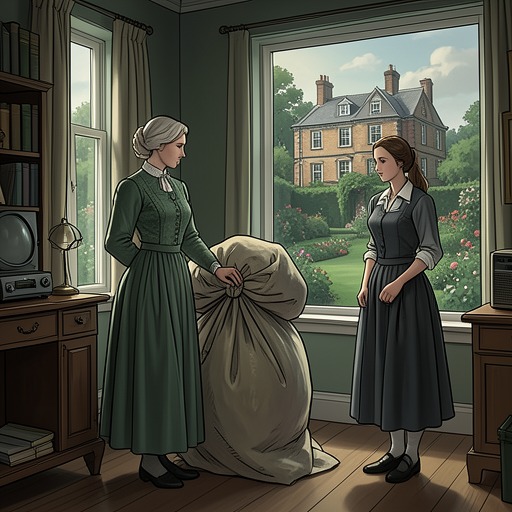
Lavinia Huntley’s newborn daughter is secretly buried
Mothering SundayThe secret burial of Lady Lavinia Huntley’s newborn daughter turns a live birth into a false death and hides a family relationship that shapes the novel’s later revelations. Sir Ashley Hunter commands that the infant be disposed of, while Zillah carries the tiny bundle to the orchard and returns prepared to tell Lavinia that her daughter was stillborn. The scene presents burial as an instrument of concealment, but its apparent finality is overturned: the child survives, and the story eventually identifies her as Sunday Small.
Birth and the order to conceal
The birth follows two long hours of labour. When the midwife announces that the child is coming, Lavinia is slipping in and out of consciousness and cannot respond to Zillah’s encouragement. The nurse intervenes to complete the delivery, and the newborn’s cries establish that the baby is alive. The child is described as having bluebell-coloured eyes and soft blonde curls the same colour as her mother’s. Zillah’s immediate concern is that the baby is a girl, not the son Lavinia had feared she might fail to bear.
Sir Ashley enters demanding news of the birth. When Zillah tells him that the child is a girl, his response makes the danger plain: he orders her to get rid of the infant, throws a pillow at her, and threatens her if she ever speaks about what has happened. He also says that Matthews is to prepare a grave. His command converts the birth into a secret to be managed, and his threat makes silence part of the concealment. The infant’s sex, rather than her condition or survival, determines Sir Ashley’s response.
The midwife leaves after washing her hands. She expects that, when Sir Ashley sends for the doctor, she will testify that the baby was born dead so that a death certificate can be issued. Her departure leaves Zillah responsible for the child and the immediate secret. The planned false testimony gives the concealment an official consequence: the truth is not only to be suppressed inside the household but also replaced by a documented account of a stillbirth.
The orchard burial
An hour later, Zillah carries the bundle through the kitchen and past the stable block to the orchard. There are already two small graves there, belonging to Lavinia’s daughters born in the two preceding years. Unlike the newborn at the centre of this event, those girls really had been born dead. Their graves establish a painful repetition: Lavinia has lost daughters before, and the new child is being placed within a family history of infant deaths even though the circumstances are different.
Matthews waits beside an open hole with his shovel. He complains about the delay and reaches for the bundle, but Zillah slaps his hand away and clutches it to herself. Her protectiveness distinguishes her from the servants who treat the task as an order to be completed. Matthews is described as intensely loyal to his master, and disliked by much of the staff; Zillah, by contrast, resists surrendering the child even while continuing with the burial arrangement. She whispers a broken farewell, then gives Matthews permission to proceed. He covers the tiny form with earth and levels the ground with the back of his spade.
The narrative thus stages a conflict between the visible act and the truth withheld from Lavinia. Zillah takes part in the burial and returns to the house, but the scene also makes clear that the child matters to her: she calls the bundle precious and holds it close before handing it over. The burial appears to seal the child’s fate; the later revelation that the daughter survived changes how that scene can be understood without erasing what it meant to those who believed the child dead.
The lie and its later reversal
After Matthews returns to the house, Zillah anticipates that Lavinia may regain consciousness at any time. She resolves to tell her mistress that she has given birth to another stillborn girl, believing that this is better than letting Lavinia discover the truth. The lie therefore reaches beyond Sir Ashley’s direct order: it becomes the explanation Zillah gives the woman whose daughter has been taken from her. Lavinia is left to grieve a child she has been led to believe was dead, without knowing that she had a living daughter.
Much later, the truth of Sunday’s birth is disclosed. Tom urges Sunday to consider Lavinia’s position: she had been told that she had delivered another stillborn child and had not known that her daughter was alive. He also reminds Sunday that Lavinia had been deeply worried while others searched for her. The disclosure revises the meaning of the orchard scene and clarifies why mother and daughter have lived apart without either understanding the real cause. The newborn’s survival, concealed at the moment when a death was being declared, is the fact that links the secret burial to Sunday’s identity.
The discovery does not instantly resolve the separation. Sunday must decide whether to allow Lavinia a chance to make up for the lost years, and she eventually approaches her at church on Mothering Sunday, offering her a posy of violets and addressing her as her mother. Their embrace gives the hidden birth a human consequence beyond the revelation of lineage: the false account has cost them years together, but the truth makes recognition and reunion possible.
Narrative significance
The event is a hinge between private coercion and the novel’s later recovery of family identity. Sir Ashley’s authority determines the official story of the birth, while the midwife’s anticipated false testimony and Zillah’s silence help that account stand. The orchard, already marked by two genuine infant deaths, makes the concealment appear consistent with the household’s earlier losses. Precisely because the newborn is treated as another stillborn girl, the living child can disappear from her mother’s knowledge.
The scene also establishes the unequal positions of the adults around the infant. Sir Ashley issues threats and arranges the grave; the midwife withdraws once her role is complete; Matthews carries out the burial; and Zillah is left to bear both the secret and the task of deceiving Lavinia. Her attachment to the child is visible in her resistance to Matthews’s reaching hand, even though the precise means by which the infant is saved are not detailed in these passages. Later knowledge prevents the burial from serving as a final ending: it becomes the first stage of Sunday’s hidden history, and the eventual mother-daughter reconciliation answers, without undoing, the years lost to the lie.