Miss Frost and Albert Pinnegar’s ambiguous and unequal-power relationship
Mothering SundayMiss Frost and Albert Pinnegar’s ambiguous and unequal-power relationship is built on an imbalance: she idolizes the workhouse master and seeks personal intimacy with him, while he privately regards her with aversion and uses her loyalty when it serves him. Their connection is more than an awkward mismatch of feeling. Miss Frost’s deference helps protect Pinnegar’s position and silence Cissie Burns, even as her authority over the girls gives her a part in deciding who can be removed from his reach. The novel makes their private entanglement consequential by placing it inside the workhouse’s unequal structures of power.
A hierarchy reinforced by deference
Miss Frost is described as being in awe of Pinnegar; she lives in the institution’s grounds and is known to idolize him. Her attachment stands in contrast to his treatment of her. When Verity Lockett approaches him about Daisy Branning’s fever, Pinnegar dismisses the concern and directs her to inform the housemother. Miss Frost then presents herself as the one who can assure that Daisy will receive attention, while also explaining away her own punishment of the girl. Her deference to Pinnegar and her willingness to manage the girls’ treatment help sustain his authority rather than challenge it.
The difference between their public and private positions is revealing. Pinnegar is the master, seated in his office among comforts and treats; Miss Frost is a subordinate who nonetheless holds power over the children as matron. When she notices that his eyes have begun following Sunday, she concludes that Sunday should be gone as soon as possible. Her judgment shows that she understands his interest as a threat, but her response is not to confront him. Instead, she wants the girl removed before his attention can develop further. Pinnegar, meanwhile, is already considering that his opportunity may be limited: Miss Frost wants Sunday gone, and he will soon have to find her employment. The two are not equal partners, but Miss Frost’s influence over the timing of a girl’s departure intersects with his desire to exploit her vulnerability.
Cissie Burns and the protection of Pinnegar
The clearest moral consequence of Miss Frost’s loyalty appears in the treatment of Cissie. Sunday later tells Lady Huntley that Pinnegar had summoned Cissie to work in his office, that Cissie feared refusing him, and that she believed he had forced her and made her pregnant. When Cissie was due to leave the workhouse, Miss Frost had promised a place where she and the baby could be cared for. Instead, the carriage that arrived was from Hatter’s Hall asylum.
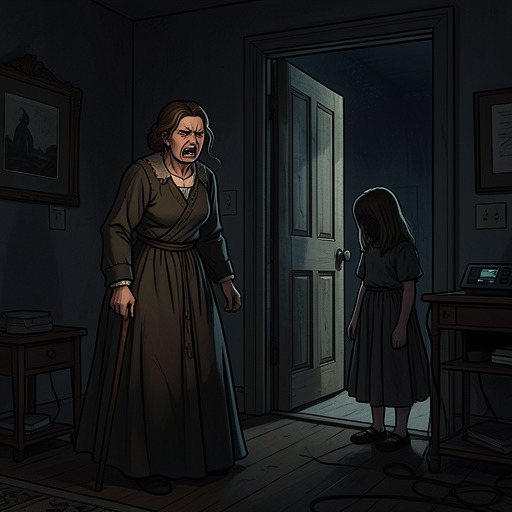
Cissie recognized the carriage and understood what its arrival meant: she feared confinement without anyone to secure her release, and separation from the chance to care for her baby. She called for Pinnegar, saying that he was responsible and would not allow her to be sent away. Miss Frost answered not by investigating the accusation but by seizing Cissie and condemning her for making it. She blamed Cissie’s supposed sexual conduct and invoked the uncertainty of the child’s paternity, turning the stigma attached to an unmarried mother against the person who accused Pinnegar. Cissie’s possessions fell as Miss Frost shook her; the scene makes the matron’s defense of the master physical as well as verbal.
This episode exposes the relationship’s institutional reach. Pinnegar does not need to be present to benefit from Miss Frost’s actions: she discredits Cissie, directs the departure, and helps close off the possibility that Cissie’s allegation will be heard. Sunday’s later account brings that concealed history before Lady Huntley, and her sobbing underscores the lasting consequence: she has never heard from Cissie again. Miss Frost’s loyalty is therefore not simply private admiration. It participates in a system in which the woman with authority over a vulnerable girl helps protect the man accused of abusing her.
The brooch and the failed performance of intimacy
The brooch episode turns the imbalance between them into awkward comedy without making it harmless. Pinnegar has bought a brooch for Sunday, but Miss Frost sees it before he can put it back in its bag. She assumes it is a birthday present for her and pins it to her austere dress. Caught off guard, Pinnegar claims that he knew her birthday was near but could not remember the exact day. His lie spares him the immediate embarrassment of admitting whom he intended the gift for, but it also lets Miss Frost believe that his gesture marks a personal regard for her.
She responds with delight and immediately proposes a private glass of sherry after their duties. She asks him to abandon formal address when they are alone and use her first name, Fanny, pointing to how long she believes they have known one another. Pinnegar agrees politely to the evening meeting, but inwardly recoils at the prospect of spending his free time with her. The difference between her eager interpretation and his private disgust is sharp: what she treats as a step toward intimacy is, for him, an obligation he cannot easily refuse. At supper, Sunday notices the brooch on Miss Frost and splutters into her tea, recognizing that Pinnegar must somehow have escaped the awkwardness of the gift’s original purpose. The object thus links Miss Frost’s hopeful reading of their relationship to Pinnegar’s continuing pursuit of Sunday.
Unequal attachment and narrative significance
The relationship is ambiguous because its emotional meanings are not shared. Miss Frost’s adoring deference and coquettish invitation suggest that she wants a closeness Pinnegar does not reciprocate; his courtesy conceals impatience, while his attention is directed toward Sunday. Yet the imbalance is not only emotional. Pinnegar possesses the office and institutional status of master, while Miss Frost exercises authority over the girls and can affect their treatment and departure. Her attachment aligns her with his power, but does not make her his equal or give her security in his regard.
That arrangement also produces a revealing contrast in how each treats those with less power. Pinnegar’s interest in Sunday is a danger that Miss Frost recognizes, but her first response is to make Sunday’s departure happen sooner, not to protect her. In Cissie’s case, Miss Frost actively assists in suppressing an accusation and enforces the stigma that helps isolate its speaker. The brooch briefly makes their private dynamic visible: Miss Frost sees affection where Pinnegar feels embarrassment, while the girl he actually intended to court understands more than Miss Frost does. Across these moments, the relationship shows how personal desire and institutional authority reinforce one another unevenly, with vulnerable girls bearing the consequences.