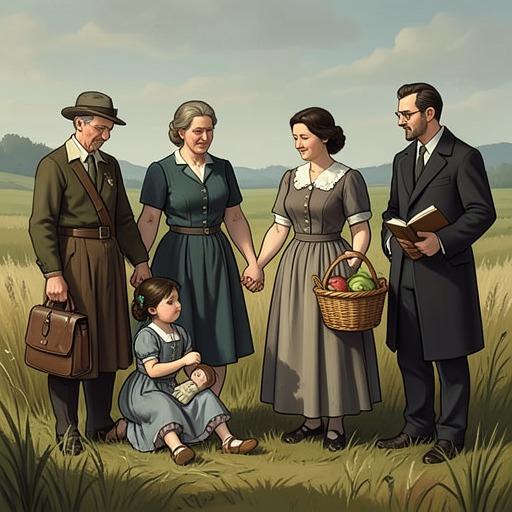
Sunday Small—Lavinia Huntley
Mothering SundaySunday Small and Lavinia Huntley’s relationship begins before either woman knows that they are mother and daughter. At first, it takes shape through the contrast between Sunday’s experience of institutional neglect and Lavinia’s decision to listen, intervene, and offer practical help. Its eventual revelation of blood ties does not create their closeness so much as give a name to an attachment already visible in their acts of care.
An Unequal Beginning, and the Decision to Listen
Sunday’s childhood at the workhouse is defined by routines that divide and discipline its residents. Women, boys, girls, and men occupy separate sections; inmates are assigned work according to age, strength, and skill. Men and stronger boys pick oakum or crush bones, while women and girls sew uniforms, cook, clean, and labour in the laundry. Families rarely come together except for Sunday church, and Sunday has seen how damaging that separation can be. The institution’s ordered appearance conceals a harsh distribution of labour and comfort.
When Lavinia speaks privately with Sunday after the girl has left the workhouse, she is not content with appearances or official assurances. She explains that the guardians provide money intended to feed the inmates well and asks Sunday to tell her whether that promise matches experience. With a notebook ready, Lavinia makes herself a listener; Sunday, deciding that honesty might improve conditions for those still inside, describes meals of dry grey bread, greasy porridge, and usually gristly meat served only a few times a week.
The confidence Sunday places in Lavinia becomes especially clear when she recounts the punishment cellar. It contains only a bucket, with no bed or blanket, and is cold, damp, and dark enough that a prisoner cannot see a hand held before the face. Sunday says she was kept there for three days without food or drink, and was so weak when Mrs Lockett found her that she needed a night in the sickbay. She also recalls two little girls who disappeared after being locked away; Miss Frost said they had died of influenza. Lavinia records the account as Sunday shudders. The exchange makes their connection more than a visitor’s sympathy: Lavinia gives Sunday’s testimony attention and treats it as grounds for action.
Support That Extends Beyond One Conversation
Lavinia’s concern for Sunday is part of her attention to the people whose lives have been shaped by the workhouse. After Sunday, Daisy Branning, and Tommy Branning are out of the institution, Lavinia remarks that they have given Biddy Spooner a new lease of life. She also notices that Daisy remains subdued and, with Zillah, acknowledges that Daisy is carrying a pregnancy forced on her through rape. Lavinia connects Pinnegar’s dismissal with the hope that no other girls will suffer the same fate, and says that she insisted Miss Frost be dismissed as well because of her sadistic treatment of the girls.
When Daisy dies, the loss does not make Lavinia turn away from the young people who remain vulnerable. Biddy wonders whether another workhouse girl might be given a chance in Daisy’s place. Lavinia offers to write to one of the guardians to suggest it, despite not attending meetings at that time. This is a small, practical offer rather than a grand promise, but it continues the pattern established when she listened to Sunday: she uses the access available to her to seek better prospects for someone emerging from the institution.
Lavinia’s concern also reaches beyond Sunday herself. When she learns from Verity Lockett that Pinnegar has been seen near Biddy’s house and that Sunday is frightened by his malicious rumours, she hears how his presence affects both Sunday and Nell. The report shows that the safety Sunday has found outside the workhouse remains precarious. Lavinia’s network of concern includes the people Sunday wants to protect, and the fear surrounding Pinnegar is treated as a real threat rather than a private embarrassment.
Shared Care and Maternal Recognition
Their relationship is repeatedly framed through care for children. Sunday had long favoured working in the nursery at the workhouse, though she hid this preference from Miss Frost, who might have kept her away out of spite. There she encounters babies left hungry and neglected: one attendant uses sloe gin to quiet them, while Sunday finds infants with sore, bleeding bottoms and begins changing them and warming their milk. The scene establishes Sunday’s instinct to respond to need through attention and hands-on care. It is a quality that later shapes how she approaches Lavinia and Lavinia’s son.
After Lavinia falls and gives birth prematurely to Stephen Huntley, she is anxious to see her child. Zillah promises to bring him once Lavinia has been washed and fed, and the reunion takes place while Lavinia is still in considerable pain. Stephen is tiny, but Molly Worthington feeds him every hour, including through the night, and the doctor says he is improving. Lavinia’s attention is fixed on his survival; the joy of having a son is inseparable from fear of losing him.
When Lavinia later visits Biddy with Stephen, Sunday asks whether she may hold him. She kisses his forehead and admires the shawl, recognizing it as like one belonging to Phoebe. Lavinia explains that she had ordered baby things from a shop in Mayfair while expecting her first baby, nearly fifteen years earlier; after the deaths of her daughters, the things had lain unused. Now they are being used for Stephen and other babies. Sunday sees the grief in Lavinia’s face and understands that the child’s shawl carries a history of loss as well as present tenderness.
Biddy notices a recurring feeling when she sees Sunday with Stephen: she cannot quite define it, but believes Sunday will one day be a loving mother. That observation makes visible what the characters do not yet know. Sunday’s gentle attention to Stephen and Lavinia’s motherly devotion to him place the two women in a shared emotional frame before their kinship is disclosed.
The Hidden Kinship and the Meaning of the Bond
The decisive revelation comes when Zillah tells Lavinia that Sunday is her daughter. She explains that she had not dared to tell Lavinia while Ashley was alive, fearing what he might do, and that the secret has weighed on her conscience. Lavinia responds without blaming Zillah: she says Zillah did her best in difficult circumstances and saved the child’s life. She places responsibility on Ashley and immediately turns to the question of how to tell Sunday and ask her forgiveness.
Lavinia’s response joins recognition to action. She leaves at once to find Sunday, who is working in the baker’s shop, intending to bring her home to Treetops Manor, where she believes her daughter belongs. The haste matters: after a lifetime in which the truth was withheld, Lavinia does not treat the discovery as an abstract family fact. She wants to reach Sunday and begin repairing the separation.
The revelation also alters the meaning of their earlier encounters without erasing their uncertainty or the harm that preceded them. Lavinia had listened to Sunday’s account of the workhouse, sought improvements, and offered help before knowing that the girl was her child. Sunday had responded to Lavinia’s attention and cared for Stephen without knowing that he was her half-brother. Their bond is therefore both found and chosen: birth explains an affinity they had already begun to express through trust, protection, and care. The relationship’s emotional force lies in that double history—an intimate connection formed in ignorance, then recognized as the family tie that had been concealed from them.