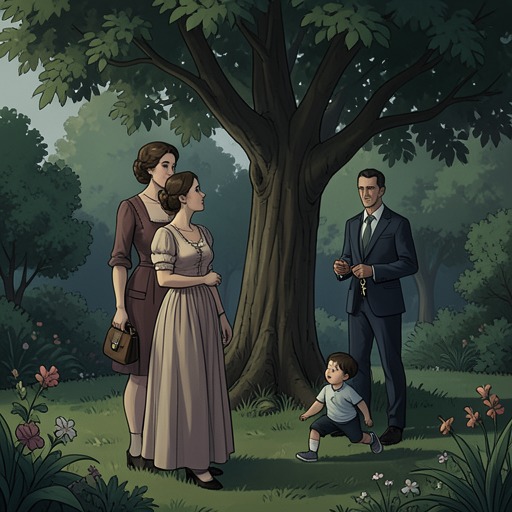
Sunday and Lavinia reconcile on Mother’s Day
Mothering SundaySunday Small and Lavinia Huntley reconcile during a Mothering Sunday service, transforming a painful dispute over abandonment into an acknowledged mother-daughter relationship. Sunday’s quiet walk down the church aisle to offer Lavinia violets becomes both a personal gesture of acceptance and the beginning of a shared plan to house foundling children at Treetops Manor.
Causes and Background
The reconciliation follows the revelation that Sunday’s apparent abandonment was not what she had believed. Zillah tells her what happened on the night she was born, explaining that Lavinia had been told she had given birth to another stillborn child. Sunday lies motionless after hearing the account, uncertain whether to trust it: she knows how devoted Zillah is to her mistress, but has never known Zillah to lie. The truth does not instantly resolve the injury; it leaves Sunday weighing a new explanation against the certainty of her experience of growing up without her mother.
That uncertainty is sharpened by Lavinia’s offer of an inheritance. Through Zillah, Sunday learns that Lavinia intends to give her Treetops Manor and a sizeable sum of money to establish the foundling school Sunday once described as her dream. Sunday initially rejects the offer as conscience money, insisting that she has managed without Lavinia and resenting what she understands as abandonment. The offer therefore carries two meanings at once: practical support for Sunday’s hopes, and a request for a relationship she is not yet ready to restore. Zillah also says Lavinia will move away and that she herself will go with her, giving the decision a sense of impending change.
Tom Branning urges Sunday to consider the account rather than blame Lavinia for what she could not have known. He reminds her that Lavinia had believed her child dead, had only recently learned she had a daughter, and had been desperately worried while Sunday was missing. Sunday does not immediately agree; she says she will think about it. The pause matters: reconciliation is not imposed by the explanation or the inheritance, but follows a week in which Sunday thinks about little else before making her decision.
Sunday’s Decision
On Saturday evening, Sunday asks Mrs Spooner whether she will attend church the next morning. When Mrs Spooner confirms that it is the Mothering Sunday service, Sunday asks to go with her. The request quietly marks a change in direction. Rather than answer Lavinia’s offer through argument or accept it merely as money, Sunday chooses a setting devoted to motherhood and prepares to make a personal approach.
The service gives that approach its occasion. After hymns and prayers, the reverend speaks about a mother’s love as enduring and unselfish; then children begin presenting gifts to their mothers. Sunday has brought a posy of violets from the flower seller at the lych-gate. Tom squeezes her fingers encouragingly, and when she looks nervously toward him, he nods. His reassurance supports her choice without making the gesture for her: Sunday rises herself and walks along the aisle, her heart pounding, toward Lavinia’s pew.
The Reconciliation
Sunday offers the violets and calls Lavinia Mother. Lavinia is momentarily speechless, then tears begin to run down her face and she gathers her daughter into an embrace. Sunday cries too, described as crying properly for the first time in years, and settles into her mother’s arms. The scene makes physical what the preceding conversation could only propose: the relationship becomes mutual through Sunday’s address and Lavinia’s response.
Lavinia weeps that her daughter has come back to her at last. The phrasing registers both the years lost and the suddenness of their reunion, while the embrace gives Sunday a closeness she has lacked. The church congregation and service provide the public setting, but the two women become absorbed in one another. They leave arm in arm, talking animatedly and seemingly oblivious to those around them. Tom beams at Sunday and winks at Zillah as they pass, making the reconciliation visible to the people who helped bring it about.
Consequences and Significance
As they walk out into the sunshine, Sunday accepts Lavinia’s offer to use Treetops Manor as a home for foundling children, on the condition that Lavinia stays there to help. Sunday explains that she and Tom are still young and will need her advice; Tom, she adds, can handle odd jobs, while she will do what she can. The proposal turns the inheritance from a rejected payment into a practical foundation for the future Sunday had imagined. It also makes room for Lavinia not simply as a benefactor but as a continuing presence in her daughter’s life.
The event’s resolution is therefore both emotional and purposeful. Sunday does not erase her sense of having been abandoned; the story she hears changes her understanding of Lavinia’s responsibility, while the gesture in church expresses a choice to begin again. The violets, offered during a service in which children give gifts to their mothers, carry that choice from private consideration into action. Their walk out together closes the immediate estrangement, and their agreement links renewed kinship to the creation of a home for other abandoned children.