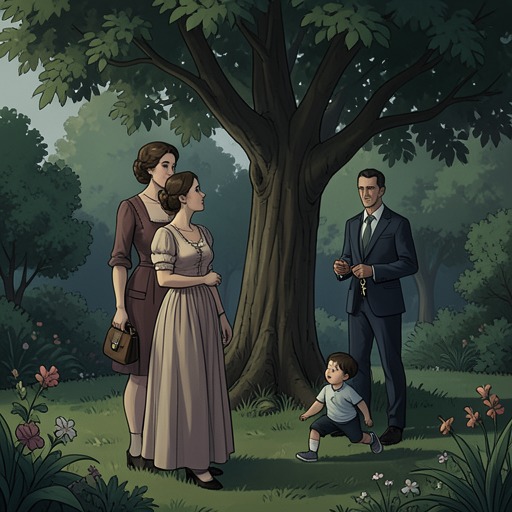
Sunday discovers she may be Lavinia’s daughter
Mothering SundaySunday Small’s discovery that she may be Lavinia Huntley’s daughter transforms a baby shawl into a clue to the identity she has never known. The possibility links Sunday’s abandonment at the workhouse to Lavinia’s secret history of lost daughters, but at first it offers suspicion rather than certainty: the evidence points towards a shared past while leaving Sunday unsure whether Lavinia knew she had given birth to a living child.
The shawl becomes a clue
The recognition comes amid a false accusation. At the Barnes household, Bill searches Sunday’s belongings and spills them across the floor after pearls go missing. Sunday sees the pearls lying on a fancy baby shawl and realizes that Bill must have planted them in her bag while she slept. Yet the pearls are not what hold her attention. The shawl seems familiar, and its resemblance to one she remembers from Verity Lockett’s baby gives her a reason to look beyond the accusation and reconsider her own beginnings.
Back in the attic, Sunday tries to assemble the clues. She had been left on the workhouse steps wearing a shawl identical to the one Verity’s baby wore; Lady Lavinia Huntley had given that shawl to Verity. Stephen Huntley, too, had possessed an identical one. What had looked like a repeated item of baby clothing now suggests a connection between Sunday and the Huntley family.
A possible birth and an impossible certainty
Sunday recalls that Lady Lavinia had ordered baby clothes from an exclusive shop in Mayfair before the birth of her first daughter, who was stillborn. The clothes had been stored, with none worn except for the burial of the tiny bodies. A second daughter was also stillborn. But the third daughter, Sunday reasons, was born on her own birthday and would have been the same age as her. The sequence raises a stark possibility: Sunday may have been that third child, born alive and then abandoned.
The suspicion is sharpened by another memory. Zillah had told Verity that Ashley Huntley wanted a son because of an inheritance from his late uncle. Sunday wonders whether she was rejected because she was not the male heir he wanted. Her hair and eyes, which she recognizes as the same colour as Lady Lavinia’s, seem to reinforce the connection, but resemblance cannot establish the truth by itself.
There is also a contradiction that Sunday cannot resolve. Three tiny graves lie in the orchard at Treetops Manor, apparently consistent with three daughters who died. The account of the birth, however, supplies the possibility that the third child survived: after Zillah delivered a girl, Ashley demanded that the child be got rid of and said he would have a grave prepared. Sunday cannot know from the clues before her what happened after that order, or whether Lady Lavinia knew her daughter had been born alive.
Doubt, danger, and delay
Sunday’s uncertainty is inseparable from her feelings for Lady Lavinia. She has come to care for her and cannot readily believe that the gentle woman deliberately abandoned a newborn daughter. If the suspicion is wrong, confronting her could cause needless pain; if it is right, the apparent grief for a lost child sits uneasily beside the possibility that Sunday herself was that child. Sunday considers asking Lady Lavinia directly, or confiding in Verity, who has become almost a surrogate mother, but hesitates to involve either of them without firmer proof.
The stolen-pearl accusation also keeps the discovery from becoming an immediate investigation. Mrs Barnes threatens to have Sunday arrested if she leaves, and Sunday concludes that she must remain in the household and work for the Barnes family for now. She rejects the prospect of marrying Bill, but cannot simply depart to seek answers. The identity question is therefore not only emotional: the accusation and her constrained circumstances postpone any attempt to confirm it.
From suspicion to recognition
The novel later gives the suspected relationship an emotional resolution. On Mothering Sunday, with Tom’s encouraging squeeze of her hand, Sunday rises and walks to Lady Lavinia’s pew carrying violets. She addresses her as her mother; Lavinia answers by embracing her, and Sunday cries in her mother’s arms. The scene does not make the earlier clues less painful or erase the years of separation, but it turns a private, fearful inference into an openly acknowledged bond. The shawl first made Sunday’s origins legible as a possibility; the later encounter gives that possibility the form of belonging.