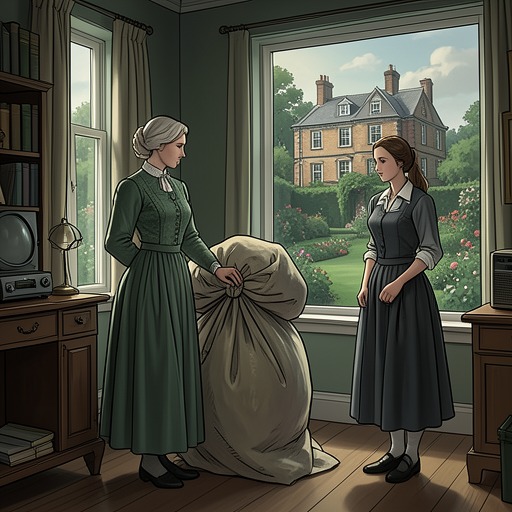
Sunday discovers the shawl clue to her birth
Mothering SundaySunday Small discovers the shawl clue to her birth while trapped in the Barnes household, where a false accusation prevents her from leaving. The garment connects her abandonment at the workhouse to Lady Lavinia Huntley’s lost children and the secret of a newborn girl whose father ordered her disappearance. It does not give Sunday proof: instead, it opens a painful possibility that unsettles her future and tests her trust in a woman she has come to care for.
The discovery in the attic
The clue surfaces during a confrontation over a missing string of pearls. Mrs Barnes accuses Sunday of stealing them and has Bill search her bags. When he empties them, the pearls fall onto a fine baby shawl. Sunday recognizes the shawl, and her attention moves away from the accusation and toward the garment itself. She believes Bill planted the pearls while she slept, but it is the shawl, not the suspected theft, that changes her understanding of her past.
Back in the attic, Sunday tries to arrange the connections. She had been left on the workhouse steps wearing a shawl identical to one Lady Huntley gave to Verity Lockett’s baby. Stephen had an identical shawl too. What had seemed an isolated keepsake now appears to belong to a group of baby clothes associated with Lady Huntley’s pregnancies. The match is specific enough to demand an explanation, but it cannot, by itself, establish who Sunday’s parents were.
The family history behind the garment
Sunday recalls Lady Huntley explaining that she had ordered the baby clothes from an exclusive shop in Mayfair before the birth of her first daughter, who was stillborn. The items had remained stored away, unworn except when used for the burials of the tiny bodies. Lady Huntley’s second daughter had also been stillborn. A third daughter, Sunday reasons, was born on Sunday’s own birthday and would have been the same age as her. The sequence makes the shawl more than a resemblance: it places Sunday’s birth alongside the Huntley family’s history of loss.
Another remembered detail sharpens the suspicion. Sunday recalls Zillah telling Mrs Lockett how strongly Mr Huntley had wanted a son because of an inheritance from his late uncle. Sunday wonders whether she might have been the third-born daughter, abandoned because she was not the male heir her father wanted. Yet the three tiny graves in the orchard at Treetops Manor complicate that conclusion. Her reasoning moves between a possible explanation and evidence that seems to contradict it; the discovery supplies a question, not an answer.
Sunday also notices that her hair and eyes are the same colours as Lady Huntley’s. That resemblance strengthens the pattern in her mind, but it remains circumstantial. She cannot reconcile the possibility of abandonment with the gentle, caring Lady Huntley she knows. If Lady Huntley had knowingly given up a living daughter, Sunday fears, the woman’s grief for her children would have concealed a truth of terrible consequence. Even as the thought occurs, Sunday resists believing it. Her affection does not erase the evidence, but it makes accusation feel dangerous and unjustified.
A revelation without certainty
Sunday considers asking Lady Huntley directly, then recoils from the possibility of hurting her if she knows nothing about a daughter born alive. She also considers confiding in Verity Lockett, who has become almost a surrogate mother to her, but hesitates to draw her into a suspicion that may be mistaken. The shawl therefore leaves Sunday caught between the need to investigate and the fear of what an unsupported accusation could do to people she loves.
The timing makes that uncertainty harder to bear. Mrs Barnes says Sunday cannot leave unless the pearls are returned and threatens to call the police. Sunday is forced to continue working for the family rather than go to the place where she expected to work. She rejects any prospect of marrying Bill, but the immediate constraint is practical as well as emotional: she cannot leave without risking arrest. The discovery arrives at the moment her choices are already being narrowed by another person’s accusation.
Consequences and later meaning
Sunday’s imagined future with her friends collapses in an instant. She had hoped to save a little money each month toward her dream; now she sees no way to do so while confined to the Barnes household. The shock overwhelms her, and she becomes physically sick. Her response conveys the scale of the disruption: the shawl has not merely suggested a new identity but made the future she had been planning seem inaccessible.
The suspicion belongs to a larger pattern of truths disclosed only after Sunday has been endangered. Later, Miss Frost reveals that she killed Albert Pinnegar and Daisy and admits to pushing Daisy into the canal. Police constables interrupt her attack on Sunday, and Tom frees Sunday from the ropes. Lady Huntley is present when Sunday regains consciousness, but the rescue scene does not itself explain the shawl. The clue’s emotional resolution comes later: at a Mothering Sunday service, Tom encourages Sunday to approach Lady Huntley, and Sunday offers her violets and addresses her as her mother. Lady Huntley embraces her, and Sunday cries in her arms. The earlier deduction remains an act of suspicion; the later embrace gives that uncertain search a human answer through recognition and chosen closeness.