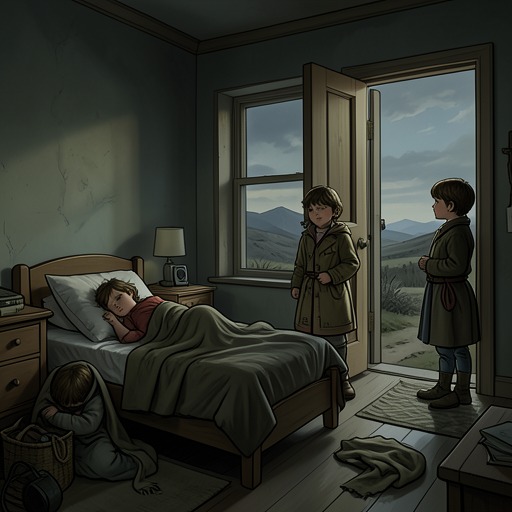
Sunday’s fantasy that her mother will come for her
Mothering SundaySunday’s fantasy that her mother will come for her gives shape to a child’s longing for rescue from the Nuneaton Union Workhouse. Sunday imagines not merely being removed from the institution but being claimed by a mother who wanted her, and entering a home where hunger, cold, and loneliness will end. Repeated across the story, this private vision measures the distance between the family life Sunday imagines and the regimented life she actually knows.
The imagined home
In Sunday’s earliest version of the dream, her mother comes to claim her and takes her to a splendid house surrounded by flowers and green grass, where birds sing and the sun always shines. The promise is intensely practical as well as idyllic: there will be wonderful food every day, and Sunday will never be hungry again. At last, she imagines, she will be treated like a princess. The fantasy answers the daily facts of deprivation by reversing them, replacing hunger with abundance, institutional care with devoted attention, and an unknown future with a home that seems secure.
The dream also gives Sunday an explanation for her abandonment that preserves the possibility of maternal love. She convinces herself that her mother desperately wanted to keep her but that some circumstance made it impossible, perhaps illness at the time of her birth. In the fantasy, her mother has recovered and can now return. Sunday’s imagining therefore does more than anticipate rescue: it lets her believe she was wanted, even though she has no knowledge that her mother will ever come. She falls asleep holding to this hoped-for ending.
Repetition and Mothering Sunday
The vision returns in more elaborate form. Sunday pictures her mother as tall and slender, with fair hair the same colour as Sunday’s and eyes as blue as bluebells. She imagines real meat rather than gristly portions, fresh fruit like the fruit seen at the market, and vegetables not boiled to mush. A large bed with soft sheets and silken pillows promises warmth and closeness; a life without chores promises release from labour as well as physical hardship. The accumulating details make the imagined home a deliberate counterworld to the workhouse’s shortages and demands.
Mothering Sunday gives this private hope a recurring public shape. Each year Sunday watches children who have mothers go to church with them, and she envies the way they beam at one another. In her imagined version, she too attends the service with her mother and presents her with wildflowers. The contrast is especially sharp because the church is full on that day, including daughters in service from other parishes who are allowed time off to join their mothers. For Sunday, the ritual displays the belonging she lacks, while the flowers let her imagine taking part in the exchange of affection rather than watching it from outside.
The workhouse that the dream opposes
The fantasy takes refuge in a world where the workhouse offers little privacy or family life. Its residents are divided into separate sections for women, boys, girls, and men. Inmates are assigned labour according to sex, age, and ability: men and stronger boys pick oakum, crush bones, or work in the gardens; women and girls sew uniforms, cook, clean, or labour in the laundry. Sunday knows that families are rarely together except on Sundays when they may attend church, and she has seen the harm separation can cause. Against this system, her imagined home promises not simply comfort but the ordinary continuity of living together.
Even everyday meals underscore the gap between the dream and reality. Sunday eats grey bread and porridge because it is better than going hungry, while staff at the table receive bacon and eggs. She imagines that, when her mother comes, she will share that better breakfast every day. Later, when Lady Lavinia Huntley asks about the food, Sunday describes dry bread, greasy porridge, thin soup, and meat so gristly it is difficult to chew; Lady Huntley has said that the Board of Guardians provides money to feed residents well. The disparity between provision and Sunday’s experience gives her imagined abundance a concrete institutional context: what she dreams of as a mother’s care is also what the workhouse fails to supply.
Punishment and fear further sharpen the contrast. Sunday tells Lady Huntley that the punishment room is a cold, damp cellar with only a bucket, no bed or blanket, and rats and spiders. She recalls being kept there for three days without food or drink, until Verity Lockett came looking for her and she had to spend the night in the sickbay. Sunday also says that two little girls locked there were never seen again; Miss Frost claimed they had died of influenza, and Sunday cannot recall a proper funeral. The home in Sunday’s fantasy is defined by its opposition to such abandonment: there, someone notices, comes looking, and keeps her safe.
Naming, doubt, and what the fantasy reveals
Sunday’s name itself carries the mark of being left without a family. Miss Frost explains that she was left on the workhouse steps on a Sunday, and that the day seemed as good a name as any. Sunday jokes that no one even tried to give her a proper name and that she might have been unlucky enough to be born on a Saturday. Daisy Branning answers with a different kind of family history: her mother named her Daisy because she reminded her of a tiny flower. The exchange sets Sunday’s assigned identity beside Daisy’s affectionate one, making visible what Sunday’s fantasy tries to supply—a mother who sees a child as particular and precious.
The hope does not remain uncomplicated. Sunday eventually realizes that she might no longer be at the workhouse if her mother comes looking for her. The possibility of leaving therefore brings an unexpected fear: the place she longs to escape is also the place where she imagines her mother might find her. Sunday then considers that her mother may have died, or may never have intended to come at all. Daisy comforts her by insisting that her mother would have come if she could, but Sunday’s earlier certainty has given way to questions she cannot answer.
The fantasy’s persistence is not evidence that Sunday has been promised a reunion; the supplied episodes leave that hope unresolved. Its importance lies in what it allows her to imagine and endure: food enough to satisfy hunger, warmth, freedom from exhausting duties, and above all a mother who chooses her. When conditions at the workhouse later improve—the meals grow better, fear and bullying recede, and the new matron breaks Miss Frost’s cane—the material environment changes, but that improvement is distinct from the family reunion Sunday has long imagined. The recurring dream thus holds together her longing for rescue and her dawning awareness that the person she hopes will come may never appear.