Tom Branning
Mothering SundayTom Branning is a former workhouse child whose defining acts come when Sunday Small needs safety: he welcomes her after she escapes an attempted assault, helps free her when Miss Frost kidnaps her, and asks her to marry him. At the novel’s close, he and Sunday accept Lady Lavinia Huntley’s offer of Treetops Manor for a home for foundling children. Tom’s role joins personal devotion to a larger purpose: the two children who grew up within an institution’s harsh divisions imagine a home where no child will feel unwanted.
Identity and Background
Tom’s early life is connected to the workhouse world he shares with Sunday. The novel describes an institution organized by separation: women, boys, girls, and men live in different sections, and families rarely come together except for Sunday church. Work is allocated by gender, age, and ability. Some of the stronger boys are put to oakum picking or bone crushing, while others work in the gardens; women and girls sew uniforms, cook, clean, or labor in the laundry. The account establishes the regulated, laboring environment of Tom’s childhood, although it does not specify which work he himself performed.
Sunday’s later testimony to Lady Lavinia Huntley exposes another side of that institution: meals could be meagre, and punishment could mean confinement in a cold, dark cellar without a bed or blanket. Sunday recalls being held there for three days without food or drink. These details are not presented as Tom’s own testimony, but they give context to the shared background that makes the promise of a safe home so consequential. For children formed by deprivation and separation, belonging is not an abstraction; it is a future they can undertake to build.
A Refuge for Sunday
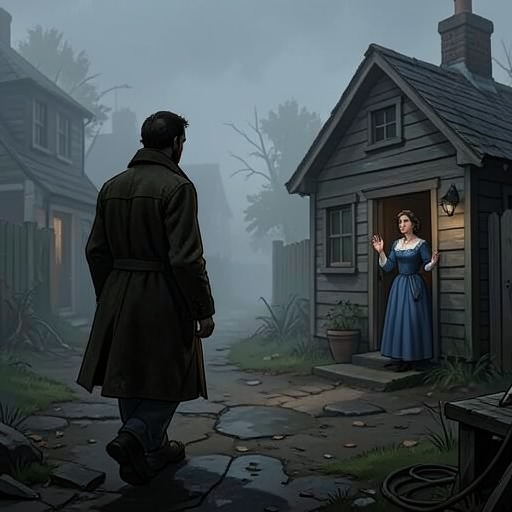
When Sunday is living with the Barnes family, Bill Barnes attempts to force himself on her. The next day she resolves to leave under cover of darkness. She intends to seek help from Verity Lockett, but has no clear plan beyond getting away from the farm. The escape is frightening and precarious: Sunday packs her belongings, waits until the household is asleep, and slips out at about one o’clock in the morning. Her decision is an act of self-preservation, but it leaves her unsure where she can safely go.
Tom receives her instead. When she arrives in distress, he leads her to a chair, takes her hands, and tells her that she did the right thing by coming to him. Sunday then confides the Barnes family’s treatment of her, Bill’s attempt, and her suspicions about Lady Lavinia Huntley. The importance of Tom’s response lies in its contrast with the accusation and blame Sunday faces elsewhere: he listens and gives her space to tell what happened. His welcome turns a desperate flight into the beginning of a path toward help.
Rescue and Commitment
Tom’s protective role becomes more urgent when Miss Frost abducts and attacks Sunday. As Miss Frost threatens her, police constables arrive and seize the knife; Tom drops beside Sunday and works at the ties binding her. He is openly sobbing as he frees her, overcome by the thought of what might have happened. Sunday is dizzy and vulnerable, and Lady Lavinia Huntley is also present when she is released. The scene makes Tom’s care physical and immediate: he does not merely promise protection, but acts to get Sunday out of danger.
Afterward, Tom’s feelings take the form of a renewed proposal. He tells Sunday that his earlier request for marriage was sincere. She asks him to ask again, and he kneels beside her bed to propose to Sunday Small. She accepts. Their engagement follows a period in which Sunday has suffered repeated threats, and the scene presents their future together as something she chooses, rather than something imposed upon her. Two days later, well enough to come downstairs, she jokes with Biddy Spooner about becoming accustomed to being fussed over, a small sign of her return to the care of others after the attack.
Chosen Family and the Work Ahead
At the Mothering Sunday service, Tom and Sunday walk arm in arm with Lady Lavinia Huntley. Sunday accepts Lady Lavinia’s offer to use Treetops Manor as a home for foundling children once she and Tom marry, on the condition that Lady Lavinia will live there too and help guide them. Sunday proposes taking responsibility for the work, while Tom will handle the odd jobs. Their plan is collaborative: it combines the couple’s labor and commitment with the counsel and continued presence of the woman who offers the house.
Tom’s response to that undertaking gives his character’s private tenderness a public direction. He turns aside to brush away a tear as he considers the home they mean to establish for lost and lonely children, where every child will belong. The closing service’s image of a candle as a light in darkness echoes that aim. Tom and Sunday, themselves former workhouse children, do not simply leave an institution behind; they imagine a different kind of care for those who might otherwise be unwanted.
Relationships and Narrative Role
Tom’s bond with Sunday is shown through trust at moments when she is most exposed: she comes to him in the night, tells him what happened, and later accepts his proposal. His tenderness is not separate from his practical actions; listening, helping to free her, and planning a home with her are different expressions of the same commitment. The novel does not present him as the sole author of Sunday’s recovery or their shared project. Sunday makes the decision to escape, asks him to propose again, and sets terms for accepting Treetops Manor. Their future is therefore represented as a partnership, with both of them choosing what they will build.
As a character, Tom helps connect the novel’s rescue plot to its final vision of reform through care. He moves from the shared history of workhouse childhood into a role as Sunday’s trusted refuge and fiancé, then into the promise of a home for abandoned children. The ending does not erase the neglect and danger that shaped their lives. Instead, it answers those conditions with a deliberate undertaking: a household intended to make safety and belonging available to other children, too.