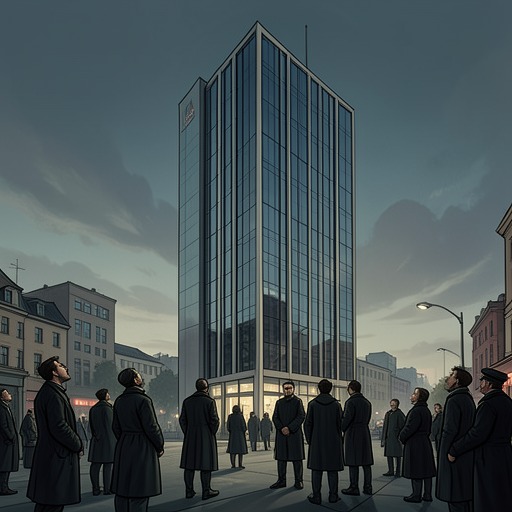
10:30 Park Avenue apartment building
Motherless BrooklynThe 10:30 Park Avenue apartment building is a Fujisaki Corporation property where Roshi’s students performed maintenance and service work as part of their training. Beneath that ordinary arrangement lay a contract worth millions and a division of its proceeds that implicated Frank Minna and Ullman. The building thus links religious training, paid labor, and the covert business surrounding The Clients.
Ownership and Service Work
Lionel Essrog asks Kimmery what she knows about the building while pursuing his investigation. She recalls that many of Roshi’s students worked there in service roles, including kitchen work and cleaning, and says she thinks there were doormen as well, though she had never visited the property herself. Her recollection gives Lionel a lead toward the building’s labor arrangements and the people who might be connected to them.
Gerard Minna later explains the arrangement more fully: Fujisaki Corporation owned the building, and Frank Minna had a hand in managing it. Gerard says he supplied the labor in exchange for consideration equal to the mortgage on the Zendo. The students’ work—cleaning and cooking—was presented as training in tasks they might perform in a monastery, carried out instead in a different setting. He confirms that doormen were part of the service operation too.
The Contract and Its Money
The building’s service contract was worth millions. Gerard says Frank Minna and Ullman diverted most of the difference into their own pockets. The scale of the contract turns the students’ routine work into more than an educational or religious service: it is the labor at the center of a substantial commercial arrangement, with a financial gap that Frank Minna and Ullman exploited.
Gerard describes his own role as supplying the labor, with the consideration supporting the mortgage on the Zendo. That account connects the building’s commercial income to the Zen community’s physical premises while also distinguishing Gerard’s stated contribution from the money Frank Minna and Ullman retained. The arrangement therefore joins property management, institutional upkeep, and private enrichment in a single chain.
Place in the Investigation
The building enters Lionel Essrog’s inquiry through a practical question about who worked there, especially whether doormen were involved. Kimmery’s partial recollection points him toward the service staff; Gerard’s explanation supplies the ownership, management, and financial details that her account could not. The movement from an informal clue to a fuller explanation gives the building a concrete place in Lionel’s effort to understand the network around Frank Minna.
The property also clarifies how The Clients’ world could touch apparently ordinary work. The building’s cleaning, cooking, and doorman services were visible tasks, but their contract concealed a lucrative division of money and depended on relationships among Fujisaki Corporation, Gerard Minna, Frank Minna, and Ullman. It is not merely a setting in Lionel’s investigation: its service arrangement is evidence of how the larger business operated.
Narrative Significance
The 10:30 Park Avenue apartment building makes the gap between the appearance and economics of service work legible. Students carried out familiar maintenance tasks under the language of training, while the contract behind those tasks involved millions and enabled Frank Minna and Ullman to take most of the difference. In the novel’s investigation, the building condenses that contrast between ordinary labor and concealed financial dealings into one address.