1030 Park Avenue
Motherless Brooklyn1030 Park Avenue is an exclusive apartment building whose service economy links the Fujisaki Corporation, the Yorkville Zendo, and the Minna brothers’ operations. Its importance is not simply its status: the building’s lucrative maintenance contract helps explain how Gerard Minna’s students became doormen and muscle, while also making visible a source of money that Frank Minna had kept from Lionel Essrog.## Setting and Identification The address enters Lionel’s investigation through practical evidence rather than a formal introduction. After men pursuing him abandon their rental car, Lionel finds its registration card and receipt in the glove compartment. The documents show a six-month lease to the Fujisaki Corporation at 1030 Park Avenue. He is already near the Yorkville Zendo, and the address’s proximity to the Zendo makes the connection immediately relevant. He takes the abandoned cell phone and calls L&L while walking toward Park Avenue, turning the rental car’s paperwork into a lead.
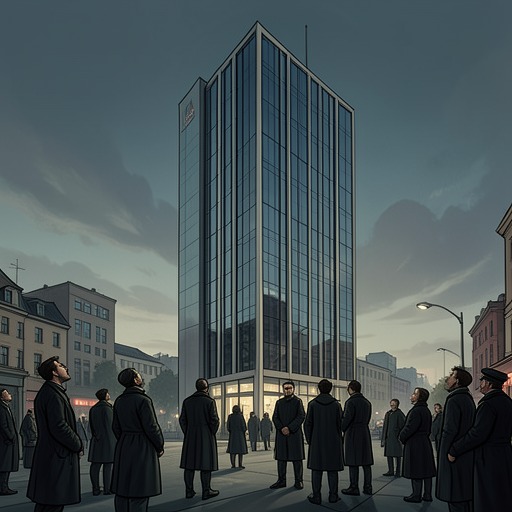
The building is a stone apartment house, distinguished less by an announced name than by the resources surrounding its entrance. Oak doors with small barred windows, a private loading zone, and a curb cut mark a controlled point of access; a curb attendant screens arrivals and visitors. Inside, the lobby is broad and deliberately dark, and a group of doormen in white gloves and blue suits with black piping quickly surrounds Lionel. Their uniform matches that of the men who had been in the rental car. The realization revises his first impression of them: they are not trained toughs by occupation but building doormen who have also been deployed in the investigation’s more threatening encounters.
Loomis later supplies a wider account of the building’s social scale. He describes an apartment house with an extensive staff and its own internal services, including wine cellars, laundry, a swimming pool, servants’ quarters, and a private chef. His account presents the property as a self-contained economy, available to a tiny class of very wealthy residents. In that setting, the discreet entrance and the staff are not incidental details: they are signs of a residential institution whose services and access are carefully managed.## The Fujisaki Connection The corporation’s name first becomes concrete through the rental-car lease, but Loomis clarifies its role: Fujisaki is the management corporation associated with the building. He identifies Ullman as its accountant and stresses the scale of the operation. That information redirects Lionel’s questions from the building’s wealth in general to the people handling its accounts and contracts. Loomis asks why Gilbert Coney would target an accountant; Lionel answers that Ullman was the last person Frank was supposed to meet, though Frank never reached him.
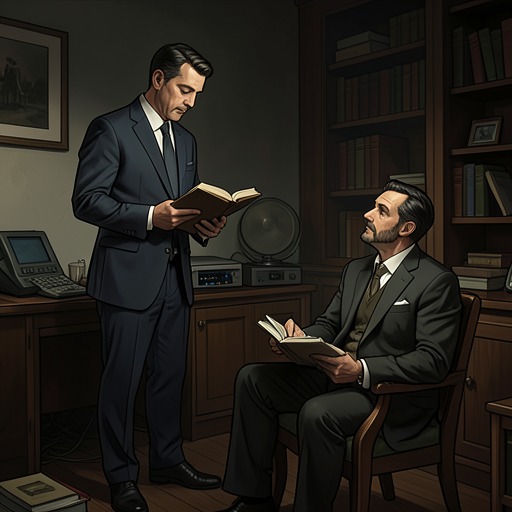
The Park Avenue address also punctures Lionel’s earlier picture of Frank’s business. Gerard argues that Frank taught Lionel only part of what he knew and kept him unaware of the larger world around their small assignments. The revelation that Lionel did not know about the building becomes evidence of that limited education. Gerard further challenges the assumption that Frank’s money came from detective work: the building’s service economy offers a more substantial source. The address therefore changes the meaning of L&L’s modest investigative jobs, which may have kept the younger men occupied without showing them the broader financial arrangements around Frank.
Gerard explains that his students performed the building’s maintenance and service work as part of their training. Their tasks included cleaning and cooking, labor resembling what they would do in a monastery, but carried out in a different setting. According to Gerard, the contract for these services was worth millions. He says he supplied the labor in return for consideration equivalent to the mortgage on the Yorkville Zendo, while Frank and Ullman took most of the difference for themselves. The arrangement joins spiritual instruction to a commercial contract: the students’ service work sustains the building’s domestic operations, and the money generated by that work passes through a relationship involving the brothers and the accountant.
The building’s doormen belong to the same labor network. Kimmery recalls that students of the Roshi worked there in the kitchen and at cleaning, and thinks some served as doormen as well. Gerard confirms the connection. The uniformed men Lionel encounters are thus not unrelated security personnel, but part of a group recruited from the Zendo. In the later account of Gerard’s followers, their building work comes before their use as drivers and strong-arms. The progression makes the building a point where ordinary service labor and the brothers’ more coercive operations meet.## The Zendo’s Labor and the Doormen The students’ work at 1030 Park Avenue is presented as both practical training and a source of income. Gerard compares cleaning and cooking there to labor they would perform in a monastery, though the building is a very different setting. His claim that the contract was worth millions gives the arrangement financial weight; his account of the mortgage consideration connects that revenue directly to the survival of the Yorkville Zendo. He also places the doormen within the same arrangement, confirming that the building’s staff included Gerard’s students.
After Gerard disappears, the group’s history becomes clearer in retrospect. Most students leave the Yorkville Zendo within days, while some seek a more authentic practice at another Zendo on the Upper East Side, twenty blocks south. The doormen, Lionel learns, had originally been genuine students of Gerard: followers drawn in by his teaching, then used first in the Park Avenue building and later as an inept group of drivers and strong-arms alongside the Polish giant. The building is therefore an early institutional setting for their transformation from students into a useful workforce. Their progression also distinguishes Gerard’s following from Frank’s Minna Men, whose organization had a different basis and whose members were not merely students gathered around a teacher.
That distinction becomes part of Lionel’s retrospective assessment of the case. He considers whether the Minna Men’s organization gave him an advantage over Gerard’s followers, while recognizing that this may be only his own explanation of how events unfolded. The building supplies concrete evidence for the contrast: Gerard’s students could be organized through their work and their dependence on the Zendo, then placed in roles beyond the service jobs that had initially brought them there.## Aftermath and Significance The disappearance of Gerard does not close the story of the building or the Zendo. The Yorkville Zendo remains open under Wallace, a quiet student who takes stewardship of the remaining community but declines the title of Roshi, asking instead to be called sensei. The contrast matters: where Gerard’s charismatic leadership had connected spiritual teaching to a lucrative labor arrangement, Wallace assumes responsibility without claiming the highest title. The students’ departure and the change in stewardship leave the organization altered, even though the Zendo itself survives.
The eventual account places 1030 Park Avenue among the larger forces that remain largely beyond the reach of Lionel and the Minna brothers. Fujisaki and The Clients withdraw without apparent injury, despite the collapse of Gerard’s position and the reorganization of the people around him. The building’s role in the story is thus both specific and structural. It is an address on a lease, a workplace staffed by Zendo students, and the source of a multimillion-dollar service contract. Through those connections, it exposes how wealth, labor, spiritual authority, and the Minna brothers’ hidden finances were entangled, while also showing the limits of what Lionel’s investigation can change.