Brooklyn Hospital grounds
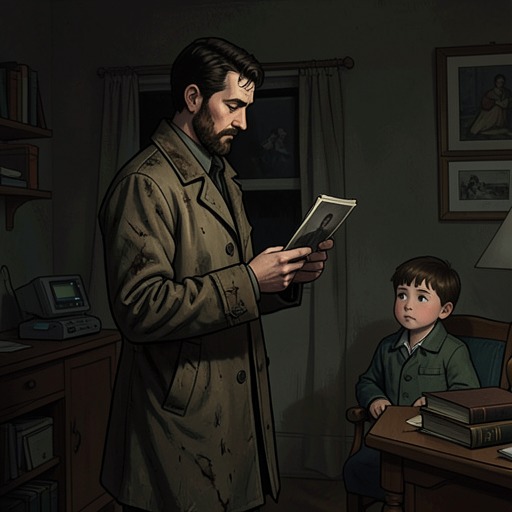
Motherless BrooklynBrooklyn Hospital grounds mark the passage from a desperate effort to save Frank Minna to the confirmation of his death. Reached by car through directions Minna gives from the back seat, the hospital becomes both a practical destination and the setting for the final separation of Frank from Gilbert Coney and Lionel Essrog. Lionel’s attention to Frank’s face and his own compulsive gestures make the emergency room a place where ordinary habits persist even as the familiar life of the group comes to an end.
Setting and Approach
The hospital enters the episode through directions rather than description. When Coney admits he does not know the area, Frank Minna identifies Brooklyn Hospital and instructs him to take the Brooklyn-Queens Expressway, continue up McGuinness, and turn off near DeKalb. Coney gets the car moving in the right direction, while Lionel turns to look at Minna in the back. The route is urgent and specific: the hospital is not an abstract destination but a place they must reach while Minna is badly hurt.
The approach passes from the expressway to DeKalb Avenue and then to the hospital’s ambulance ramp. Minna insists on immediate attention and rejects the prospect of waiting in the ordinary emergency-room queue. His directions and demands keep him active in the journey, even as Coney and Lionel are trying to get him help. The ramp becomes the point where the group confronts the hospital’s rules: Coney says they cannot drive up it, and a security guard challenges their access. Lionel answers by presenting their arrival as an ambulance call and asking for a stretcher.
Emergency Treatment
Once Minna is taken inside, Coney moves the car while Lionel follows the stretcher, staying close to Frank rather than remaining outside. The account records the contrast between the hurried transfer and Lionel’s attempt to preserve a semblance of normal contact. He taps Minna’s shoulder intermittently as if they were still talking in the L&L office or walking together on Court Street. That imagined continuity places a familiar shared routine beside the unfamiliar emergency setting without changing the seriousness of Minna’s condition.
The medical staff settle Minna in a semiprivate area of the emergency room and begin treatment. When he opens his eyes, he asks where Coney is. His concern for the absent companion briefly reconnects the hospital scene to the small group whose members brought him there. Coney returns to the scene of treatment, but the encounter offers no resolution: the hospital is the place where Minna receives care, not where the story restores the life they had before the journey.
Death and Immediate Aftermath
A doctor tells Coney that Minna could not be revived and that blood loss caused his death. Coney objects because Minna had been alive when they brought him in and because he had expected that Frank needed treatment rather than resuscitation. His response expresses the gap between the urgency of the drive and the outcome announced at the hospital. The fact that the group reached the emergency room does not prevent the loss.
Lionel’s response is registered through a repeated physical action rather than an explanation. He feels compelled to tap the doctor’s shoulders in a symmetrical pattern, then straightens the doctor’s collar so that the edges sit evenly. The gestures bring his Tourettic compulsions into the hospital encounter at the moment when no orderly action can alter what has happened. They also keep his attention fixed on the person in front of him, while Coney tries to challenge the doctor’s account of Frank’s death.
Brooklyn, Memory, and Narrative Significance
The hospital’s role becomes clearer against the novel’s other Brooklyn settings. Lionel grew up at St. Vincent’s Home for Boys in a district defined by traffic, courts, the post office, and other institutions, a part of the borough he describes as overlooked and difficult to claim as a neighborhood. By contrast, Frank Minna’s Court Street is a dense social world of barbershops, small businesses, favors, and unspoken understandings. The hospital episode brings the group from the spaces of their shared Brooklyn life into an institution organized around emergency care, where their familiarity with one another cannot determine the outcome.
After Minna’s death, Lionel visits places associated with him, including the Casino, Minna’s name for a small newspaper shop on Smith Street. He hopes that returning to Minna’s familiar haunts might let him resist the evidence of the death. This later movement through the neighborhood gives the hospital scene an enduring narrative consequence: it is the place where the loss becomes undeniable, while the streets and businesses that follow remain sites where Lionel tries to hold on to Minna’s presence. Brooklyn Hospital grounds therefore stand not simply as a destination on the route but as the boundary between an urgent attempt at rescue and the difficult work of living with what cannot be reversed.