Detective Seminole Stops Tony and Lionel at Gunpoint
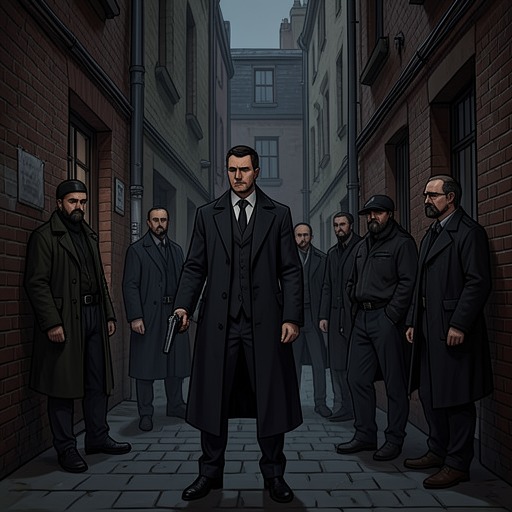
Motherless BrooklynDetective Seminole Stops Tony and Lionel at Gunpoint is a roadside confrontation in which Detective Seminole takes control of Tony Vermonte and Lionel Essrog, removes Tony’s gun, and questions them about the cases surrounding Frank Minna and Ullman. What begins with an armed interruption becomes a moving interrogation: the detective places himself behind the two men, presses Tony for an explanation, and then turns Lionel’s attention toward a woman who has gone to Boston. The exchange establishes that the police are connecting the men and their investigations to Ullman’s killing, while leaving the questions driving their own search unresolved.
The Stop
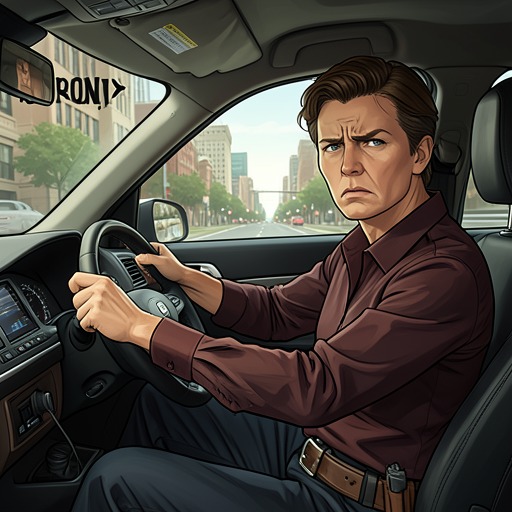
The encounter begins with a tap on the driver’s-side window. The object making contact is the muzzle of a gun, held by an arm extending from behind an elm tree. Detective Seminole then appears from the same cover. The abrupt reveal gives the scene its governing reversal: Tony and Lionel are no longer simply traveling together; they are under the control of an armed homicide detective.
Seminole’s appearance is notably unceremonious. Even in daylight, he seems threadbare and jaded, as if coffee has ceased to help, and he does not appear to have changed out of his suit since the previous night. Lionel’s account contrasts this weary manner with the authority of the weapon: he trusts Seminole with a gun more than he trusts Tony. That comparison does not remove the danger of the stop, but it distinguishes the detective’s force from the suspicion Lionel feels toward his companion.
Seminole has the pair move to the front of the car and stand with their legs apart, attracting the attention of two elderly women nearby. He takes Tony’s gun and checks whether Tony has another weapon concealed on him: Tony opens his jacket to show the empty holster and raises his pant legs to demonstrate that nothing is strapped to his ankles. When Seminole attempts to pat Lionel down, Lionel starts patting Seminole in return. The gesture briefly disrupts the expected roles of officer and subject, but it does not undo the detective’s control of the scene.
From the Roadside to the Back Seat
After searching them, Seminole orders the men back into the car and asks Tony for the keys first. Tony hands them over, and both men return to the front seat. Seminole opens the rear doors and settles into the back behind them, keeping his gun trained on the backs of their heads. The arrangement turns the car into a confined interview room: Tony controls the front-seat position but not the vehicle, while Seminole controls the keys and watches both men from behind.
This change of position also gives the confrontation a practical sequence. The detective first removes Tony’s immediate capacity to resist, checks that no second weapon is being carried, and then conducts his questioning from a place where the two men cannot easily turn toward him. His weary demeanor remains in contrast with his careful control of the gun, the keys, and the occupants’ movement. The episode’s tension rests less on a struggle than on that imbalance: Tony and Lionel can answer, but Seminole determines where they sit and when they leave the car.
The Questions and What They Establish
Seminole challenges Tony with the possibility that the men might turn against one another, then asks what connection Frank Minna had to Ullman. In answering the question himself, the detective supplies a specific account of Ullman’s work: Ullman kept the books for a property-management firm in Manhattan. Seminole says that this continued until Gilbert Coney shot and killed him, and characterizes the killing as tit for tat. He also remarks on how quickly the men have gone to work. His words place the investigation in a wider pattern of retaliation and make clear that he sees Tony and Lionel as active participants in the aftermath, rather than as detached observers.
The information is revealing, but not complete. The exchange connects Ullman to a Manhattan property-management firm and identifies Gilbert Coney as the person who killed him; it does not explain the full relationship between Ullman and Frank Minna. Seminole’s question makes that connection an explicit line of police inquiry, while his own account supplies the known link between Ullman and Coney. The men’s presence together, and the speed with which they have begun investigating, are themselves part of what draws his attention.
Seminole then redirects the interrogation to a woman who has run to Boston. The passage does not establish her full circumstances here; instead, the detective’s abrupt shift shows that he has another line of inquiry in mind and expects Lionel to answer for it. He addresses Lionel as an alibi and tells him to turn around so they can discuss the woman. Lionel responds by getting out onto the curb. The movement ends the exchange inside the car without resolving what Lionel knows or what the woman’s departure means.
Narrative Function
The stop changes the balance of information as well as the balance of power. Before Seminole speaks, the men face an immediate armed threat; once he begins questioning them, they learn how the police are framing the deaths and what details the detective already possesses. Yet the questioning is not a solution to their investigation. It supplies a new account of Ullman’s work and death, then introduces the Boston-bound woman as an unresolved subject.
The scene’s small physical details keep that uncertainty concrete: the elm tree conceals the detective until the gun taps the window; Tony’s empty holster proves only that the confiscated gun was the one visible weapon; the keys pass from Tony to Seminole; and the detective occupies the rear seat with his weapon directed forward. At the end, Lionel’s step onto the curb shifts him from passenger to the next person under questioning. The episode therefore closes not with an answer, but with a change in who must speak and what the detective wants to know.