Founding of L&L Car Service as a detective agency
Motherless BrooklynThe founding of L&L Car Service as a detective agency was a decisive change in Frank Minna’s arrangement with four boys from St. Vincent’s Home for Boys: what began as occasional moving work became an investigative operation with a storefront, vehicles, and surveillance equipment. The transition was not a clean break. Minna built the agency on the same wages, personal ties, and neighborhood familiarity that had bound the boys to L&L Movers, while concealing its purpose behind the promise of a car service.
From the Home to L&L Movers
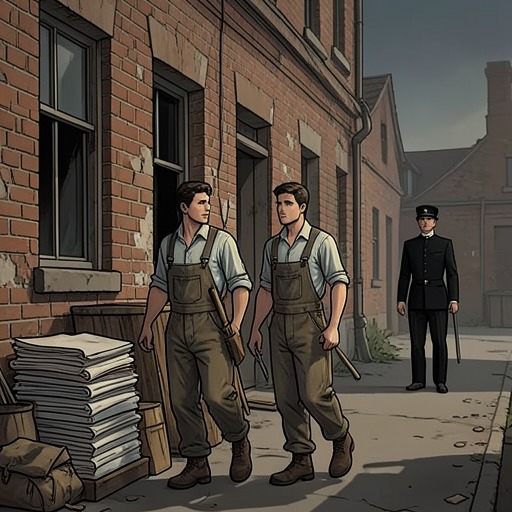
Minna first recruited Tony Vermonte, Gilbert Coney, Danny Fantl, and Lionel Essrog as a junior crew. He handed each boy twenty dollars and a business card for L&L Movers, bearing the names of Frank Minna and Gerard Minna. The boys’ work was called moving, a label Minna insisted on even when the circumstances made the job seem less straightforward. The cards and cash made their association tangible; Minna’s sporadic calls, sometimes with no notice, kept them waiting for the sound of his van after school.
Their assignments ranged from ordinary apartment moves to hauling merchandise through storefront basement grates on Court Street. They carried furniture up walk-ups, maneuvered sofas through third-story windows with a rope-and-pulley arrangement, and helped move people out of a fire-damaged factory. On another job, they emptied an electronics showroom while Minna spoke with the person who had opened its gates. The work placed them among clients who watched the boys for signs of theft or disloyalty. The boys took nothing, watched the clients in turn, and listened. In this early phase, the moving crew was already learning how to observe people and how transactions depended on trust, intimidation, and local connections.
That education was also social. The four boys formed a tighter group at the Home and at Sarah J. Hale High School, where they looked out for one another. Minna’s world extended beyond paid jobs to Court Street’s unspoken arrangements: businesses and familiar faces operated within a local network that did not always explain its rules aloud. The boys’ entry into that world came through work, but the work taught them that what mattered could remain unstated.
The return and the new operation
When Minna returned after two years away, he collected the boys outside Sarah J. Hale High School in a new, bruise-purple Cadillac. Lionel, who had grown taller than Minna, still felt the force of his presence and remembered how Minna had once drawn him out of the Home’s library and into the world. The familiar bond made the change in Minna’s manner more striking: he was less jocular and more impatient, though the boys quickly fell back into his orbit.
Minna handed them new business cards for L&L Car Service. They carried a phone number but no names or advertising slogan. He asked whether they had learner’s permits; none did. He gave them twenty dollars apiece and planned to take them to the Department of Motor Vehicles, first stopping to show them a boarded-up storefront on Bergen Street. Lionel knew it as a former candy store with a comic-book rack. Minna presented it as the future home of L&L Car Service, giving the new business a physical base as well as a name.
The plan required the boys to become drivers and to outfit the operation. Minna arranged free lessons through Lucas at Corvairs Driving School and wanted them to obtain limousine-operator’s licenses, which cost only ten dollars more than ordinary licenses. The purple Cadillac was the fleet’s only car for the moment, but more vehicles were expected. Meanwhile, the boys would repair the storefront and equip it with radios, office supplies, telephones, tape recorders, microphones, a television, and a small refrigerator. Minna also urged them to leave school and get haircuts and suitable clothes. The sudden list of requirements made clear that this was not simply a new name for the same casual moving work: the boys were being prepared to operate communications and recording equipment as part of a professional-looking team.
The cover and the agency’s work
Minna eventually disclosed the distinction on which the new enterprise depended: L&L Car Service was not really a car service but a detective agency using that business as a front. The car-service cards, storefront, licensing, and equipment were therefore both practical preparations and a public-facing explanation for the operation. Minna’s boys were expected to drive, use cameras and recorders, and take part in surveillance, even as the business presented itself as a transportation service.
Once established, the agency handled ordinary investigations as well as assignments whose larger purpose the boys could not see. They tracked a wife for a husband, watched an employee suspected of theft or falsifying accounts, and produced reports from information gathered with bugs and cameras. Under Minna, the work gave them a detailed view of private lives in Cobble Hill and Carroll Gardens, a kind of informal social record assembled through observation. The Clients formed a more shadowy presence. Their assignments came in broken fragments; Minna’s instructions were disjointed, and the boys could tell from his unease when a job involved Matricardi and Rockaforte. He changed his routines, shut the storefront for days, and became more guarded. In those operations, the team was no longer gathering complete stories it understood; it was being used in matters whose beginnings and ends remained hidden from them.
Development and legacy
The agency’s later history exposed the tension built into its founding. L&L could be a detective agency, a car service, and a cover for work on behalf of powerful clients, with the same boys moving between those roles. Gerard Minna’s name had appeared on the original moving-company cards, but it was absent from the new car-service cards; the new operation was presented by Frank Minna without an explanation of Gerard’s place in it. The difference registered in Lionel’s thoughts as an unanswered question about the other L in L&L.
The detective work could also reveal the economic arrangements beneath respectable institutions. Gerard later explained that students at the Yorkville Zendo performed maintenance and service work as part of their training, while a lucrative building-services contract was handled by Frank Minna and Ullman, who kept most of the difference for themselves. This disclosure connected the agency’s world of errands, surveillance, and clients to a larger system of concealed payments and exploitation; investigation did not merely record individual behavior but could expose the structure behind it.
By the time L&L was reorganized after the upheavals surrounding Frank Minna’s death, it had become a clean detective agency with no clients and a genuine car service that accepted calls when cars were available. Danny Fantl arranged flyers and new cards, and Minna’s Lincoln joined a small fleet making regular runs around Brooklyn. That later form gives the founding its full arc: the car-service identity began as camouflage for detective work, then became a real business in its own right. The agency’s origin lies in the overlap between those functions, and in Minna’s conversion of four boys’ loyalty, labor, and attentiveness into an organization.