Frank Minna
Motherless BrooklynFrank Minna’s decisive legacy is the group of boys he gathers from St. Vincent’s Home for Boys and turns into his employees, companions, and devoted successors. To Lionel Essrog, Minna is both a practical mentor and the person who gives him a language for belonging. Yet the agency Minna builds rests on concealed dealings with dangerous people, and the questions surrounding his disappearance and clients survive him.
Identity and Introduction
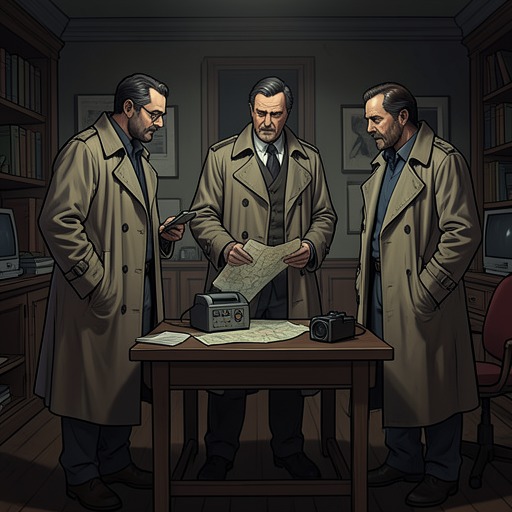
Minna first appears in the evidence as a familiar presence returning to the boys’ orbit at a moment of concealed business. He approaches Lionel and Gilbert Coney beside their car near the Yorkville Zendo, wearing a trench coat and keeping low by the window, apparently wary of being seen from the building. His arrival is unusual enough to signal that something complicated is underway, and the boys recognize that they have again been kept outside the important decisions.
Lionel’s greeting is a habitual touch to Minna’s left shoulder. The gesture has lasted for fifteen years, beginning when Lionel was thirteen and Minna was twenty-five. Its repetition gives their relationship a physical continuity: long before Lionel can explain what Minna means to him, he has marked their encounters with the same small act. Minna does not acknowledge it, but the habit persists as part of the bond Lionel remembers.
Recruiting the Boys
Minna’s connection to the boys begins through Mr. Kassel, a teacher at St. Vincent’s who knows him from the neighborhood and allows him to borrow four boys for an afternoon. The four are selected from the home’s five white boys. Minna wants white workers to suit the presumed prejudices of his clients, and the recollection also notes his own prejudices. Lionel is brought from the library rather than the schoolyard; to the adults he appears an unlikely recruit, while to the boys the opportunity offers an escape from their routine.
Minna puts Lionel, Tony Vermonte, Gilbert Coney, and Danny Fantl into the back of his dented van without explaining the errand or asking their names, then closes and padlocks the doors. The boys accept the strangeness of the arrangement because it takes them somewhere beyond St. Vincent’s. The work is physical and demanding. At the end of their first job, Minna tosses his beer can into the van, and the job is over. He gathers them again the next week for nearly the same task, involving roughly 242 to 260 boxes. The repetition is not yet a promise of friendship, but the boys begin to function as a team through the work itself.
The Agency and Its Hidden Business
Minna’s organization changes from a moving company into the Minna Agency, but its work never becomes simply detective work. The boys remain errand runners as well as investigators, and the presence of the Clients can be sensed in assignments that make Minna uneasy. When their business presses close, he changes his routines: he may stop visiting familiar places, shut the storefront for days, or insist on sitting with his back to a restaurant wall. Even his manner on the street shifts. His guardedness shows that the agency’s ordinary errands coexist with a riskier world he does not explain to his employees.
That danger has a history. The brothers’ later account of their flight from Brooklyn describes them acting as liaisons between two aging Brooklyn mobsters and suburban truck hijackers. The mobsters redistributed stolen goods; the brothers increased their own share by arranging to warehouse some of the goods and find a buyer. Once the mobsters discovered the betrayal, they decided to kill the brothers, driving them to seek refuge at a Zen center in Maine. The account makes Minna’s dealings more than a vague atmosphere of menace: his livelihood has been entangled with theft, profit, and betrayal. It does not, however, resolve every question about his later clients or the precise circumstances of his own choices.
Relationships and Character
Minna’s bond with the boys is expressed less through explanation than through the structure of the life he gives them. They become a working group under his direction, and after his death they continue to model themselves on him. Gilbert Rockaforte tells Lionel that Minna loved him and that this is why the clients care for and worry about him. The remark confirms that Minna’s attachment to Lionel is remembered not only by Lionel himself but by people who knew the wider risks around him.
Minna’s relationship with his brother Gerard Minna is marked by a major silence. After Minna returns from an absence of three years, he never discusses why he left, where he went, what happened during that time, or why he came back when he did. Gerard had hustled him out of Brooklyn on the day he disappeared in May. Minna also leaves unexplained how he met and married Julia Minna, and what became of Gerard. These omissions make the brothers’ shared past a continuing mystery within the agency rather than a settled part of Minna’s story.
Death and Continuing Influence
Minna’s death is reported to the boys in clinical terms: he could not be revived, and loss of blood was given as the cause. Julia is told she cannot leave because the homicide detective wants to question her about Minna. The news changes the meaning of the organization’s routines. A litany of what Minna’s men do—drive, listen to tapped lines, collect money, answer phones, and follow instructions—ends with the recognition that they are trying to be like him, but Minna is dead. Their code is both a practical inheritance and a portrait of their dependence on the man who organized them.
Minna’s influence also persists in the physical and social shape of L&L. Lionel lives in the apartment above the storefront from the day he leaves St. Vincent’s, while trying to keep his private rooms separate from the business below. The agency itself is no longer a moving company, though its employees remain errand boys as much as detectives. In Gerard’s judgment, Minna taught the boys so thoroughly that Lionel sounds like him when he speaks; the observation captures how the mentor’s manner has survived in his pupil. Minna’s legacy is therefore not a clean solution to the mysteries he leaves behind, but a group of men who continue his work and carry his habits into a world whose dangers he never fully disclosed.