Gerard Minna
Motherless BrooklynGerard Minna is Frank Minna’s brother, an intermittently present figure whose brief appearances conceal a central role in the novel’s mysteries. First glimpsed at a family Christmas, he later vanishes from the account of Frank’s return, only to reappear under the identity of the Roshi at the Yorkville Zendo. The discovery that Gerard is also the voice on Frank Minna’s surveillance wire joins a family secret, a hidden business arrangement, and Lionel Essrog’s investigation into one belated recognition.
Identity and First Appearances
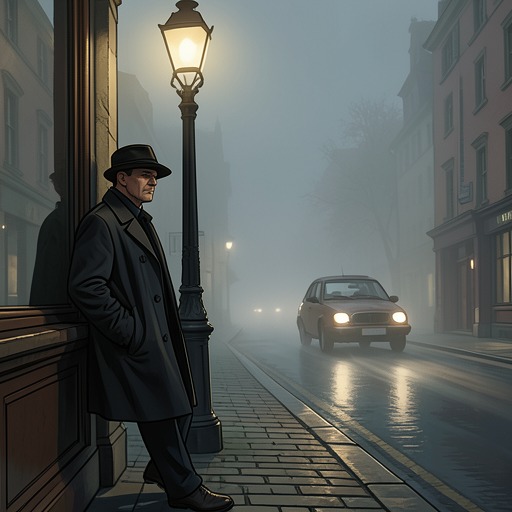
Gerard first appears on Christmas Day, 1982, at the apartment of his mother, Carlotta Minna. Although his name is on the L&L business card, Lionel Essrog recalls that the group has met him only once before, and never on a moving job. He enters without being noticed, then speaks of the small moving company. In Lionel’s first impression, Gerard is a taller, fleshier version of Frank: dark-eyed and dark-haired, with the same wry mouth, but wearing a buttoned brown-and-tan leather coat and keeping his hands in its pockets. The family resemblance is clear, though the brothers’ difference in presence will matter as much as their likeness.
Gerard’s manner immediately suggests authority within the family. He brings Frank a fat white legal envelope, but when Frank starts to open it, Gerard orders him to put it away in a low voice that Lionel perceives as carrying the force of longstanding sibling authority. The envelope’s contents are not disclosed. The moment nonetheless establishes that Gerard arrives with business of his own, and that he can govern Frank’s response without explaining himself to the others. Carlotta, meanwhile, prepares food for her older son; Gerard asks her to make it to go. The domestic scene places his power inside ordinary family exchanges rather than announcing it outright.
The next time Lionel sees Gerard is about five weeks later, on a Sunday morning in late May, when he arrives at the boys’ Home with Frank. This is only the second time the group has laid eyes on him. His appearances are therefore sparse, and the gap between them is filled not by a clear account of his life but by uncertainty about Frank: the boys have not seen Frank during the intervening weeks and do not know whether his absence means anything. Gerard is present at the return, but the narration does not yet explain the connection between his movements and his brother’s disappearance.
The Missing Years and the Roshi Identity
After Frank returns from his three-year absence and establishes the Minna Agency, Gerard becomes one of the subjects Frank will not discuss. Lionel and the others do not know why Frank left, where he went, what he did, or why he came back when he did. They also do not know what happened to Gerard. There is no further sign or mention of him in the account of the Agency’s early years, and the period “upstate” remains so thoroughly obscured that its duration can seem hard to believe. Gerard’s absence is thus bound to an absence of explanation: Frank’s history contains a blank where the brothers’ shared past should be.
That blank is eventually filled by a visual recognition at the Yorkville Zendo. During a visit, Lionel sees a file of six bald Japanese monks enter, followed by a seventh, robed and bald but physically distinct: a large American with black hair covering his back and shoulders and circling his neck. Before seeing the man’s face, Lionel connects him to Kimmery’s description of the American teacher who founded the Zendo. A joke and a voice on the wire have already led Lionel toward the name Irving, but he cannot initially make the association work. The scene makes recognition a process of partial clues: first a striking body in ceremonial dress, then the remembered voice, and finally the identity behind the religious title.
The realization is explicit: the Roshi is Gerard Minna, and Gerard is the voice on the wire. His religious persona therefore does not replace the family member so much as cover him. The delayed identification also reorders his earlier absences. The man who seemed to have disappeared from Frank’s story has returned to New York City under a new public identity, while Lionel’s limited knowledge has allowed the two parts of Gerard’s life to remain separate until the clues converge.
The Zendo and the Fujisaki Connection
Gerard’s role as Roshi is connected to a larger arrangement involving the Fujisaki Corporation. An account of the brothers’ history says that Gerard returned to New York City, declared himself a Roshi, and began the Yorkville Zendo. Fujisaki, a powerful group of Japanese businessmen he had met in Maine, subsidized the institution. The group had taken over and renovated a modest Zen center and the neighboring lobster pound there before extending its project to New York.
The account presents Fujisaki’s religious ambitions and business interests together. Its members sought recognition as penitents and teachers in a context where, in Japan, respected monkhood was restricted by lineage and spiritual devotion was seen as incompatible with aggressive capitalism. In Maine and then New York City, the organization could present itself as a source of wisdom and peace while pursuing business. Gerard was part of that plan: he and the Fujisaki men hoped to conduct business through the enterprise. His role as religious founder is consequently both sincere-looking public identity and the institutional setting for a commercial undertaking; the evidence does not reduce one aspect to the other.
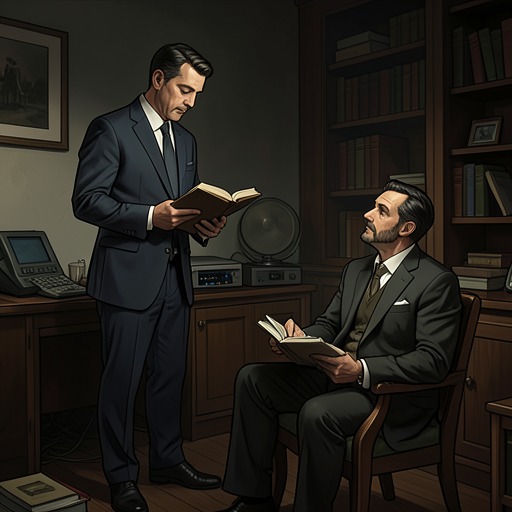
When Lionel confronts Gerard in his private quarters, the Zendo’s outward role and Gerard’s concealed life meet in a starkly spare room. The bedroom contains almost no furniture: a low board balanced on bricks, a few candles and books, a glass of water, and a small bowl of ashes marked with Japanese script, arranged like a tiny shrine. Gerard sits cross-legged on a flat mattress, propped on pillows, with a closed book at his knees. Lionel understands the bareness as part of Gerard’s self-reinvention. The room gives that reinvention a physical form, but it also becomes the place where Lionel reaches the man hidden behind the title.
Gerard tells Lionel that Frank consorted with dangerous people and stole from them, at substantial risk. He also explains that the Fujisaki men own the building and that Frank had a hand in managing it, emphasizing the scale of the money involved. These disclosures connect Frank’s past work to the organization supporting Gerard’s Zendo, though Gerard’s account does not by itself settle every question about the brothers’ dealings. He provides information while still controlling its terms, as he had done with the envelope in Carlotta’s apartment.
Family Secrecy and Narrative Significance
Gerard’s importance lies partly in the way his life reaches the reader through other people’s limited knowledge. At Christmas, Lionel can observe his appearance, his envelope, and his authority over Frank, but not the purpose of his visit. During Frank’s absence, the brothers’ history is withheld from the boys. At the Zendo, Lionel again sees Gerard first from the outside, as a robed figure whose body does not match the expected image of a monk. Only after that visual encounter do the remembered clues resolve into a name. The separation between what Lionel sees and what he can understand sustains the mystery without making Gerard’s eventual identity arbitrary.
For Lionel, naming Gerard also helps make Frank’s death speakable. When he tells Kimmery that Gerard is Frank’s brother, he explains Frank as the man who was killed. The identification brings a name and a family relation into a grief that had resisted formulation. Gerard is therefore more than the answer to the question of who was speaking on the wire: he is the point where Frank’s erased years, the Fujisaki arrangement, and Lionel’s effort to understand the dead man’s life converge. Even after the reveal, the brothers’ history remains partly unaccounted for; Gerard’s reappearance supplies a crucial connection, not a complete explanation.