Irving
Motherless BrooklynIrving is the giant who appears with Frank Minna shortly before Minna is beaten, and the name Lionel Essrog eventually associates with the man responsible. He is defined less by a known history or stated motive than by a sequence of impressions: a black coat, extraordinary size, hidden hands, a hurried departure, and blows heard from a distance. That gap between physical presence and limited knowledge makes Irving both a concrete threat and an uncertain piece of Lionel’s investigation.
Appearance and First Encounter
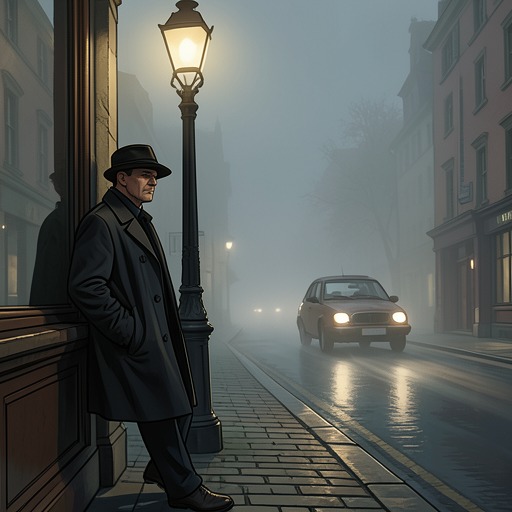
Lionel and Gilbert Coney see Minna and a second man emerge and hurry ahead of them along the sidewalk. The stranger seems nearly seven feet tall to Lionel, with shoulders so broad that Lionel imagines football pads or angel wings beneath his black coat. The image briefly becomes almost comic: Lionel wonders whether a small girl might be curled against the man’s shoulders like a backpack. But the impression of scale also makes the encounter alarming. The giant’s hands remain hidden in his pockets, and Lionel wonders whether he has a gun.
That suspicion is not confirmed. Lionel immediately counters it with a comforting fantasy: perhaps the pockets contain loaves of bread or chunks of salami, snacks for a giant in winter. He recognizes the thought as self-comfort, a way of imagining that Minna is the only person with a firearm. The scene therefore supplies no reliable account of what Irving carries or intends; instead, it shows Lionel trying to manage danger by turning an unknown man into an image he can bear.
Flight and the Sounds of Violence
Minna and the giant cross between parked cars and climb into the back of a black K-car that has pulled up behind Lionel and Coney. The car immediately drives away. The pursuers have delayed their reaction because they assumed the men would need time to start a parked vehicle, and the mistake lets Minna and Irving escape. Lionel’s shouted order to go marks the moment when watchful observation becomes pursuit.
On the Brooklyn side of the Pulaski Bridge, Lionel and Coney drive slowly down the slope while searching for the K-car. Lionel then hears doors opening and slamming, followed by footsteps. The men have reached a destination, but he cannot see them. Minna’s mocking voice identifies the place as Harry Brainum Jr.; he makes another needling remark, while the giant says nothing. The contrast is stark: Minna keeps talking, and Irving remains silent as the encounter turns physical.
Lionel hears a thud and an exhalation, then another blow. Minna calls out, a struggle follows, and a further impact leaves him sighing as he loses his wind. Because Lionel is listening from elsewhere, the violence arrives as separated sounds rather than a visible fight. The narrative establishes that Minna is struck repeatedly, but it does not describe Irving’s movements or explain what begins the assault. The giant’s silence and the limits of Lionel’s hearing preserve that uncertainty even as the danger becomes unmistakable.
The Name and Minna’s Clue
Afterward, Minna is badly injured, and Lionel asks who attacked him. Minna answers through a joke about Octopus and Reactopus, then turns Lionel back toward a joke he had previously told about a Jewish woman visiting Tibet to see the High Lama. Lionel recognizes the name Irving. Minna repeats it and says that is who, making the name a clue rather than providing a full account of the attack.
Lionel then tests his inference directly: was Irving the person who hurt Minna, and was he the big man from the car? Minna whispers something Lionel hears as “remember.” The exchange connects the name to the giant, but it remains compressed and oblique. Minna does not narrate the assault, identify a motive, or explain how Lionel should interpret the reminder. The reader receives the same kind of partial information as Lionel: enough to link the unknown companion to the beating, but not enough to reconstruct the whole encounter.
Narrative Role and Limits
Irving’s effect on the episode comes from the difference between how plainly he can be seen and how little can be known about him. His height and coat make him visually unmistakable; his hidden hands invite suspicion; his silence offers no correction to Lionel’s guesses. The reader encounters him through Lionel’s anxious, imaginative attention, then hears of his violence indirectly through the sounds of Minna being hit. Neither perspective yields a complete portrait.
The name also acquires significance through delayed recognition. At first, Irving is only the giant in the car. Later, Minna’s broken exchange gives Lionel a name to attach to that earlier image, and the question of what Lionel is supposed to remember remains unresolved in the scene. Irving consequently functions as a person implicated in a specific act of violence and as a fragment in a chain of clues. The evidence presented here establishes his association with Minna’s beating, but supplies no independent account of his motives, history, or fate.