L&L
Motherless BrooklynL&L’s storefront is more than the office of Frank Minna’s detective agency: it is the ground-floor center of the Minna Men’s work and memory, with Lionel Essrog’s apartment directly above it. Its two levels hold a tension between public business and private ritual; its changing operations register the loss of Frank Minna and the men’s effort to build a different life in the same place.
Setting and neighborhood
The storefront belongs to a Brooklyn shaped by neighborhood ties and tacit rules rather than formal explanations. Frank Minna’s Court Street is presented as a placid surface alive with conversation, deals, casual insults, and unwritten understandings. Barbershops, small businesses, and familiar faces form a local network in which people look after one another while denying that any special arrangement exists. L&L’s setting makes its work legible within that world: the agency is not separate from neighborhood life but embedded in its habits and loyalties.
That social landscape also gives the office a history before it becomes a legitimate business. Minna gathers Lionel, Tony Vermonte, Gilbert Coney, and Danny Fantl from St. Vincent’s Home for Boys, drawing them toward an adult world beyond the institution. Tony’s confidence that Minna represents the Italian rescue he has imagined helps kindle his belief in a future under Minna’s command. The group’s later identity as the Minna Men grows out of this recruitment and the neighborhood system Minna teaches them to read.
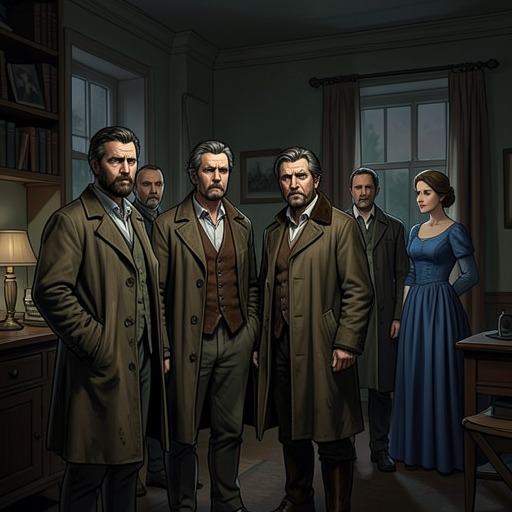
The office is a storefront on Bergen Street, and its street-facing glass becomes a vantage point as well as a boundary. Late one night, Lionel watches from the opposite sidewalk rather than enter, wary that Detective Seminole, Tony, or doormen might be waiting inside. The storefront is familiar enough for Lionel to know what can be seen through it: Tony pacing, Danny behind the counter with a newspaper, smoke in the office, and a television on. A place that ordinarily houses the group’s shared work can, in an instant, become a scene under suspicion.
Office and home
Lionel lives upstairs in the apartment above the storefront, having moved there when he left St. Vincent’s. He tries to keep the two spaces mentally distinct, even though the stairs run down into the back of the office. The separation is maintained through deliberate contrasts: beer downstairs and whiskey upstairs; cards below and a chess problem above; Touch-Tone phones in the office and a Bakelite dial phone at home. These are personal rules rather than architectural divisions, but for Lionel they give the two parts of his life separate identities.
The apartment’s arrangement is shaped by his compulsions. Because the possibility of having to touch every visible object affects how he furnishes the room, he favors a sparse, almost Japanese simplicity. He taps his keys against the upstairs door before opening it, adding six more impressions on one occasion, and touches switches beneath lampshades as part of settling in. His belongings make the room specific: unread paperbacks with covers scored by his fingernails, a black boom box, Prince CDs, and a single fork taken years earlier from a table at Matricardi and Rockaforte’s brownstone. The everyday objects of a home carry traces of memory and repeated action.
The division between work and home is not absolute. After speaking with a homicide cop, Lionel lets himself into the storefront with his key, leaves its ringing phone unanswered, and goes into the back. When he goes upstairs, he keeps the lights low so an observer outside will not connect the apartment with the business. The shared building that once makes living and working together convenient also exposes the relationship between them when Lionel needs privacy.
The agency at work
L&L’s public identity changes over the course of the story. At one point, Lionel’s assertion that the men are a detective agency rather than a car service emerges as a tic disguised as ordinary speech. The distinction matters: the agency gives the Minna Men a name and an investigative purpose, even as the storefront and its vehicles remain tied to practical transportation work.
After Frank and Tony are gone, the operation becomes a clean detective agency for the first time, but it has no clients. It is also, now genuinely, a car service: calls are accepted unless there are no cars available. Danny has flyers and new business cards printed, advertising economy and efficiency throughout the boroughs. The Lincoln in which Frank bled to death is cleaned and put back to work in a small fleet. Its regular runs connect places including the Cobble Hill Nursing Home, the Promenade Diner, the Boerum Hill Inn, and apartment buildings along Prospect Park West and Joralemon Street. The former death car becomes a working vehicle in an ordinary service, a practical sign that the business has been reorganized rather than simply abandoned.
The storefront remains a shared workplace, but Frank’s absence changes how its occupants relate. Danny and Lionel had functioned, in Lionel’s understanding, as opposite expressions of Frank’s impulses: Danny’s silent, imposing presence contrasted with Lionel’s talk and descriptions. Without Frank as the link between them, they must begin to understand one another again. The office therefore holds not only the agency’s business but the difficult adjustment of its members to a group no longer organized around its founder.
Change after Frank Minna
The change is visible in an ordinary late-night scene. At two in the morning, the men play poker on the storefront counter and listen to music Danny likes, now that Frank and Tony are gone. Gilbert, recently released after five nights in custody for lack of evidence in Ullman’s killing, complains and plays; the gathering resumes a familiar rhythm without restoring the former hierarchy.
Danny’s new position emerges less through an announcement than through his conduct. He sits apart, dressed increasingly sharply, and leadership seems to settle on him without a contest. He listens to Lionel’s account of what happened in Maine, nods once, and does not reopen the subject. Gilbert, Loomis, and Lionel do not challenge his authority. The storefront thus becomes the setting where succession is enacted through presence, restraint, and the group’s recognition, rather than through a formal transfer of power.
Narrative significance
L&L’s connected office and apartment give physical form to the novel’s uneasy overlap of work, memory, and private life. The ground floor is a place for investigation, driving, poker, and the men’s changing business; the upstairs room is Lionel’s carefully ordered refuge, yet its entrance and utilities remain tied to the office below. The boundary he constructs is necessary but permeable.
The business’s transformation is equally concrete. A detective agency that has lost its clients survives as a real car service, and the Lincoln associated with Frank’s death returns to the streets carrying passengers. Danny’s leadership and the men’s continued use of the storefront show that the group persists, but not unchanged. L&L remains their common address while its purpose, authority, and relationship to the neighborhood are remade.