Lionel Essrog's grief over Frank Minna
Motherless BrooklynLionel Essrog's grief over Frank Minna is not only sorrow for a murdered mentor: it is the loss of the man around whom Lionel's chosen family, work, and sense of purpose were built. The loss drives him to pursue Frank's killer, makes him newly protective of Tony Vermonte, and shapes his attempt to reach Julia Minna through their shared attachment to Frank.
A bond formed in childhood
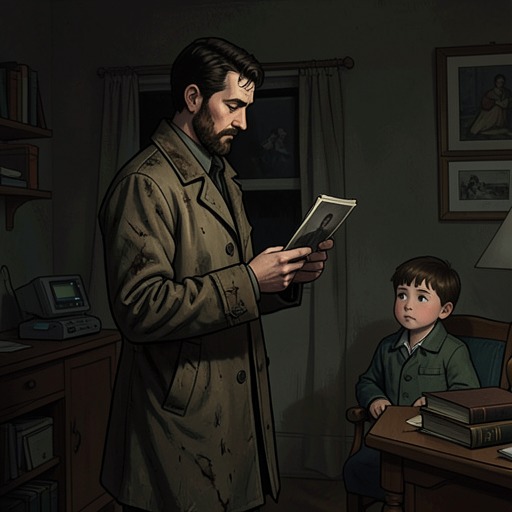
Frank's importance to Lionel began when Lionel was a boy at St. Vincent’s Home for Boys. Frank recruited him alongside Tony, Gilbert Coney, and Danny Fantl, putting the boys in his van and carrying them away from the institution without first asking their names. The boys did not yet know what Frank's plans meant, but Lionel felt accepted by them and wanted to belong. Frank's intervention became the beginning of the group and of the future Minna Men.
Tony, in particular, saw Frank as the answer to his own longing for rescue. He believed that his Italian identity meant someone would come for him, and he read Frank's arrival as the fulfillment of that expectation. Frank's attention to Tony helped kindle the vision of a team he could cultivate and command. Lionel's grief therefore reaches back to a formative moment: Frank was not simply an employer but the adult who gathered the boys into a life and a family they had not possessed before.
Frank also served as a model of adult behavior. The boys studied the way he moved among women, teasing and handling them with a confidence they did not yet have, and stored away his gestures as lessons in how men behaved. Years later, Frank described his preferences in terms of a need for something that could soften the exposure of intimacy. That recollection underlines how much of Lionel's understanding of adulthood had been filtered through Frank, even where the model was complicated or emotionally distant.
Grief turned toward vengeance
After Frank's death, Lionel confronts Gerard Minna with questions about the use of the Yorkville Zendo as a trap. In Gerard's room, Lionel stands with his arms at his sides and does not move closer. He is physically large, but recognizes that he is no avenging giant: he has neither surprised Gerard from sleep nor disturbed his calm, and he is not holding a gun on him. Gerard is free not to answer. The imbalance makes Lionel's grief visible as helplessness as well as anger; his accusations cannot compel the truth he wants.
Lionel reaches for Frank's characteristic expressions as if language itself might restore the dead man. He repeats Frank's sayings on any pretext, imagining that he could assemble a golem from them and send it after the killer or killers. The image gives his mourning a practical, violent direction, but also exposes its impossibility: remembered speech can keep Frank present in Lionel's mind, yet it cannot act in Frank's place. At the confrontation, Gerard remains serenely unresponsive, and Lionel's borrowed language does not make him powerful enough to force an answer.
Loyalty to Tony and the inheritance of Frank
Lionel's grief also renews his care for Tony. After the two have failed to communicate well, Lionel recognizes Tony as a heedless adventurer trying to imitate Frank in everything. Tony belongs to Lionel's family of L&L and the Minna Men, but is now exposed to threats from the giant, Detective Seminole, and The Clients. Lionel believes that he and Gerard are the only ones who understand the danger facing him. Gerard, in turn, tells Lionel that he and Tony share the pain of Frank's loss, though they have not actually come together, and urges patience.
Lionel's later understanding of Tony complicates this apparent kinship. He concludes that Tony intended to take over Frank's share of the Fujisaki scam, though there was nothing left to take over. Lionel wanted to be a virtuous detective; Tony wanted to become a corrupt one, perhaps even an outright wiseguy. Tony had been fitting himself for the darkest parts of Frank's wardrobe, and Frank's vulnerability had shown him that power could change hands. After Frank died, Tony imagined occupying Frank's roles both in Brooklyn with The Clients and in Yorkville with Gerard and the Fujisaki Corporation, but doing so more efficiently and brutally. Grief thus binds Lionel to Tony while forcing him to see how differently each man would carry Frank's legacy.
Julia and the abandoned family
At the lighthouse, Lionel's response to Julia is shaped by grief as much as by the case. He thinks that the Minna Men had once studied her as the first woman Frank brought into their lives, trying to understand what it meant for Frank to marry. What they read as rage, Lionel now understands as disappointment and fear. He wants to rescue Julia from the lighthouse and from the exposed bareness of her story, and wants her to recognize them as fellow disappointed lovers of Frank and abandoned children.
Lionel tries to make that connection by pointing out that he and Julia are nearly the same age and grew up as teenagers at much the same time. His appeal does not establish that she shares his interpretation; she looks at him blankly. The moment nevertheless reveals what his mourning seeks: not only an account of Frank's death, but recognition among those left behind. He turns the loss into a claim of kinship, even when that claim cannot make the survivors useful to one another.