Lionel Is Attacked at the Yorkville Zendo
Motherless BrooklynLionel Is Attacked at the Yorkville Zendo marks the moment Lionel Essrog discovers that Roshi is Gerard Minna—and that Gerard is connected to the giant who helped doom Frank Minna. The recognition turns a tense visit into a coordinated assault: after Lionel disrupts the gathering, Gerard gives the giant a slight nod, and the giant takes Lionel outside at gunpoint and strikes him unconscious.
The Zendo and the Recognition
The encounter unfolds among people gathered in the Yorkville Zendo. Six important Japanese monks enter in a file, their robes showing glimpses of brown skin and white underarm hair. The lead monk swerves to deliver a blow to Lionel as he passes. Lionel cannot decide whether the blow is a reprimand or an attempted lesson in enlightenment; his ears and scalp grow hot. Kimmery, by contrast, seems not to notice and remains placidly absorbed in the sitting.
A seventh robed figure arrives behind the monks. His polished bald head suggests the same formal role, but his body hair—black plumes across his back and shoulders, circling his neck—sets him apart. He takes the remaining place near the front before Lionel can see his face. Lionel thinks this must be the American teacher, the Roshi, and a nagging joke about someone named Irving begins to take on significance. The joke is not merely stray wordplay: Lionel eventually understands its equation as Roshi equals Gerard, and recognizes Gerard as the voice on the wire. The discovery identifies the Zendo’s spiritual authority with the brother whose presence is bound up in the case surrounding Frank’s death.
Disruption and Exposure
Recognition does not calm Lionel. Looking at Gerard, he feels bitterness rather than relief: Gerard’s resemblance to Frank seems to Lionel like an inadequate substitute for the man who has been taken from him. He attacks the gathering verbally, deriding its comfortable, social version of Zen and shouting, "Zengeance!" Some people turn; Gerard does, along with several others, while Kimmery is among those who keep practicing calm by ignoring him. Lionel continues with a string of Z-heavy outbursts and raps the scalp of the sitter in front of him.
The sequence makes the clash bodily as well as verbal. Lionel’s Tourette’s-driven language spills into the room, while the gathering’s stillness and the response of those who ignore him offer a stark contrast. When the giant approaches, people move or scuttle out of his way according to how readily they can unfold their legs. Kimmery darts clear rather than risk being crushed. Lionel has drawn attention, but he has not gained control of the encounter; the size and movement of the approaching man make the imbalance plain before anyone speaks.
Gerard’s Signal and the Assault
Lionel sees Gerard give the giant a barely perceptible nod, and the giant nod in return. The gesture supplies what the scene’s earlier oddities could not: proof, for Lionel, that Gerard and the giant are acting together. He connects them to the team that had doomed Frank and fears that he himself will be its next victim. The threat is conveyed without a public explanation or a prolonged exchange. A small signal is enough to transform the giant’s approach into a directed attack.
The giant wraps Lionel in his arms and lifts him, leaving the paddle clattering to the floor. Though Lionel weighs nearly two hundred pounds, the giant carries him down the stairs and out onto the street without straining. Lionel is shaken and winded when the giant sets him on the sidewalk; the giant, meanwhile, unloads a bag of kumquats and sucks out their juice and pulp, leaving the fruit’s bodies like orange raisins in his hands. In the nearly dark street, with dog-walkers far enough away to give them privacy, the casual handling of the fruit sits beside the overwhelming force the giant has just used.
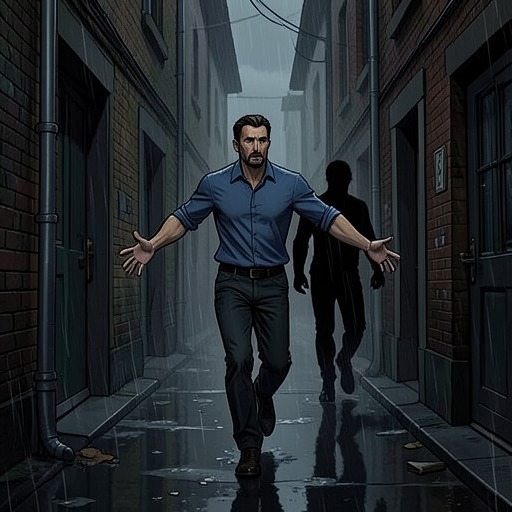
The giant first answers Lionel’s resistance with threats and orders him into the narrow, dark channel between the Zendo and the neighboring apartment building. When Lionel says he has Tourette’s, the giant claims not to hear well, puts the fruit away, and brings out a gun. He points toward the steps with his chin and shoves Lionel toward them with his free hand. Lionel tries to shove back but cannot even reach the giant’s shoulder. His mind turns the disparity into a chain of absurd associations, while his spoken language breaks into further fragments. He ultimately steps down because the gun and the giant’s repeated command leave him no workable advantage.
The Blow and Its Consequence
As soon as Lionel enters the darkness, the giant swings the gun at his head. The assault ends not with a neat exchange or a victory for the investigator but with a blank interval: Lionel describes falling into obscurity and awakening to a grainy nothingness, accompanied by resentment at the absence of memory and the fear that he does not want to die. The scene’s abrupt loss of consciousness interrupts his attempt to make sense of the attack even as the reader has seen the decisive signal that preceded it.
The event therefore advances the investigation and raises its immediate stakes at once. Lionel has identified Gerard as Roshi and as the voice on the wire; he has also witnessed Gerard’s silent coordination with the giant. But recognition has not given him the means to confront them. The paddle falls, the fruit is put away, and the gun replaces talk: objects and gestures mark how completely the encounter shifts from discovery to physical danger. Lionel’s subsequent blankness leaves the assault unresolved at the level of his own experience, while establishing that the danger surrounding Frank’s death has reached him inside the Zendo.