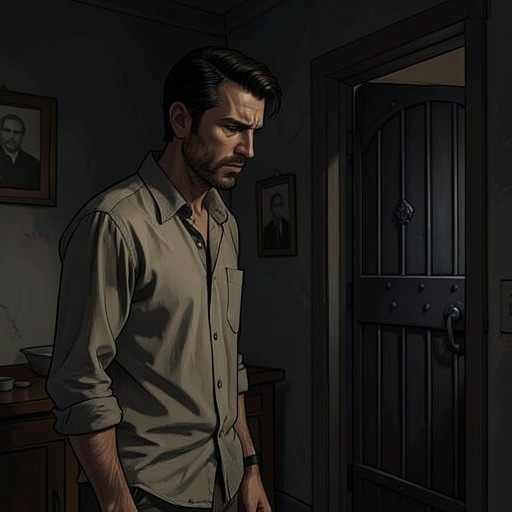
Lionel Reveals Gerard’s Location to The Clients
Motherless BrooklynLionel Reveals Gerard’s Location to The Clients is a terse negotiation in which Lionel Essrog tells The Clients that Tony Vermonte is dead, identifies Gerard Minna as responsible for Frank Minna’s death, and gives away Gerard’s hiding place. The decisive turn is not merely the disclosure: Lionel presents it as a final exchange that frees L&L from its ties to The Clients, then ends the scene unsure whether he can or will pursue vengeance.
The Call and Its Terms
Lionel calls a New Jersey number and reports Tony’s death. When Matricardi begins to respond with sympathy, Lionel cuts him off. The interruption marks an abrupt change in his manner: he describes himself as beyond ordinary sorrow, anger, loneliness, or even moodiness, and as raging with purpose. His focus is not on receiving consolation but on making the terms of the conversation unmistakable.
He tells Matricardi that Frank and Tony are gone, then says he has something The Clients want and that the exchange will end their relationship. Lionel does not present himself as acting alone on behalf of a private grievance. Asked who is speaking, he answers for L&L. That collective answer gives the offer an institutional edge: even with Frank and Tony dead, Lionel insists that L&L remains a party capable of setting its own terms.
Matricardi questions what it can mean to speak of L&L after Frank’s and Tony’s deaths. Lionel refuses to explain. His response keeps the agency’s meaning and authority on his side of the conversation, rather than allowing The Clients to define what remains of it. When Matricardi asks what Lionel has to offer, Lionel gives him the information directly.
What Lionel Discloses
Lionel identifies Gerard’s location as a zendo on East Eighty-fourth Street, where Gerard is living under another name. He also tells Matricardi that Gerard is responsible for Frank’s death. The disclosure joins a precise lead with an accusation: The Clients are not left to infer why Gerard matters or why his location is valuable to them.
Matricardi asks what a zendo is, and Lionel describes it as a Japanese church. The brief clarification makes the hiding place legible to his listener without changing the central point of the exchange. Lionel has supplied both an address and the setting in which Gerard has concealed himself, while the mention of an assumed name emphasizes that Gerard is not living there openly under his own identity.
The information is delivered as the price of separation, not as an invitation to resume a continuing arrangement. Lionel’s formulation makes the exchange finite: he gives The Clients something they want, and in return says that L&L will no longer be bound to them. The scene does not show what The Clients do with Gerard’s location; its immediate consequence is that they accept the information as relevant and agree to respect Lionel’s wishes.
Silence, Authority, and Aftermath
The pauses after the disclosure matter. Matricardi says that Lionel’s action is not what they expected, but acknowledges that it interests them. Lionel does not answer. When Matricardi then promises to respect his wishes, Lionel remains silent again. The call therefore ends without a fuller explanation, emotional reconciliation, or stated plan for what comes next. The limited exchange leaves Lionel’s conditions clear while withholding any assurance that the danger surrounding Gerard has been resolved.
That silence also distinguishes Lionel’s position from Matricardi’s. Matricardi voices surprise and then makes a promise; Lionel does not elaborate on his motives or ask for reassurance. His offer is concrete, but his restraint keeps the moral meaning of it unsettled. The Clients accept the bargain, yet nothing in the conversation establishes that they have become allies or that Lionel trusts them beyond the terms he has just imposed.
Guilt and Vengeance
The scene closes by separating guilt from vengeance. Lionel recognizes guilt as something familiar to him, but calls vengeance another matter and admits that he will have to think about it. That ending prevents the call from reading as a simple declaration of revenge. He has exposed Gerard and given The Clients a route to him, but he has not said that he intends to kill Gerard, join The Clients in pursuing him, or personally carry out any punishment.
The distinction gives the exchange its moral tension. Lionel acts with what he describes as purposeful rage, and his disclosure can expose Gerard to consequences; at the same time, he insists on ending L&L’s obligation to The Clients rather than renewing it. His decision is therefore neither an uncomplicated surrender of information nor a settled vengeance plot. The call closes one bond by negotiation, while leaving Lionel to decide what, if anything, he owes to the dead and what vengeance would require of him.