Lionel Wrecks the Giant’s Car
Motherless BrooklynLionel Wrecks the Giant’s Car is a turning point in Lionel Essrog’s pursuit through Maine: when the Giant Killer chases him to a ferry landing with a gun, Lionel turns the layout of the parking lot into a means of escape. He does not retrieve the gun waiting in Tony Vermonte’s Pontiac or try to fight the pursuer directly. Instead, he uses his car, the lot’s exit spikes, and a series of calculated collisions to disable the Giant Killer’s Contour, then drives away in the Pontiac. The episode converts Lionel’s precarious position into a temporary escape, but leaves the pursuer’s ultimate condition unresolved.
Setting and Immediate Context
The confrontation follows Lionel’s arrival at Yoshii’s, where he parks above the water and looks for signs of Tony Vermonte and the Giant Killer. After going down toward the shore, Lionel experiences the Maine coast as a rupture in the verbal and urban surroundings on which he relies. The open water seems to strip away the familiar language of Brooklyn, leaving him struggling to assert a sense of self. That disorientation matters to what follows: the danger is not only a pursuer behind him but a landscape that offers none of the reassuring walls and streets of home.
Lionel’s earlier life gives this contrast particular force. He grew up at St. Vincent’s Home for Boys in an overlooked stretch of Brooklyn, amid courts, roads, institutions, and the humming postal annex. Later, Frank Minna’s Court Street offered another kind of structure: a neighborhood organized through unwritten rules and tacit understandings. Even the Casino, Minna’s name for a cramped newsstand, is bound up for Lionel with the memory of Minna alive. Maine’s exposed coast is different. It provides no familiar social code to interpret and no city grid to lean on; the immediate problem must be solved through the physical arrangement of the ferry lot.
The Pursuit to the Ferry Lot
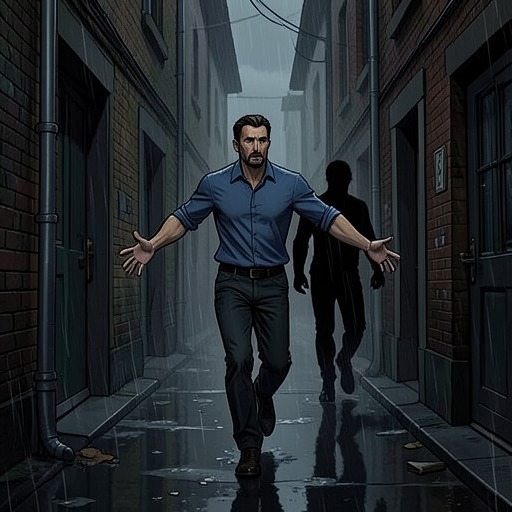
After seeing the Giant Killer, Lionel runs across the ferry landing and fishing dock toward the hilltop restaurant and his car. The pursuer catches up in a Contour just as Lionel gets into his Tracer. Lionel reverses out of the Contour’s path, then drives onto Route 1 with the Giant Killer close behind and holding a gun. The threat makes Lionel recall that Frank Minna and Tony Vermonte were both murdered; he understands that his own encounter could become similarly fatal, though noisier.
Lionel turns back toward the ferry dock, where Tony Vermonte’s Pontiac remains parked. A gun is under its driver’s seat, and Lionel’s thoughts fix on reaching it. He has never fired a gun, however, and the pursuit gives him no straightforward opportunity to leave his car and retrieve one. When he breaks through the lot entrance, the Contour is still pressing against the Tracer. Lionel circles past the Pontiac and toward the rock barrier, then avoids driving himself into the water. Each movement keeps him trying to create space without letting the pursuer break away.
The lot’s exit is marked by signs warning drivers not to back up over its one-way spikes, which are intended to prevent vehicles from leaving without paying. Lionel has already found a way around that restriction. As the cars move around the perimeter, the Giant Killer’s Contour rams the Tracer and pushes it away from the Pontiac. Lionel then turns toward the exit, making the obstacle that ordinarily governs traffic into the focal point of his plan.
The Collision and Reversal
Lionel brakes hard after crossing the flexible spikes. The Giant Killer’s Contour strikes the back of the Tracer, carrying it farther forward, but the pursuing car is stopped on the far side of the grate. Its air bag deploys. A gunshot follows from inside the Contour; the windshield breaks, but the shot does not hit Lionel. The sequence leaves him alive and still able to act, while the Giant Killer is temporarily obscured behind the air bag.
Lionel shifts into reverse and drives the Contour back toward the spikes. Its rear tires are punctured, leaving the car immobilized. He then changes gears, moves forward, and crashes into the driver’s side, deforming the door and bodywork. Although the Giant Killer appears still beneath the air bag, Lionel does not stop there. He feels compelled to make the damage symmetrical and backs into the passenger side as well. The repeated impacts transform escape into a deliberate wrecking of the car: the force used to stop the pursuit becomes an act of compulsive completion.
Escape and Significance
With the Contour damaged on both sides and its rear tires punctured, Lionel transfers the map and cell phone to Tony Vermonte’s Pontiac. He drives out through the entrance gate he had broken and continues onto Route 1. No one appears to have heard the collisions or gunshot; even the attendant remains inside his shack. The account does not establish what happens to the Giant Killer after Lionel leaves, so the escape should not be mistaken for confirmation that the pursuer is dead or permanently incapacitated.
Lionel’s drive in the Pontiac carries him toward Friendship Head Lighthouse, where he is due to meet Julia Minna. He is shaken and tired, and the earlier assault still affects him, but he remains mobile and reaches the next stage of his pursuit. The car wreck therefore marks a change in immediate power rather than a resolution of the larger danger: Lionel escapes the lot, but the story does not close the confrontation by settling the Giant Killer’s fate.
The episode also brings together two recurring aspects of Lionel’s experience. His Tourette syndrome shapes the compulsive demand for symmetry that makes him return to damage the Contour’s second side; at the same time, the unfamiliar Maine landscape has forced him to act without the verbal and urban structures he usually depends on. Faced with a weapon and a larger pursuer, he finds an improvised answer in the lot’s practical design. The spikes, gate, and cars become instruments of escape, while the attempted symmetry shows that survival does not free him from the patterns governing his actions.