Minna Men
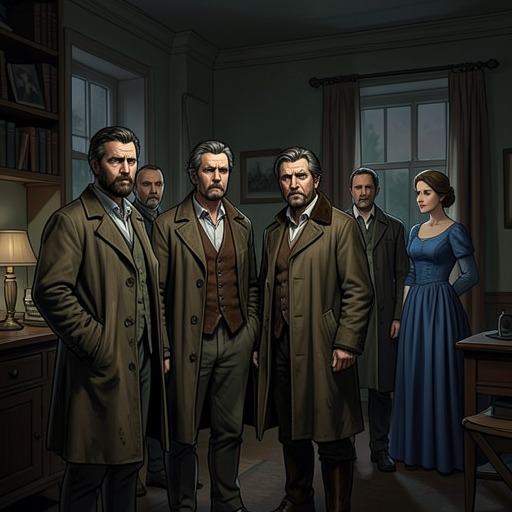
Motherless BrooklynThe Minna Men are the four boys Frank Minna recruited from St. Vincent’s Home for Boys and trained to work at the shifting boundary between moving jobs, private errands, surveillance, and detective work. Their formation gives the group both its bond and its fragility: Minna teaches them how to operate, assigns each a place in the crew, and even helps Lionel Essrog find a public use for his unruly speech. When Minna dies, the boys discover that their collective identity has been organized around him; rebuilding L&L requires them to take on the work without the man who made them a team.
Recruitment and Formation
The crew begins with a selection made on a sweltering August afternoon. Minna asks for white boys to suit what he assumes are his clients’ prejudices, as well as his own. Four of the five white boys at St. Vincent’s are chosen: Tony Vermonte, Gilbert Coney, Danny Fantl, and Lionel Essrog. The narrator allows that Minna may have imagined reclaiming or cultivating them, but cannot know whether that idea was already present. What the boys encounter first is not an explanation or a promise. Minna opens the rear of his dented, graffitied van, tells them to climb in, then shuts and padlocks the doors without asking their names.
The boys respond to this abrupt removal from institutional routine with excitement, even though they do not know where they are going or what the job means. Lionel’s repeated chirping sounds fill the dark ride; Tony tells him to stop, but does not press the rebuke with his usual force. For Tony, Minna’s arrival seems to answer a long-standing hope that someone would come for him. The four boys are not equally ready to imagine that future: Tony believes in rescue, while Lionel and Gilbert are still trying to understand their sudden place in the outside world.
Their first job ends in silence. Minna tosses a beer can into the van and sends them off, and the narrator marks the moment as the end of that first assignment. Minna gathers them again the following week for nearly the same task, moving between 242 and 260 boxes. The work remains physically demanding and tense, but repetition begins to make a team of them. Their shared labor supplies a kind of practical knowledge and cooperation that none of them had entered the job possessing.
Hierarchy and Individual Roles
The Minna Men are a group, but Minna does not treat the boys as interchangeable. He sometimes arrives in his Impala rather than the van, asks for one boy by name, and takes him away alone. Tony is the recognizable leader and Minna’s right hand, although his ambition and pride sometimes cost him Minna’s favor. He treats private errands as marks of distinction but refuses to tell the others what they involved. His age and experience help establish his authority: at fifteen, he is older than thirteen-year-old Lionel and Gilbert and fourteen-year-old Danny, and he has already spent time outside the Home before returning.
Danny becomes Minna’s trusted courier. Tall, athletic, and silent, he is sent on private deliveries and meetings; Minna even gives him early driving lessons in an empty Red Hook lot. Gilbert is assigned the heavy, practical labor: waiting in double-parked cars, repairing split cartons with strapping tape, taking the legs off an oversized dresser so it will fit through a doorway, and repainting the van after neighbors object to its graffiti. Lionel is brought into back rooms, offices, and barbershop negotiations as an extra set of eyes, ears, and opinions. Minna asks him to assess the people they meet, then listens to his judgments.
That role gives Lionel a distinct place in the crew. Minna mistakes his echolalia and Tourette-related speech for impressions, but encourages him to speak and enjoys the way his outbursts interrupt the smooth talk of clients and associates. He explains Lionel away to startled listeners, then privately acknowledges their shared understanding. Under Minna’s protection, speech becomes more than an involuntary disruption for Lionel: it is a way to participate in the crew’s observations and, briefly, to quiet the pressure within himself. The group’s roles are thus not only job assignments; they are also the different capacities through which Minna makes the boys useful to one another and to him.
Work, Conduct, and the Clients
The Minna Men’s outward code is terse and disciplined. They wear suits, drive cars, listen to tapped lines, stand behind Minna, carry and collect money, answer phones, pick up packages, and follow instructions. They do not ask questions. The list presents them as a recognizable unit, assembled around work and imitation: they try to be like Minna, though the rule’s final fact is that Minna is dead. Its clipped repetition sounds less like a description of independent men than a set of habits inherited from their leader.
After L&L becomes the Minna Agency, the crew’s work extends beyond ordinary investigations. The Clients remain an unseen pressure within the agency, and Minna’s behavior changes when their assignments appear to be involved. He alters his routines, closes the storefront, tells the boys to disappear for a few days, and becomes watchful and uneasy. The assignments themselves are often incomplete fragments rather than cases with clear beginnings and endings. Under Minna, the boys can investigate ordinary domestic and workplace disputes and produce reports that give them a sense of mastery; when The Clients direct their movements, they may be tools in a larger story whose purpose they cannot see.
One early assignment makes that uncertainty physical. The crew is stationed around an apparently empty Volvo on Remsen Street, with instructions to let a tow truck take it at five. Five becomes six and then seven. The car seems ordinary, yet the boys treat it as though it were conspicuous and dangerous; every passerby becomes a possible threat. When the tow truck finally arrives, its workers laugh at their nervousness, offer no explanation, and chain the Volvo to the rig. The episode leaves the boys feeling that they have failed a test, although they do not know what was being tested. With time they become less jumpy, but Minna continues to keep them in the dark, turning uncertainty into part of their professional routine.
Minna’s Death and the Crew’s Reorganization
Minna’s death exposes how completely the group has relied on him as its center. When Tony says the others have already heard the news, Lionel and Gilbert return to L&L in a numb fog. The narrator imagines the boys’ heads, put together without Minna, as empty balloons: his death has removed the force that tethered them, and no one can tell how quickly they might drift apart. Tony tries to turn grief into a plan. Because Gilbert is the name the police have, Tony sends him out to investigate Ullman, while the group attempts to direct its attention toward the Yorkville Zendo.
The loss also disrupts the boys’ ability to read one another. Danny’s silent presence no longer carries the meaning it had when Minna connected his reticence to Lionel’s talk. Without that intermediary, the two men must begin again to understand each other as separate people, rather than as opposite expressions of Minna’s character. The gap is not simply organizational: Minna had supplied a shared language and a common frame for their differences.
Gerard Minna later names the group and recognizes what his brother had meant to them. He observes that Frank taught the four of them almost everything and that Lionel sounds like him. Lionel, in turn, feels care for Tony, whom he understands as a member of his family in L&L and among the Men. That loyalty survives even when Tony’s actions place him in danger from the giant, Detective Seminole, and The Clients. The group’s bond is real, but it does not make its members alike: Lionel wants to be an honest detective, while Tony has been drawn toward the corrupt and violent power he associates with Frank’s world.
By the time Gilbert returns after five nights in custody, having been released for lack of evidence in Ullman’s killing, the agency has begun to find a new arrangement. Danny sits apart, says little, and appears increasingly to occupy the leadership Frank once held. His authority comes through conduct and appearance rather than speeches: he dresses sharply, waits, and lets the others accept the role that has fallen to him. L&L is now a detective agency operating cleanly for the first time, although it has no clients, and also a genuine car service that takes calls when cars are available. Minna’s Lincoln, once stained by his death, has been cleaned and put to work in a small fleet; Danny is arranging flyers and new business cards. The Men preserve the organization Minna built, but its changed business and quiet new leader show that carrying it forward is not the same as restoring its founder.