The Clients
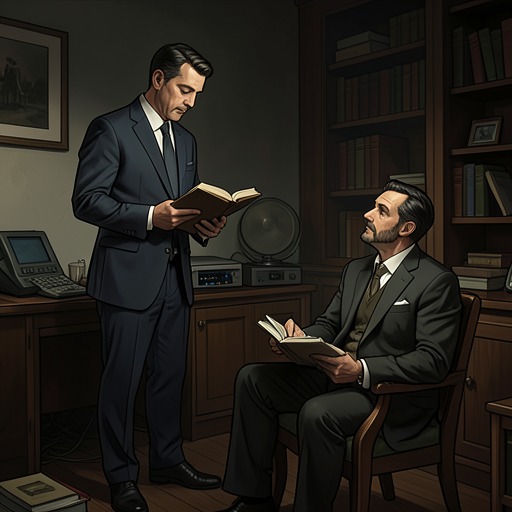
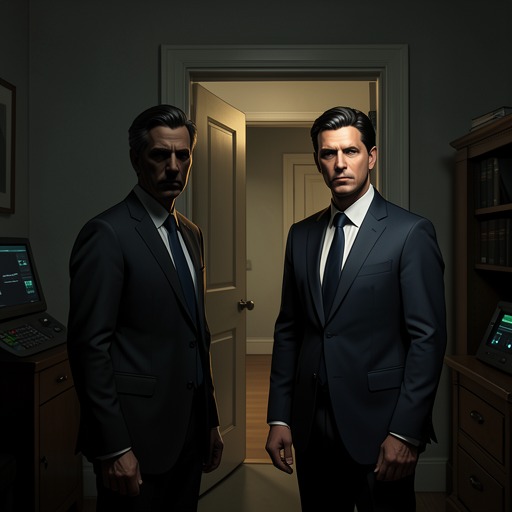
Motherless BrooklynThe Clients are the hidden force behind some of the Minna Agency’s most unsettling work: powerful patrons whose names are treated as dangerous, whose assignments arrive without explanation, and whose influence persists even when they are not present. Identified as Alphonso Matricardi and Leonardo Rockaforte, they occupy a space between clients and criminal principals. Their relationship with Frank Minna gives his agency access to work and power, but leaves his employees uncertain about what they are doing, whom they serve, and what the consequences may be.
Identity and Secrecy
The Clients’ names are governed by an unusually strict taboo. When Lucius Seminole asks Lionel Essrog whether Alphonso Matricardi and Leonardo Rockaforte mean anything to him, Lionel recognizes not merely the men but the rule against saying their names aloud. The first names feel newly exposed and wrong to him; even in his thoughts, the warning is to avoid the names. If identification is unavoidable, the men can be called The Clients or referred to by the cover name Garden State Brickface and Stucco. This enforced anonymity makes the title more than office shorthand: it marks a boundary between ordinary investigation and a powerful world the Minna Men are not meant to name.
The secrecy also shapes what can be known about the men. They are present in the life of the agency as a recurring pressure rather than as fully explained clients. Frank Minna never discusses them openly, and his employees often cannot tell whether a given errand serves their interests. The Clients’ reach is therefore registered less through direct instructions than through Minna’s behavior, the uncertainty surrounding assignments, and the changes he makes to protect himself and his operation.
Work Through the Minna Agency
The agency’s early history begins in a different register: Minna recruits four boys from St. Vincent’s Home for Boys as a junior moving crew, paying each twenty dollars and handing out L&L Movers business cards. As the work develops, the boys learn to carry out assignments for customers whose purposes are not always transparent. They move goods, guard property, collect information, and watch how Minna uses favors, names, and local relationships. Later, when L&L is no longer a moving company and operates as a detective agency, The Clients’ presence becomes discernible in a portion of its errands.
Work associated with The Clients differs from the more legible investigations the Minna Men conduct. When they follow a spouse or watch an employee suspected of theft or falsifying accounts, the investigators can assemble a coherent story from the evidence they collect. Assignments connected to The Clients, by contrast, feel like fragments without a clear beginning or conclusion. The men may be dispatched to seize equipment, collect money, open an envelope, or tap a telephone; neither the purpose nor the destination of what they gather is necessarily disclosed. Minna keeps them uninformed, and in doing so makes them more professional while also making their work harder to interpret.
The Clients’ presence changes the way Minna conducts himself. When their interests seem involved, he may stop visiting the barbershop or arcade, close the L&L storefront, and send the staff away for several days. He insists on sitting in restaurant corners with his back to the wall and turns to look behind him while walking. His humor, ordinarily a steady stream of commentary, becomes broken and gives way to grim silences. These changes suggest the practical cost of serving patrons whose business Minna himself regards with unease. They also help explain why the agency’s routine work and its more dangerous commissions can be difficult for the employees to distinguish.
Tests, Loyalty, and Frank Minna
One early assignment associated with The Clients requires four men to watch an apparently empty Volvo on Remsen Street and yield it to a tow truck at five o’clock. The truck does not arrive at five, or six, or seven. As the wait stretches on, the men grow increasingly nervous: passersby seem like possible threats, while the parked car takes on an importance they cannot explain. When the tow truck finally arrives, its crew laughs at their vigilance, offers no account of the Volvo, and simply begins removing it. The Minna Men feel that they have failed a test, although they do not know what the test was or whether Minna and The Clients even learn of their failure.
They eventually grow more accustomed to this uncertainty. The Clients become a largely subliminal presence in the agency’s work, and the men learn to continue without knowing whether a particular task is theirs. In this sense Minna’s secrecy is both instruction and control: his employees acquire practical discipline, but they do not acquire a clear account of the larger enterprise in which they are working.
After Frank Minna’s murder, The Clients approach Lionel Essrog through the bond they say Frank created. Leonardo Rockaforte tells Lionel that Frank loved him and presents that affection as the reason the men care about and are concerned for him. They express grief for Frank and wish for the killer to suffer, while urging Lionel to stand behind Tony Vermonte as Tony pursues the case. Their loyalty to Frank is real in the terms they give, but it is also joined to a calculation about who should act in his place: they say Tony has replaced Frank in the world of the living.
That support does not amount to straightforward trust in Tony Vermonte. The Clients tell Lionel that Tony has been unclear about Julia Minna and ask him to investigate the matter, return with what he learns, and share it with them. Lionel is thus assigned to examine the very people involved in the murder investigation he wants to solve. The request places him between The Clients’ claims of care and their demand that he become their eyes and ears. Their interest in his findings makes his independence uncertain even as they describe him as a trusted extension of their operation.
The Brothers’ Past and the Final Disclosure
When Lionel names The Clients to Gerard Minna, Gerard responds with sorrow and describes them as examples of Frank’s dangerous associations and his willingness to exploit those associations. The later account of the brothers’ departure from Brooklyn supplies the criminal context: the brothers had acted as intermediaries between two aging Brooklyn mobsters and suburban truck hijackers, helping to move stolen goods. The brothers increased their own share by arranging to warehouse some of the cargo and find a buyer. When the mobsters discovered the betrayal, they decided the brothers should be killed. This account makes clear the kind of dangerous network surrounding Frank and Gerard, though it does not independently spell out every connection between that earlier arrangement and the agency’s later assignments for The Clients.
After Tony Vermonte dies, Lionel calls The Clients in New Jersey and tells them that Frank and Tony are both gone. He offers information they want, but makes clear that the disclosure is a transaction on his terms. He identifies Gerard Minna’s location on East Eighty-fourth Street, where Gerard is living at a Zendo under another name, and accuses him of responsibility for Frank’s death. The Clients say they had not expected this from Lionel, then acknowledge that the information interests them. Their response leaves the exchange unresolved: Lionel has delivered the secret, but the scene does not establish what they will do with it.
Narrative Significance
The Clients make the agency’s central contradiction concrete. L&L presents itself as a detective operation, and its ordinary investigations can produce complete accounts of people’s small, local dramas. Under The Clients’ influence, however, its employees become instruments in stories they cannot see whole. Secrecy gives the men power over the agency while denying its workers a reliable understanding of their own assignments.
Their relationship with Frank also complicates the meaning of loyalty. The Clients remember him with genuine affection and extend that attachment to Lionel, yet they direct Lionel to support Tony while separately using him to investigate Tony’s obscurities. Later, Lionel’s disclosure about Gerard converts him from a recipient of their instructions into a bargaining participant. The Clients remain influential, but they do not control what the information means to him or what he chooses to reveal. Their continuing presence gives the agency’s history a shadowed continuity: the names are rarely spoken, the work is often unexplained, and the consequences outlast the people who first carried it out.