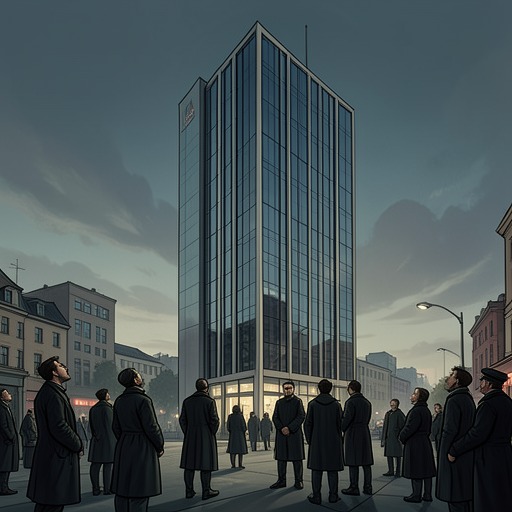
The Doormen Intimidate Lionel into Staying Away from the Zendo
Motherless BrooklynThe Doormen Intimidate Lionel into Staying Away from the Zendo turns an attempted abduction into a contest of nerve and observation. Four men try to make Lionel Essrog abandon his investigation of the Yorkville Zendo, but their own fear gives him leverage. When they flee, an abandoned phone and the rental car’s paperwork turn the failed scare into a lead toward the Fujisaki Corporation.
Background and Stakes
The confrontation follows Lionel’s visit to the Yorkville Zendo, where his investigation has stalled amid his distraction by Kimmery and the unsettling sense that he has learned little. After she shuts the door, he is alone on the street. Two men seize him by the elbows and push him into a waiting car. The abrupt shift—from an inconclusive visit to physical coercion—makes clear that someone wants his inquiry stopped, even though the men initially reveal little about who they are or what they know.
The four men share a conspicuous uniform: blue suits with black piping, black sunglasses, and a look Lionel likens to a wedding band. They are packed into a rental car, where one, nicknamed Chunky in Lionel’s account, puts an arm around his neck in a brotherly-looking choke hold. The gesture combines forced familiarity with restraint. Lionel is not simply being questioned; he is being handled and transported by men who expect their numbers and physical control to do the persuading.
The episode carries particular weight because Lionel has already learned to watch people and gather information through his work with Frank Minna. L&L began as a moving company, where Minna taught its young staff to treat apparently ordinary jobs as opportunities to observe clients and their surroundings. Later, as a detective agency, the work made that habit more explicit: its reports could capture the private dramas of Cobble Hill and Carroll Gardens, while assignments tied to The Clients left the Minna Men feeling like tools in stories larger than they understood. In the car, Lionel applies that training under pressure, reading not only what his captors say but what they are afraid to say.
The Attempted Scare
The men’s intimidation is muddled from the beginning. Chunky orders the driver, called Pinched by Lionel, to take the FDR Drive, while the others question the route and Pinched complains that he cannot get over. Their quarrel over the road sits awkwardly beside the threat they are meant to deliver. Chunky eventually spells out the purpose: “We’re supposed to throw a scare into you,” he says, and tells Lionel to stay away from the Zendo. The assignment is coercion by performance: the men have to make danger convincing, but their bickering repeatedly exposes their lack of composure.
Their physical control is real. Chunky keeps an arm draped over Lionel’s shoulders; later, when Lionel tries to speak by phone, another man takes the cell phone while Chunky twists Lionel’s arm behind his back. The other men, meanwhile, argue about parking. Lionel’s position is uncomfortable and constrained, but the captors’ attention keeps splintering between him, the traffic, the phone, and one another. Their effort to control the scene is never as coordinated as their matching suits suggest.
Lionel tests the limits of their composure by bringing up Ullman. When he says, “You don’t like hearing the name Ullman,” Chunky answers, “Ullman was a friend,” and Pinched cuts in with, “Don’t let him talk about Ullman.” The exchange gives Lionel a specific point of pressure: Ullman is not just a name the men would rather avoid but a subject that divides their reactions. They warn Lionel not to guess and not to open his mouth, yet their insistence makes their unease visible.
Fear Reverses the Encounter
Lionel presses further, saying the men seem more afraid than he is. He identifies their fear as fear of a big Polish man. One of them calls the situation stupid and gets out of the car; Chunky then admits, “What if we are scared of him? We ought to be, take it from us. We wouldn’t be working for him if we weren’t.” The admission does not identify the man or explain the full arrangement, but it changes the balance of the scene. The men who have taken Lionel captive reveal that they, too, are working under pressure.
At a coffee shop on Second Avenue, Chunky loosens his grip enough for Lionel to straighten up. Through the window are young people flirting over small computers and magazines, absorbed in an ordinary scene that does not notice the men or their captive. Lionel acknowledges that he is afraid of the powerful man too, then points out the practical weakness in the intimidation: a frightened person is not good at frightening someone else. The exchange lets him recognize the threat without accepting the role his captors have assigned him.
The men’s attention becomes still easier to unsettle. Lionel makes them turn their heads in alarm; Chunky releases his arm, and Lionel imitates their movements rather than searching for whatever has supposedly drawn their attention. The moment is a small reversal, not a physical victory over four men so much as a chance to exploit their nervousness. One mutters that he has had enough. He and Chunky scramble out, following Pinched and leaving Lionel alone in the car. The attempt to scare him ends with the men abandoning both their captive and the scene.
The Lead Left Behind
The escape leaves Lionel with evidence the men have failed to protect. Pinched has taken the car keys, but a cell phone remains on the seat; Lionel pockets it. He opens the glove compartment and finds the rental agency’s registration card and receipt. The paperwork shows that the car is on a six-month lease to the Fujisaki Corporation at 1030 Park Avenue. Lionel recognizes that the address’s ZIP code appears to place it in the same area as the Zendo. Rather than treating the men’s departure as the end of the encounter, he follows the address and walks to 1030 Park Avenue.
That discovery gives the confrontation a concrete investigative consequence. The men never provide a coherent account of their employer, and their admission about working for a frightening man remains incomplete. The lease does not establish every link in the chain, but it connects the rental car used to seize Lionel with a named corporation and a specific address. The abandoned phone and paperwork are the material remainder of a threat that was supposed to leave him with nothing but fear.
Later information about the Zendo gives the episode a broader institutional context. Gerard explains that students performed maintenance and service work at the building as part of their training, while the contract for those services was worth millions; he says his brother and Ullman took most of the difference for themselves, and adds that the doormen were involved too. He further says Fujisaki sent the powerful man after Frank Minna and the bookkeeper. These later disclosures clarify why the Zendo, Ullman, the doormen, and Fujisaki belong to the same investigation, without making the men in the car’s limited confession more explicit than it is.
The scene thus moves Lionel’s inquiry forward through a reversal of attention. His captors intend to make him feel watched and powerless; instead, their fear, their argument over Ullman, and their abandoned belongings become things he can read. The intimidation fails to keep him away from the Yorkville Zendo. It supplies the lead that takes him toward 1030 Park Avenue and deeper into the forces surrounding the investigation.