Yorkville Zendo
Motherless BrooklynYorkville Zendo, at 109 East Eighty-fourth Street on Manhattan’s Upper East Side, is at once a religious center, Gerard Minna’s hideout, and the setting where the investigation into Frank Minna’s death repeatedly meets the history of the Minna brothers. Its quiet rituals and sparse rooms conceal a less contemplative purpose: Gerard has built a following that can be redirected into a network of guards and enforcers. After he disappears, the institution outlasts his control, under a more modest form of leadership.
Setting and First Encounters
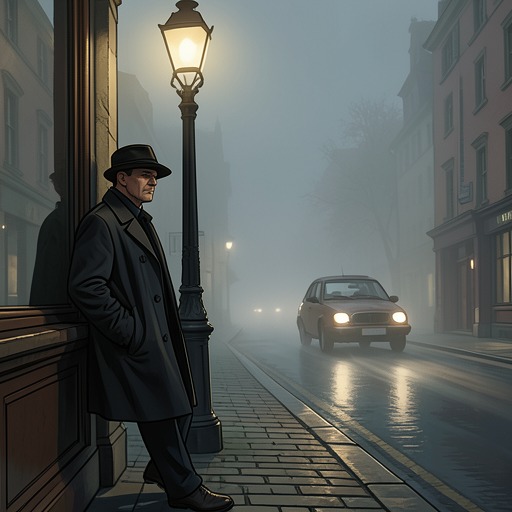
The Zendo occupies a lone townhouse wedged between much larger doorman apartment buildings. Its bronze door plaque gives the address a formal religious identity, but the surrounding street remains emphatically urban: at dinner hour in November, bicycle couriers carrying hot Chinese food flit through the neighboring foyers, and doormen watch the street. The contrast between the small, self-contained townhouse and the imposing apartment blocks around it makes the place appear both exposed and curiously difficult to read.
Lionel Essrog and Gilbert Coney first approach the address as part of a stakeout. They have driven back from Spanish Harlem with White Castle burgers and fries and double-parked while waiting for a space to open. Frank Minna plans to enter while Gilbert holds the door and waits just inside at the bottom of the stairs. The operation makes the Zendo a monitored threshold from the start: Lionel listens through Frank’s wire, hears Frank’s shoe scrape the pavement, and watches a neighboring doorman observe the group. The building is not merely a destination; access to it, and the possibility of being seen outside it, are part of the scene’s tension.
Frank’s visit establishes a connection between the Zendo and Ullman. A voice on the wire recognizes Frank, and Frank asks whether Ullman is there; he is told that Ullman is downtown and that Frank will go to him. Later, Lionel understands the instruction as a direction given by the man inside the Zendo, not simply a location Frank chose for himself. The address thus becomes an early link in the trail leading away from the apparent encounter and toward the larger mystery.
Surveillance, Memory, and Return
The Zendo’s plaque stays in Lionel’s attention after Frank’s death. When he returns to question people connected with the place, its bronze sign becomes a physical prompt for his investigation. He gestures toward it while asking what is known about the Zendo, and his involuntary verbal play with its name accompanies his attempt to turn an unsettling site into something legible. The building’s ordinary front door carries the burden of an unresolved history: it is the entrance through which Frank went, and the point to which Lionel’s search keeps circling back.
At one visit, Lionel paces the block before ringing the bell. He experiences the approach almost as movement toward a shrine, imagining that the plaque ought to tell the story of Frank’s martyrdom. He rings once, then four more times, and stops with a feeling of completeness. That small repeated action shows how the location has entered his compulsive pattern of thought. The Zendo is not yet a place where he feels at home; it has become a charged landmark, part crime scene and part object of fearful reverence.
His eventual entry depends on a different kind of access. Using one of the stolen keys, Lionel passes through the sitting room and climbs to the private quarters at the top of the building. The higher he goes, the darker the halls become, until he can see only the thin line of light beneath a sealed door. The spatial movement—from public entrance, through communal rooms, toward an isolated upper floor—leads directly to the secret at the heart of Gerard’s presence there.
Religious Practice and Gerard’s Institution
The Zendo is not presented as a mere disguise. Kimmery explains that its practice is religious discipline rather than the stress-reduction or self-centering Americans may expect, and she identifies zazen as a practice a visitor should understand. She also describes students doing service in the kitchen and cleaning up. These ordinary forms of work help establish an operating community, even as the story later reveals how Gerard’s authority has shaped its members’ availability for other purposes.
Inside the second-floor sitting room, the setting is spare and deliberately ordered. A pot of smoldering incense rests on a high shelf beside a jade Buddha; undecorated paper screens line the walls, and thin cushions lie on the glossy parquet floor. Lionel counts twenty-two practitioners, some in black robes and others in street clothes. He tries to copy Kimmery’s posture, folding his legs and straightening his back, while his awkward effort draws a quick glare from the sitter he jostles. The room’s discipline is visible in bodies arranged in rows, but Lionel enters it as an observer who must negotiate his own body and attention within that order.
The arrival of the teacher alters the room’s meaning. Six robed people move to the front, followed by a seventh, a large American with a polished bald head and conspicuous dark body hair. From Kimmery’s description, Lionel recognizes him as the founder and Roshi. The figure does not match the conventional image suggested by the robes, and his presence makes the authority at the center of the Zendo unmistakably personal. The religious title belongs to Gerard Minna, who has remade himself there as a Zen teacher.
Gerard Minna’s Hideout and Network
The Zendo’s public practice and Gerard’s private refuge converge on the upper floor. His bedroom is almost empty: a low board supported by bricks holds candles, books, a glass of water, and a small bowl of ashes marked with Japanese script. Gerard sits on pillows on a flat mattress, legs crossed, with a closed book at his knees. The room’s austere arrangement gives material form to his self-reinvention, while Lionel resents its resemblance to Kimmery’s sparse apartment and the possibility that she might have visited Gerard’s private quarters. The apparent serenity of the space is inseparable from the suspicion surrounding its owner.
Gerard describes his role in the institution as supplying labor in exchange for consideration equal to his mortgage on the Zendo. He presents the arrangement as a means through which Buddhism spreads, but the building’s later history shows the double edge of that claim. The Zendo is subsidized by the Fujisaki Corporation, a powerful group of Japanese businessmen Gerard met in Maine. They had taken over and renovated a modest Zen center and the lobster pound beside it. In New York, religious teaching, financial support, and Gerard’s personal protection occupy the same institutional structure.
The students’ devotion also supplies Gerard with manpower. Many of the Zendo’s doormen began as authentic students, seekers susceptible to his charismatic teaching. They were first exploited in the Park Avenue building and later used as drivers and strong-arms when Gerard needed people alongside the Polish giant. Their progression from followers to an inept armed network distinguishes Gerard’s organization from Frank Minna’s Minna Men, whose loyalty is grounded in a different history. The Zendo’s spiritual hierarchy therefore has practical consequences outside its walls: it gathers people, gives them a leader, and makes them available for coercive work.
After Gerard’s Disappearance
Within days of Gerard’s disappearance, most students have trickled away. A real Zendo on the Upper East Side, twenty blocks south, draws defectors seeking what they regard as a truer practice. The departures expose how much the Yorkville community depended on Gerard’s charisma, rather than on an institution strong enough to hold its members independently of him. Yet the building does not close. Wallace, a quiet sitter, takes stewardship of the remaining community and declines the title of Roshi, asking instead to be called sensei, a lesser term for an apprentice-instructor.
That succession gives Yorkville Zendo an ending distinct from Gerard’s disappearance. The institution survives, but its authority is reduced and its leadership more restrained. Wallace’s stewardship also parallels the quiet redirection of Frank’s organization by its own quieter disciples: both Minna organizations are guided past corruption by people who do not claim the prominence of their former leaders. The Zendo remains standing, while the Fujisaki Corporation and The Clients withdraw largely unharmed. Its modest continuity cannot undo the uses to which Gerard put it, but it separates the practice and place from the man who had made them instruments of his power.