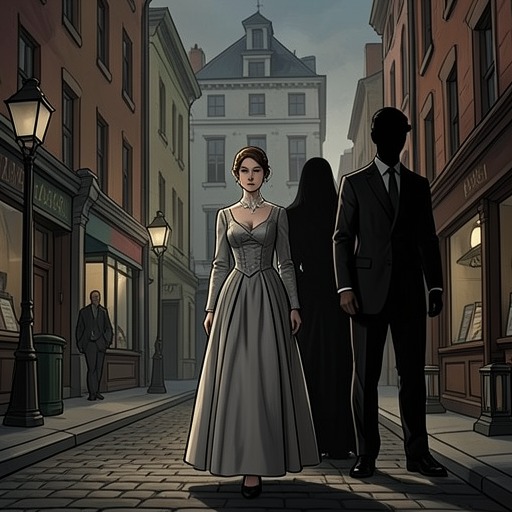
“Here was one room; there another”
Mrs Dalloway“Here was one room; there another” gives concise form to Clarissa Dalloway’s sense that human beings remain separate even when they live close enough to see one another. As she watches an elderly neighbour move through her bedroom, the rooms become an image of private lives that touch the same world but cannot be entered from outside. The phrase holds both the pain of isolation and the limits of the connections Clarissa tries to make through her evening party.
The Neighbour and the Window
At the half-hour, Big Ben’s stroke seems to Clarissa to draw the neighbour away from the window, as if the sound were a string attached to her. Clarissa follows the woman with her eyes as she disappears from view, then catches the movement of her white cap at the far end of the bedroom. The neighbour’s ordinary passage from chest of drawers to dressing table becomes, at a distance, a mystery: Clarissa can see that the woman is there, but cannot cross the boundary between them.
That act of looking sets the phrase’s spatial logic in motion. One room is visible from another, but visibility is not intimacy, and the neighbour’s presence does not disclose what her life means from within. The scene turns a window into a limit as well as an opening: Clarissa can watch, imagine, and feel the other woman’s existence, but the rooms remain distinct.
Separation and the Limits of Belief
Clarissa considers whether religion or love can solve the mystery of separation, but she does not accept that either offers a complete answer. She doubts that Doris Kilman or Peter Walsh has understood what she is trying to grasp. The question is not simply whether people care for one another; it is whether any belief or feeling can abolish the distance between one consciousness and another. The image of adjoining rooms gives that uncertainty a concrete shape without pretending to resolve it.
The thought also belongs to Clarissa’s wider effort to make connection. She senses people living in different parts of London—in South Kensington, Bayswater, and Mayfair—and regrets that their lives remain scattered. Her parties bring them together, an offering through which she tries to combine separate presences and create a shared occasion. Yet the phrase marks the limit of that project: people can be gathered in one house without ceasing to inhabit distinct inner rooms.
The Daily World Beside the Great Clock
The scene contrasts Big Ben’s solemn, public measure of time with the neighbour’s small private movements and the household details waiting to be managed. A second clock, striking two minutes later, follows the great stroke with its own less authoritative rhythm; its sound recalls practical arrangements, including Mrs. Marsham, Ellie Henderson, and glasses for ices. Public time and domestic tasks continue around Clarissa’s reflection, placing the large question of human separation within an ordinary day.
The phrase’s force comes from this scale shift. A view across a street, a woman moving inside a bedroom, and the preparations for a party all become parts of Clarissa’s attempt to understand how lives coexist without merging. “Here was one room; there another” is therefore not a denial of connection: it is the condition against which her acts of attention and gathering acquire meaning.