Beauty as truth
Mrs DallowayBeauty as truth is a recurring perception in Mrs Dalloway through which beauty appears not as ornament but as a way of recognizing the world. Flowers in a London shop and the living details of Regent’s Park make this apprehension concrete. Yet it is never simply an agreed, objective doctrine: for Clarissa Dalloway it offers a sensory and emotional refuge, while for Septimus Warren Smith it becomes an overwhelming revelation that ordinary explanations cannot contain.
Flowers and the ordinary world
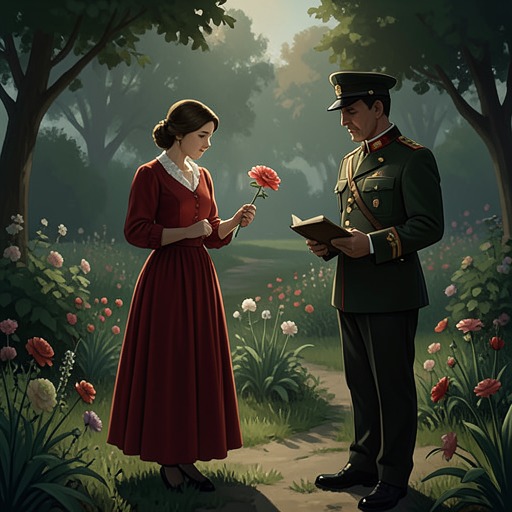
At Mulberry’s, Clarissa Dalloway moves among delphiniums, sweet peas, lilac, carnations, roses, and irises. The catalogue gives beauty material presence: color and scent belong to specific flowers, gathered together in Miss Pym’s shop. Clarissa breathes in their earthy, garden-like sweetness, and the act of choosing turns attention away from the thought she has been trying to dismiss. Beauty begins in an ordinary errand, not in a separate or idealized realm.
The flowers also arrive as a felt abundance. Clarissa’s attention imagines them at evening, when roses, carnations, irises, and lilac glow in distinct colors. In that vision, each flower seems to burn softly and purely on its own; the scene opens onto a remembered or imagined garden world of muslin-clad girls, summer dusk, cherry pie, and moths. The passage makes beauty at once immediate and expansive: it is in the flowers before her, but it can also draw the mind into a larger atmosphere of recollection and imaginative perception.
Beauty as consolation and connection
As Clarissa goes from jar to jar with Miss Pym, she lets the shop’s beauty and scent flow over her. The moment is not solely private: Miss Pym likes and trusts her, and that human warmth is bound to the flowers’ colors and fragrance. Together, sensory pleasure and another person’s regard rise against the hatred Clarissa has been feeling. Beauty does not erase that feeling by argument; the image of a wave suggests that it can temporarily surmount and lift her beyond it.
The scene’s consolation is real but not invulnerable. A pistol shot sounds in the street, interrupting the quiet encounter. Miss Pym attributes the disturbance to the motor cars and apologizes, turning back to the sweet peas. The contrast keeps beauty within the noisy, unsettled city: it can gather attention and offer relief, but it does not remove the world’s shocks. Its truth is a lived experience of value and connection, not a promise that disturbance will cease.
Septimus and the revelation of beauty
In Regent’s Park, Septimus Warren Smith encounters beauty with a different intensity. Sitting beside him, Lucrezia Warren Smith urges him to look, following Dr. Holmes’s advice that he take an interest in things outside himself. Septimus sees the smoke writing overhead as a message addressed to him. Its shapes seem to promise inexhaustible beauty, offered freely and forever to anyone who merely looks. Tears run down his cheeks; the experience is at once aesthetic revelation and a sign of how forcefully he interprets the world as speaking directly to him.
The scene also places that perception beside an everyday explanation. A nursemaid tells Lucrezia that the smoke is advertising toffee, and they begin spelling out the word. The smoke can thus be read as commercial lettering and, for Septimus, as a signal of beneficent beauty. The difference is not merely a contrast between two descriptions of the same sky: it marks the distance between the ordinary public meaning of the display and the private, overwhelming significance Septimus discovers in it.
The world as evidence
Later, Septimus looks again at Regent’s Park. Sunlight streams at his feet; trees wave, and the world seems to welcome, accept, and create. Beauty appears in houses and railings as well as in the animals stretching over the park railings. A trembling leaf, swallows swooping with apparent control, flies rising and falling, and sunlight spotting leaves with soft gold all become evidence within his vision. Even a chime, perhaps a motor horn, seems to ring divinely among the grass stalks. The revelation is made from ordinary things rather than from an escape from them.
The passage insists on the importance of that ordinariness: because the scene is composed of common objects and movements, its beauty can feel like truth discovered in the world itself. Septimus’s perception gathers disparate details into an encompassing affirmation, culminating in the conviction that beauty is everywhere. Yet the perspective remains his; the scene does not establish that other people share his reading or that the world is literally sending him messages. Its force lies in the intensity with which commonplace life becomes meaningful to him.
A shared motif, unequal experience
Across Clarissa’s visit to the florist and Septimus’s encounters in the park, beauty is associated with looking, sensation, and a temporary enlargement of experience. Flowers give Clarissa a means of moving through distress, and the park gives Septimus an image of welcome and inexhaustible generosity. In both passages, beauty depends on attention to particulars rather than abstraction: named blooms, the quiver of a leaf, the flight of birds, and light falling on foliage.
The resemblance does not make the experiences equivalent. Clarissa’s response is eased by a social exchange with Miss Pym and remains a passing, restorative encounter; Septimus’s revelation is bound to an unusually urgent sense that signs are directed to him. The novel allows the idea that beauty can disclose truth while preserving the uncertainty and danger of individual perception. Its beauty is powerful precisely because it can console, connect, or overwhelm without resolving the differences between those outcomes.