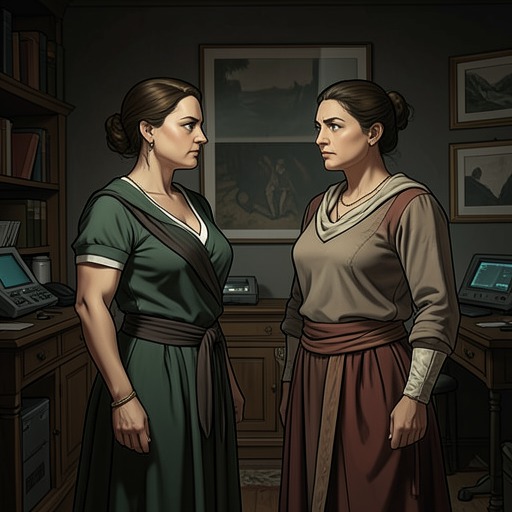
Clarissa Dalloway—Doris Kilman
Mrs DallowayThe relationship between Clarissa Dalloway and Doris Kilman is marked by Clarissa’s resentment of her daughter’s closeness to Doris and by her struggle to understand the force of her own dislike. Clarissa judges Doris as both a particular person and a figure onto whom class grievance and personal insecurity have gathered; that tension makes the antagonism more complex than simple dislike.
Origins of the Antagonism
Clarissa’s immediate concern is Elizabeth. She thinks her daughter cares little for the gloves and shoes that matter to Clarissa, and that Elizabeth’s strongest attachment is to her dog. Yet Elizabeth is also inseparable from Doris, attends Communion, and appears to be under her influence. Richard Dalloway regards Doris as capable and possessed of a historical mind, and suggests Elizabeth’s attachment may be a passing phase, perhaps a form of falling in love. Clarissa cannot accept that reassurance as sufficient: what troubles her is not only a changed daughter, but the person who seems to have become central to Elizabeth’s life.
Clarissa recognizes that Doris has been treated badly. Doris was dismissed from her teaching position during the War, and Clarissa knows that this history calls for sympathy. She also acknowledges Doris’s charitable commitments: she would do anything for the Russians and deprive herself for the Austrians. But Clarissa sets these acts beside her conviction that Doris can be insensitive in private, and experiences her manner as making others feel inferior. The relationship is thus filtered through opposing judgments: Doris’s hardship and public benevolence are visible to Clarissa, but they do not dispel her sense of being judged and diminished.
Class, Faith, and Projection
Material differences sharpen Clarissa’s reaction. She imagines Doris’s life as one of poverty, without the comforts Clarissa possesses, and sees Doris’s grievance over her dismissal as something that has hardened into lasting bitterness. Doris’s green mackintosh coat becomes a recurring marker in Clarissa’s account of her: year after year, she wears it, and Clarissa reads it together with her poverty and resentment. This description reveals as much about Clarissa’s social position as about Doris. The contrast between Clarissa’s comfortable home and Doris’s deprivation gives the conflict a class dimension, while Clarissa’s awareness that Doris has suffered prevents her from dismissing that difference as undeserved.
Religious feeling adds another source of estrangement. Clarissa believes religious ecstasy, like political causes, can blunt people’s feelings. In her view, Doris’s concern for distant populations does not guarantee kindness in intimate encounters; Clarissa instead experiences Doris as callous and overbearing. That judgment is not presented as an impartial account of Doris’s character. It belongs to Clarissa’s consciousness, which repeatedly joins observation to resentment and recognizes that the emotion may distort the person she is trying to judge.
The narrative makes that distinction explicit: Clarissa’s hatred is directed not simply at Doris but at an idea of her. That idea has absorbed more than Doris herself and has become, in Clarissa’s mind, a dominating figure that seems to consume her strength. Clarissa even imagines that, under different circumstances, she might have loved Doris. The admission does not undo the hostility; it exposes its contingency. Clarissa’s antagonism is forceful precisely because it is not a settled, objective verdict: she can glimpse the distance between the actual woman and the figure created by her own grievance, while remaining unable to bridge it.
Effects on Clarissa
The conflict intrudes upon Clarissa’s sense of well-being. She experiences her hatred as a disturbance within herself, one that can make her feel physically hurt and unsettle her pleasure in beauty, friendship, being well, being loved, and making her home delightful. Her private hostility therefore reaches beyond her opinion of Doris. It threatens the very forms of domestic and social contentment through which Clarissa understands her life.
Clarissa responds to that disturbance by trying to dismiss it as nonsense, but the effort does not erase what she has just acknowledged. Her inner struggle lies between the wish to preserve her pleasures and the recognition that resentment has made them feel insecure. Doris is consequently both the object of Clarissa’s anger and the occasion through which Clarissa encounters an unwelcome part of herself.
Distance and the Work of Connection
The two women’s relationship is also shaped by their indirect connection through Elizabeth. Clarissa worries that her daughter is inseparable from Doris, while Doris’s religious influence and presence in Elizabeth’s life remain a source of unease. The evidence presents Clarissa’s apprehension and judgments, not a reciprocal account of Doris’s feelings toward her; the relationship’s emotional center is therefore Clarissa’s response to a bond she does not control.
Clarissa’s larger account of social life offers a contrast to this division. She senses the existence of people living separately across London and feels the waste of their isolation; her impulse is to bring people together through her parties, which she understands as a gift and an offering. Yet the desired act of connection does not settle the private antagonism with Doris. The distance between the women persists alongside Clarissa’s ideal of gathering people, showing the limits of social hospitality when resentment and class difference remain unresolved.