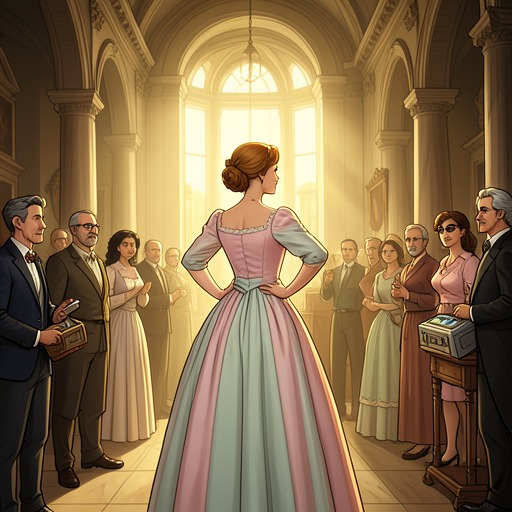
Clarissa Dalloway’s party
Mrs DallowayClarissa Dalloway’s party gathers the day’s practical preparations, social performances, and private memories into a single evening, while exposing how fragile any gathering is before the realities it cannot contain. Clarissa hopes to bring people together as an offering, but the party’s significance finally lies not in flawless success: it lies in the connections it briefly makes possible, and in the private reckoning with death that sends its hostess away from the crowd and back to it changed.
Preparation and Purpose
The party begins well before the guests arrive. In the morning, Clarissa decides to buy the flowers herself, while the work of preparing the house gathers around her: Lucy has her work cut out, doors are to be taken off their hinges, and Rumpelmayer’s men are coming. These practical arrangements establish the party as labor as well as spectacle, dependent on servants and the coordination of a household.
Later, Clarissa discovers that her green evening dress has been torn. Rather than send it away, she carries it to the window and resolves to mend it herself, planning to take her silks, scissors, and thimble downstairs and continue attending to the house. The small repair makes the evening’s preparation intimate and material: the hostess who will receive a roomful of people is also seated with a needle, trying to restore a favorite dress.
When Lucy offers to help, Clarissa declines because Lucy already has enough to do, but thanks her repeatedly. The exchange reveals Clarissa’s dependence on her servants’ work and her wish to treat them generously; she reflects that they like her and that their help sustains the person she wants to be. The dress itself carries another relation beyond the household: it is one of Sally Parker’s designs, made by a dressmaker Clarissa considers a real artist and hopes, though she never finds the time, to visit in Ealing.
Clarissa’s private account of the party reaches beyond hospitality. She senses the lives of people dispersed across London and feels the waste of their separation; if only they could be brought together, she thinks, so she does it. She calls the party an offering, an act of combining and creating, while also admitting uncertainty about whom the gift is for. That uncertainty does not cancel its purpose. The gathering is valuable to her precisely as a gift made through the act of bringing people into one room.
The Party Takes Shape
The evening opens under Clarissa’s fear that the party may fail. As she greets each arrival with the same welcoming words, Peter Walsh judges her manner effusive and insincere and wonders why he came. Clarissa, meanwhile, can see him at the edge of her vision and imagines him criticizing her. Their contrasting perspectives make the hostess’s public welcome and the guest’s private discomfort coexist inside the same room.
The mood turns when Clarissa sees Ralph Lyon beating back the curtain embroidered with birds of Paradise and continuing to talk. The moment reassures her that the party is not a failure after all. It has begun, though she still feels its success is precarious; guests seem to arrive in a rush, and the house’s preparations give way to the demands of a crowded evening.
Sally Seton’s unexpected arrival brings the past into the gathering. Clarissa recognizes the voice before she fully absorbs Sally’s changed appearance, and the two women kiss by the drawing-room door. They laugh and speak in a tumble of explanations about being in London and hearing of one another. For Clarissa, the reunion is extraordinary: the rooms are full, and she sees Sally’s hand in hers amid the candlesticks, moving curtains, and roses Richard has given her. The scene joins an old intimacy to the present social occasion without making the years between them disappear.
The Prime Minister’s arrival supplies a different kind of public spectacle. Peter announces him, but the distinguished guest looks so ordinary that one could imagine him behind a counter selling biscuits. As he makes his rounds with Clarissa and Richard, he performs his role competently, yet the guests largely continue talking rather than turning their attention to him. His presence therefore adds ceremony without commanding the room; the party’s social life cannot be reduced to the status of its most important visitor.
Reunion, Memory, and Social Performance
Clarissa’s renewed ease at the party does not erase its tensions. She has to keep receiving people, and the welcome she gives to everyone is at once a hostess’s necessary performance and, in Peter’s eyes, a reason to doubt her sincerity. When the gathering starts to feel successful, that success remains conditional: Clarissa is still expected to stand in place and hold the social scene together as more guests arrive.
Seeing Sally draws Clarissa and Peter into a shared past. Clarissa thinks that she and Peter have settled down together in conversation, as though their talking were familiar, and imagines the subjects they might revisit: the garden, the trees, the drawing-room wallpaper, and the smell of the mats at Bourton. She feels that Sally must always be part of her past, as Peter must always be. Yet she cannot remain with them. She turns back to her duties, including approaching Lady Bradshaw, whose social manner she dislikes. The reunion is real, but the party’s obligations continue to divide Clarissa’s attention.
News of a Death
The gathering’s social rhythm is broken when Lady Bradshaw explains that her husband has been called to a case: a young man who had been in the army has killed himself. Clarissa receives the news in the middle of her party as the intrusion of death into the occasion. She leaves the company and enters the small room where the Prime Minister and Lady Bruton had been talking about India. Now it is empty; the chairs retain the impression of their recent presence, and the party’s splendor seems to fall away around Clarissa alone.
The news becomes more than an abstract report. Clarissa imagines the young man’s fall from a window and the abruptness with which his life ended, then asks herself why he did it. She resents that the Bradshaws have brought the subject of death into her party, even as she cannot keep the death at a distance. Her response moves between the crowded rooms she must rejoin and the solitary space in which the report takes hold.
The narrative connects this death to the larger social world surrounding the evening. Earlier in the day, a motor car’s explosive sound had drawn attention to a face hidden behind a blind, and an aeroplane had written smoke-letters that onlookers tried to decipher. The party likewise gathers people around shared sights and signs, but its central news cannot be turned into a public spectacle that resolves what happened. The young man remains known to Clarissa only through the report and her response to it.
Return to the Gathering
From the little room, Clarissa watches an old woman in the house opposite move toward her window and prepare for bed while laughter and shouting continue in the drawing room. The contrast holds private solitude and social noise in the same field of attention. As the clock strikes, Clarissa thinks of the words Fear no more the heat of the sun. She does not pity the young man; instead, his death makes her feel, in a way she cannot fully explain, both glad and newly conscious of beauty and fun. The passage presents her response as a complex recognition, not a simple judgment about suicide.
The striking clock and the dissolving leaden circles mark Clarissa’s return from solitary thought to the party. She resolves to assemble herself, find Sally and Peter, and go back into the rooms. Peter, seated with Sally, asks where Clarissa has gone. The ending thus returns attention to the gathering and to the people waiting within it: the party does not remove death, but Clarissa re-enters its company carrying the knowledge that private experience can interrupt even the most carefully maintained social occasion.