Clarissa Dalloway’s party preparations
Mrs DallowayClarissa Dalloway’s party preparations are more than the practical work of hosting: they give her a way to gather people, animate her house, and offer connection amid the separations of ordinary life. The torn green dress, the polished silver, the servants’ labor, and the passing hours make that purpose tangible, while her reflections reveal both the limits and the importance she assigns to her gift.
The House Prepared
The work begins as a household undertaking. Clarissa has said she will buy the flowers herself, while Lucy has plenty to do: doors must come off their hinges and Rumpelmayer’s men are coming. Clarissa’s plans are embedded in a larger division of labor, with servants and workers making the party possible even as she takes responsibility for its atmosphere and presentation.
The house gathers activity around the evening. Pausing on the landing, Clarissa senses the temper of her home in its sounds: a map being moved, tapping and knocking, a message repeated in the basement, and silver clinking on a tray. The preparation is distributed through the building, from the front door to the basement and drawing room; in her mind, all of it is for the party.
When Lucy presents the silver, Clarissa praises how it looks and straightens a crystal dolphin. Her attention moves among practical details and small exchanges with the staff, including asking about a play Lucy’s party guests had to leave early. The scene shows hosting as a sequence of acts of notice and arrangement, rather than a single display at the evening’s end.
The Green Dress and the Work of Care
Clarissa’s own preparations include repairing a favorite green dress. She finds that its skirt was torn after someone trod on it at an Embassy party, and recalls feeling the fabric give beneath the folds. Although it had shone under artificial light, the sun now drains its color. She decides to mend it herself and plans to bring her silks, scissors, and thimble downstairs, where she can sew while writing and keeping an eye on the household.
Lucy offers to help, but Clarissa says she already has enough to do. Her refusal is accompanied by genuine thanks: sitting with the dress over her knees, she repeatedly expresses gratitude to Lucy and, more broadly, to the servants who help her become the gentle, generous-hearted person she wants to be. Their work is not incidental to her conception of herself as hostess; it helps make that role possible.
The dress also connects the present preparations with an absent maker. It is one of Sally Parker’s designs, nearly the last she made before retiring to Ealing. Clarissa thinks of visiting her, though she doubts she will ever find a moment. She remembers Sally as a real artist whose clothes could be worn at Hatfield or Buckingham Palace without seeming eccentric. A small repair thus opens onto memory, admiration, and the pressures that leave other acts of care indefinitely postponed.
The Party as a Gift
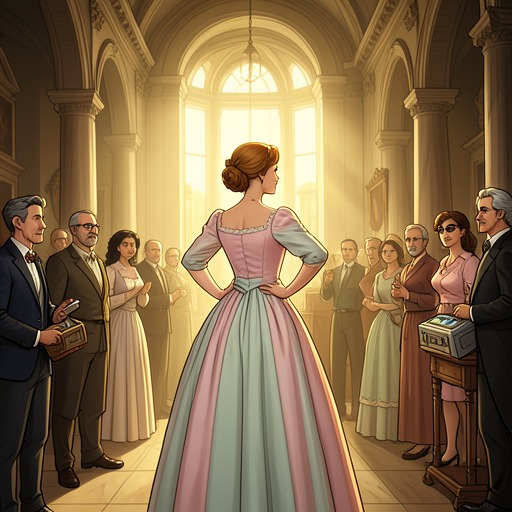
Clarissa understands her social role through the image of a center. She imagines a world gathered into one woman in a drawing room, making a meeting point and perhaps a refuge for lonely people. She has helped young people who were grateful to her, and has tried to present a consistent self without exposing all her faults, jealousies, vanities, and suspicions. The thought that Lady Millicent Bruton did not invite her to lunch unsettles that self-image: even the person who connects others can feel excluded.
Her account of the party’s purpose is not simply that it will be successful or enjoyable. She notices people living separately in South Kensington, Bayswater, and Mayfair, feels the waste of their isolation, and responds by bringing them together. She calls the gathering an offering: an act of combining and creating, valuable even though she cannot say to whom it is offered. Hosting becomes a gift whose worth lies in the effort to make human contact possible.
Clarissa is also unsparing about what she lacks. She thinks she cannot think, write, or play the piano; she muddles Armenians and Turks, loves success, hates discomfort, wants to be liked, and talks nonsense. These admissions complicate, rather than cancel, the meaning of her work. The party is not proof of intellectual accomplishment or moral perfection; it is the form of giving she can make from the capacities and resources she has.
Public Time and Private Purpose
The preparations unfold inside a day measured by public clocks. Clarissa experiences a pause before Big Ben strikes, then hears its warning and the hour, which feels irrevocable; the sound becomes a passage through the air as its leaden circles dissolve. The clock makes time communal and audible, while the party gives Clarissa a private purpose within that shared London day.
The half-hour strikes again as Clarissa lays the green dress on her bed and the Warren Smiths walk down Harley Street for an appointment with Sir William Bradshaw. The juxtaposition places an ordinary act of preparation beside another household’s urgent medical visit, without making the two events equivalent. Later, Big Ben strikes the half-hour once more as Clarissa reflects on the woman across the way and on the privacy of the soul. The recurring chimes register a world in which private lives continue alongside one another, only partly known.
The evening’s social promise is set against the city’s changing rhythms. Peter Walsh, back in London, is surprised by the prolonged evening under Mr. Willett’s summer time and by the beauty of the light on the squares. Earlier, Clarissa’s love of London had encompassed its traffic, noise, crowds, and sudden interruptions. Her party belongs to this public city: it cannot abolish separation or control what the day brings, but it creates a room in which people who might otherwise remain apart can meet.