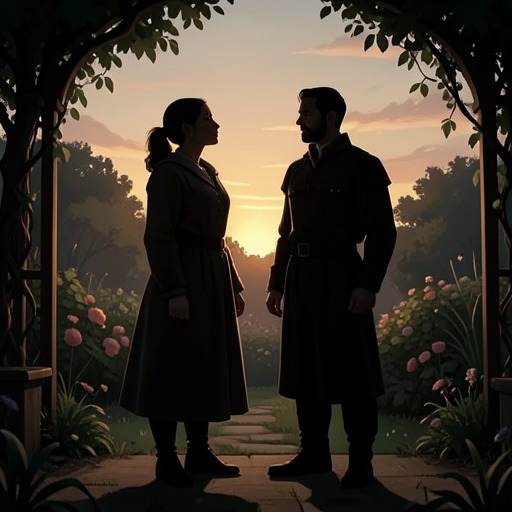
Clarissa and Peter’s break in Bourton
Mrs DallowayClarissa and Peter’s break in Bourton is the decisive end of their early intimacy: a remembered confrontation at a garden fountain turns Peter’s hope of a shared life into a permanent separation. The novel gives the scene two sharply different meanings. Peter recalls a devastating rejection and a loss that still defines his life; Clarissa remembers choosing not to marry him because she believed his demand for complete emotional sharing would destroy them both. Their separation therefore becomes more than a failed courtship: it establishes the contrast between Peter’s insistence on total disclosure and the private independence Clarissa finds possible in her marriage to Richard.
Background and the Misunderstanding
Peter’s account begins with a small exchange at lunch on a hot afternoon. Sally makes a remark about Dalloway, and Clarissa, after stiffening and colouring, sharply tells her that they have had enough of the feeble joke. Peter takes Clarissa’s reaction as a declaration that she is merely amusing herself with him and has an understanding with Richard. His interpretation is not presented as a confirmed statement of Clarissa’s intentions; it is what the exchange means to Peter at a moment when he has not slept for nights and feels that the matter must be settled.
The misunderstanding gives the meeting its immediate pressure. Peter sends Clarissa a note by way of Sally, asking her to meet him at three and adding that something very important has happened. In retrospect, the note makes a private uncertainty into a formal confrontation: he wants an answer, while the evidence establishes only the urgency of his demand, not that Clarissa has agreed to his assumptions. The remembered scene thus turns on a gap between what Peter fears Clarissa’s response means and what she ultimately says.
The Meeting at the Fountain
The fountain stands in the middle of a small, secluded shrubbery, with trees and shrubs all around it. Clarissa arrives before the appointed time. The broken spout continues to let water fall between them, a precise detail that fixes Peter’s memory of the meeting in a still, confined setting. Instead of resolving the uncertainty that brought them there, the encounter hardens into a demand and a refusal.
Peter repeatedly asks Clarissa to tell him the truth. He remembers himself as overwhelmed and Clarissa as contracted, rigid, and unyielding. The interruption of the old man Breitkopf, who appears carrying The Times, stares at them, and goes away, does not break the impasse: neither Clarissa nor Peter moves, and Peter returns to his question. After he has spoken for what seems to him like hours, with tears running down his cheeks, Clarissa tells him that there is no use and that this is the end. She then turns and leaves. The decisive action is not a mutual agreement but Clarissa’s departure after Peter’s prolonged appeal has failed to change her answer.
The Separation and Its Lasting Cost
Peter calls after Clarissa, but she does not come back. The account makes the finality concrete: he goes away that night and never sees her again. He describes the scene as terrible and believes it mattered more than anything in his life, while allowing that this judgment might be an exaggeration. That qualification does not dissolve the loss; it shows how the remembered event has become the measure against which he understands his own past.
Clarissa’s later recollection supplies a different account of the break’s cause and consequence. She believes there must be some licence and independence between people living together day after day, the kind of latitude she and Richard give one another. Peter, by contrast, wanted everything shared and gone into. Clarissa says that when their relationship reached this point, she had to break with him or, as she was convinced, both would have been destroyed and ruined. Her conviction does not make the separation painless: she has carried its grief and anguish for years like an arrow in her heart.
The later news that Peter married a woman he met on the boat to India deepens Clarissa’s recollection of the break. She remembers hearing it at a concert and never forgetting the moment. Peter had called her cold-hearted and a prude, yet she could not understand how he cared for her. She also recalls his later assurance that he was perfectly happy alongside his claim that his life had been a failure. These remembered judgements do not undo the separation or settle whose view is correct; they show that its emotional consequences continue to shape how each understands the other.
Narrative Form and Significance
The fountain scene reaches the reader as a retrospective episode in Peter’s consciousness rather than as an uninterrupted account of a shared present. Its details—the note sent through Sally, the appointed hour, the broken fountain, Breitkopf carrying The Times, and Peter’s unanswered calls—belong to a memory that has remained intensely legible to him. The narrative also places beside that memory Clarissa’s later explanation of why she chose separation. This difference in perspective matters: the scene Peter experiences as the ruin of his hope is, in Clarissa’s account, the painful necessity of preserving room for independence.
The break also establishes a lasting contrast between Peter and Richard as Clarissa understands it. Peter requires that everything be shared and examined; Richard grants her, and receives from her, some privacy within a life lived together. Clarissa’s defence of her choice does not erase her grief, just as Peter’s enduring sorrow does not prove that marriage to him would have worked. Instead, the event keeps intimacy and autonomy in tension: the relationship ends because Peter presses for an answer Clarissa will not give, and its meaning continues to divide between the person who remembers being rejected and the person who remembers having to leave.