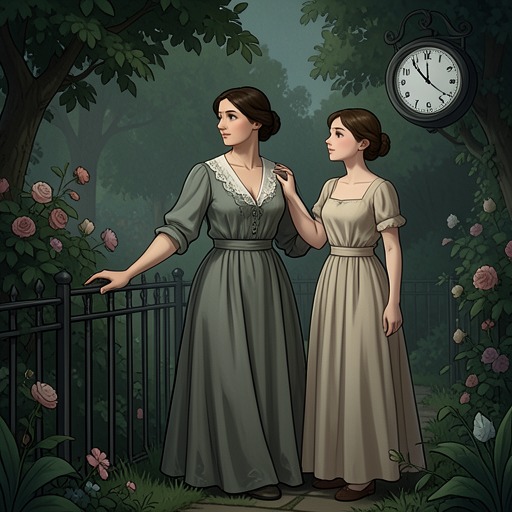
Clarissa and Sally’s kiss
Mrs DallowayClarissa and Sally’s kiss is the radiant center of Clarissa Dalloway’s memory of youth at Bourton: a brief act of intimacy that seems to suspend the surrounding world and give her a gift she cannot fully uncover. Recalled amid the routines and disappointments of a June day in London, it becomes a measure of what intimacy can disclose—and of how Clarissa tries, through hospitality, to bring people together.
The scene at Bourton
Sally Seton enters Clarissa’s memory against a background of other people and their ordinary pursuits. By the fireplace, Sally speaks to Clarissa’s father in a beautiful voice; then she declares that it is a shame to sit indoors and draws the company out onto the terrace. Peter Walsh and Joseph Breitkopf continue talking about Wagner while Clarissa and Sally fall behind. The kiss happens as they pass a stone urn filled with flowers: Sally stops, picks a flower, and kisses Clarissa on the lips.
For Clarissa, the moment immediately exceeds its physical brevity. The others seem to disappear, leaving her alone with Sally, and the kiss feels like a present entrusted to her to keep rather than inspect. Clarissa imagines it as a diamond wrapped up, whose radiance nonetheless burns through its covering. The memory gives the kiss the shape of a revelation—precious, private, and difficult to translate into ordinary language.
Interruption and lasting meaning
The private interval ends when Peter Walsh and Joseph Breitkopf come upon the two women and Peter asks whether they are star-gazing. His arrival breaks the scene’s isolation, but does not erase its significance. In Clarissa’s recollection, the interruption marks the contrast between an inward experience that seems almost sacred and the familiar social world that can only approach it from outside.
The kiss remains Clarissa’s most exquisite moment, not simply because it expresses affection, but because she remembers it as a disclosure of value: something infinitely precious has been given to her. Its emotional intensity is carried by the scene’s movement from company to privacy and back again, and by the image of a diamond whose light survives concealment.
Memory within Clarissa’s London day
The recollection is set against the present-day work of preparing for Clarissa’s evening party. Her decision to buy flowers herself begins the day, and the remembered kiss gives those flowers an intimate association: at Bourton, Sally picked one from the stone urn just before kissing her. The memory does not replace Clarissa’s present duties, but enters among them, making the day’s social arrangements coexist with a private past.
The contrast sharpens when Clarissa later discovers that Lady Millicent Bruton has not invited her to lunch. She feels aged and diminished, then withdraws upstairs and encounters the emptiness at the heart of life. Her exclusion from one gathering stands beside the larger social role she has made for herself: she imagines people dispersed across London and understands her work as bringing them together. The earlier kiss is not presented as the cause of that role, but its image of concentrated intimacy resonates with Clarissa’s wish to create a meeting point for others.
Intimacy, hospitality, and the present
Clarissa’s hosting gives social form to a desire for connection, though she knows its limits. She regards the party as an offering, a gift whose purpose is to combine and create, while also recognizing that her own abilities and knowledge are imperfect. The remembered kiss offers a contrasting image of connection: not a public arrangement of guests, but an encounter whose importance is inward and cannot be explained away by the company around it.
In the present, Clarissa tends a torn green evening dress herself, refusing Lucy’s offer to help because the servant already has enough to do. Her gratitude toward her servants and her attention to the dress’s repair show the care embedded in everyday preparations. Set beside the remembered flower and kiss, this domestic work gives the memory a quiet afterlife in the practices through which Clarissa sustains a household and prepares to gather people. The kiss remains singular; the party is her repeated attempt to make connection possible for others.