Clock time
Mrs DallowayClock time in Mrs. Dalloway is more than a measure of the hours: it is the city’s shared rhythm, a summons to ordinary tasks, and a recurring interruption that shapes how private experience unfolds. Big Ben’s measured strokes divide the June day, while memory and consciousness move across years; the contrast makes time both an authority imposed on London and a medium through which lives briefly touch.
Public Time in London
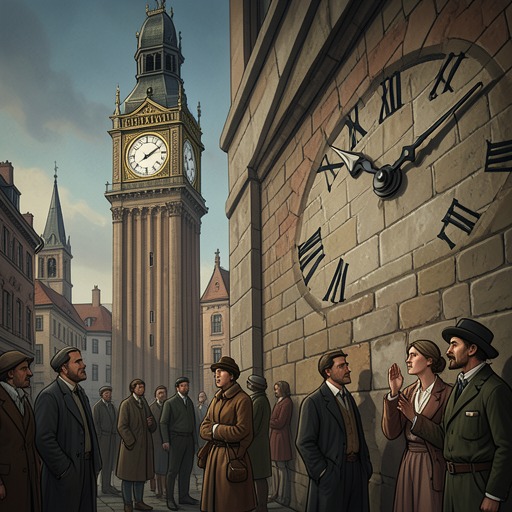
For Clarissa Dalloway, Big Ben’s approach is perceptible before the hour itself. After more than twenty years in Westminster, she feels a pause or suspense before the bell sounds, though she wonders whether the sensation belongs to her heart, affected by influenza. The clock first gives a musical warning, then announces an hour that cannot be recalled. Its measured sound is at once civic and inward: it makes the present feel momentous, then disperses into the air as Clarissa crosses Victoria Street.
The sound belongs to a city already in motion. Clarissa finds life in traffic, carriages, omnibuses, vans, crowds, music, and an aeroplane overhead, and the hour’s passing does not stop that movement. Instead, public time and urban life coexist: the clock marks a shared instant while London continually renews itself around it. Its strokes offer a point of orientation, not a pause from experience.
The same public rhythm reaches people in different places. When St. Margaret’s strikes half-past eleven, Peter Walsh is ashamed and hollow after reflecting that Clarissa refused him. The church’s voice is imagined as a hostess arriving precisely on the hour to find guests already gathered. That personification turns timekeeping into a social act: the bell acknowledges those waiting in the city and gives the moment a composed public form, even as Peter’s private distress remains unresolved.
Clocks and the Day’s Divisions
At twelve, Clarissa lays her green dress on the bed as the Warren Smiths walk down Harley Street to their appointment with Sir William Bradshaw. Rezia notices the grey motor car outside and thinks it may be his. The coincident hour links separate scenes without making their circumstances alike: Clarissa attends to her dress and the coming party, while Septimus and Rezia enter a doctor’s authority. The clock’s recurring formula, that its leaden circles dissolve in the air, marks how an announced hour passes even as its consequences continue.
On Harley Street, the clocks do more than report time. Their strokes are described as dividing and subdividing the June day, reinforcing submission and authority and advocating a sense of proportion. The language makes measured time resemble an instrument of social discipline: each small division seems to narrow the space available to experience. By half-past one, however, a commercial clock above a shop in Oxford Street gives the hour in a genial, almost companionable manner. The contrast between Harley Street’s stern chorus and the shop clock’s friendly announcement shows how the same system can sound coercive or commonplace according to where and how it is heard.
The hours also organize domestic and social obligation. After Big Ben strikes the half-hour, a later clock follows two minutes behind, bringing Clarissa a flood of practical reminders: Mrs. Marsham, Ellie Henderson, and glasses for ices. The later stroke does not simply repeat the first. It opens a different register of time, moving from the solemnity of the public hour to the unfinished details of hosting and household arrangements. Clarissa must telephone at once; the clock’s delay has made room for the small tasks that constitute her day.
Public Hours and Private Duration
The clock’s regular divisions stand beside a consciousness that does not proceed in a straight line. Clarissa’s present-day movements are crossed by memories of Bourton and by reflections on people she has not seen for years. In recollecting a theory she once discussed with Peter, she remembers how unsatisfactory it seemed to meet people daily and then not for six months or years, and how little one could truly know of them. Her account of feeling herself everywhere, rather than only in one place, sets an expansive, relational sense of experience against the clock’s bounded hours. The city’s time connects lives in passing, but cannot guarantee knowledge of them.
This difference is especially clear in Clarissa’s attention to the elderly neighbor across the way. Big Ben’s half-hour stroke seems to draw the woman away from her window and back into her room, making the ordinary movement solemn in Clarissa’s view. The neighbor remains private and separate; Clarissa can watch her, but cannot know the interior of her life. The clock creates a moment of imagined connection, not access. Its public sound is shared, while the meanings attached to it remain individual.
Summer Time and the Changing Evening
The clock’s authority is also historically adjustable. During Peter Walsh’s return to London from India, he encounters Mr. Willett’s summer time, introduced since his last visit. The prolonged evening is new to him. It gives young people more time after work, and he watches their faces and clothes in the yellow-blue light as they pass through the city. What seems at first to be a natural evening is therefore also shaped by a social decision about the hour: the clock has been altered, and people’s use of the city changes with it.
Peter’s response complicates any simple opposition between mechanical time and lived experience. He is astonished by the evening’s beauty, and the extended light feels encouraging, even though its duration has been arranged by public convention. The altered schedule changes what the streets permit people to do and how long the city remains available to them. Clock time is neither wholly fixed nor merely private; it is a collective arrangement experienced through bodies, work, leisure, and perception.
The Last Stroke and Its Echo
At the end of Clarissa’s brief withdrawal from the party, she watches the elderly neighbor in the room opposite, quietly moving toward bed. The clock strikes one, then two, then three. Clarissa has learned of the young man’s suicide, yet the party continues elsewhere in the house; the hour’s measured sequence places death beside ongoing social life without resolving their tension. Watching the neighbor put out her light, Clarissa recalls the words, Fear no more the heat of the sun, and feels a connection to the dead young man. She then recognizes that she must return to the guests and find Sally and Peter.
The repeated image of the leaden circles dissolving in the air carries the clock’s double meaning to this final scene. The strokes pass, but what they have brought into contact—death and the party, an unseen neighbor and Clarissa, private grief and the continuing city—does not vanish with them. Clock time moves the day toward its ending; the novel’s shifting attention allows that single day to hold remembered years and separate lives within its hours.