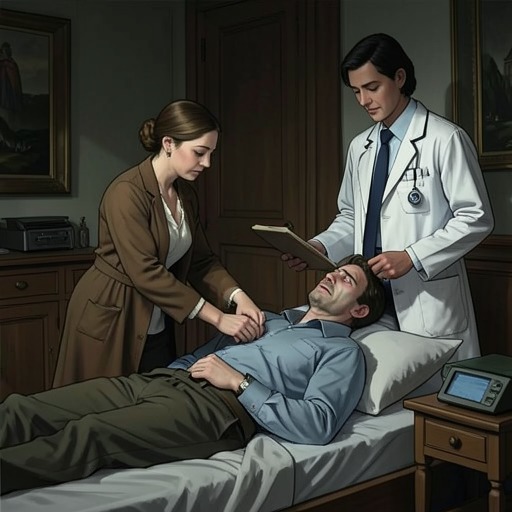
Dr. Holmes
Mrs DallowayDr. Holmes is the doctor called to care for Septimus Warren Smith, and his defining role is to interpret severe distress as a manageable failure of nerve rather than to recognize the patient’s account of his suffering. Though he presents himself as practical and friendly, his repeated dismissal of Septimus’s symptoms and his physical insistence on access to him make him an emblem of the authority that the couple cannot trust.
Identity and approach
Dr. Holmes is Mrs. Filmer’s doctor, summoned by Lucrezia when Septimus becomes unable to rouse and she fears for him. He examines Septimus and reassures Lucrezia that there is nothing seriously wrong. He explains the situation through familiar habits and common remedies: Septimus might go to the Music Hall, take a day off with his wife, play golf, or try bromide at bedtime. Holmes also turns readily to other subjects, including the old panelling in Bloomsbury houses. His manner treats the crisis as a temporary indisposition to be met with routine and diversion.
That approach remains consistent when Holmes comes again. He calls Septimus’s headaches, sleeplessness, fears, and dreams nerve symptoms, advises him to take up a hobby, and invokes his own health and work habits as evidence that a person can control his condition. He opens Shakespeare, then puts the book aside, returning instead to the practical prescription of outside interests. His casual attention to Lucrezia’s comb further shows how readily he shifts from her husband’s distress to ordinary social observations.
The conflict over Septimus’s account
The gulf between Holmes’s assessment and Septimus’s experience is visible in the couple’s different readings of his behavior. Septimus describes visions and discoveries, including the conviction that trees are alive and that universal love must be made known; Lucrezia records what he says, even when some of his writings seem to her nonsensical. Holmes, by contrast, classifies the experience as nerves and urges distraction. When Septimus refuses to see him, Holmes does not treat the refusal as a reason to stop: he smiles, pushes past Lucrezia, and enters the bedroom.
Holmes’s repeated denial is consequential because Septimus experiences it not as reassurance but as persecution. In his private language, Holmes stands for human nature and for a world that condemns him; even the doctor’s practical recommendations and his interest in Shakespeare become material for Septimus’s fearful imaginings. Lucrezia, who initially welcomes Holmes’s first reassurance as a relief, comes to fear the consequences of his approach as she sees her husband’s condition and his terror deepen.
Medical authority and separation
When Sir William Bradshaw speaks with Lucrezia, Holmes’s judgment has already shaped the frame in which Septimus’s distress is handled: the question is treated as one of rest and management, not as a matter of hearing Septimus’s own account. Bradshaw recommends that Septimus be sent away to a country home, separated from his wife, and presents the plan as necessary because Septimus has threatened suicide. Lucrezia is told that the condition is not called madness but a lack of proportion. The contrast between clinical confidence and the patient’s resistance leaves little room for Septimus’s own wishes to determine what happens next.
The pressure becomes immediate when Lucrezia goes downstairs, thinking Holmes may have arrived, and tries to prevent him from reaching her husband. Holmes says he has come as a friend, but he puts her aside and continues upstairs. From inside, Septimus anticipates Holmes entering and imagines that the doctor will seize control of him. He considers ways to avoid that anticipated encounter, then jumps from the window. The narrative establishes the sequence directly: Holmes’s approach precedes the suicide, though Holmes himself cannot understand why Septimus acted.
Aftermath and narrative significance
After Septimus’s death, Holmes calls him a coward and enters the room. He tells Lucrezia that her husband is gravely injured and that she must be spared from seeing him; she is left to face the shock and the coming inquest. Holmes tells Mrs. Filmer that no one is to blame and admits that he cannot conceive why Septimus did it. His certainty in treatment has not given him an understanding of the patient’s experience or of the danger his intervention carried for Septimus.
Holmes functions as more than an individual doctor in the novel’s account of illness. The contrast between Septimus’s fragmented, intense perceptions, Lucrezia’s attentive but frightened observations, and Holmes’s routine medical explanations shows how a professional label can displace the patient’s meaning. His friendliness does not prevent harm: he means to help, yet his insistence that nothing serious is wrong and his refusal to respect Septimus’s resistance intensify the conflict. The tragedy lies in that disparity between the doctor’s confidence that he is acting for the patient’s good and the patient’s conviction that the doctor represents an intolerable threat.