Elizabeth Dalloway
Mrs DallowayElizabeth Dalloway, the seventeen-year-old daughter of Clarissa Dalloway and Richard Dalloway, occupies a quiet but consequential place between her mother’s social world and a future she has not yet chosen. Her reserve and seriousness make her difficult for Clarissa to read; her departure from tea with Doris Kilman, followed by an independent journey through London, gives that reserve a direction of its own. In Elizabeth’s movement from a watched room to the open city, the novel presents not a settled vocation or identity but the first outlines of self-determination.
Identity and Family
Clarissa calls Elizabeth her daughter with marked emotion when the young woman enters the room. The moment registers both affection and performance: Clarissa’s greeting is described as emotional and perhaps histrionic, while Elizabeth answers simply and comes forward. The contrast between a mother who makes social feeling visible and a daughter who offers little display establishes a distance that is not the same as indifference.
Clarissa’s account of Elizabeth is shaped by everyday preferences and disagreements. Elizabeth cares most for her dog and has little interest in the shoes and gloves that her mother values. Clarissa also notices that her daughter is close to Doris Kilman and has begun going to Communion. She wonders whether this attachment is only a phase, or whether it might be a form of falling in love, but does not claim to know. Richard, by contrast, regards Kilman as capable and historically minded. Their different assessments leave Elizabeth’s bond with Kilman open to competing parental interpretations rather than reducing it to a confirmed motive.
At seventeen, Elizabeth appears to Clarissa as strikingly unlike the Dalloways, who are generally fair-haired and blue-eyed: Elizabeth is dark, with a pale face and eyes her mother describes as Chinese. Clarissa associates her with gentleness, consideration, and stillness, and remembers a child with a strong sense of humour. The serious young woman she sees now seems to her like a flower not yet opened to the sun. That image expresses Clarissa’s uncertainty about her daughter, not a definitive account of Elizabeth’s inner life.
The Mother-Daughter Distance
Clarissa’s worry about Elizabeth is tangled with her own dislike of Kilman. She resents the older woman’s presence in her daughter’s life and contrasts Kilman’s religious devotion with what she sees as a lack of feeling toward individuals. But Clarissa also recognizes that Kilman has been badly treated and that her grievance has a history. Her judgments therefore reveal the mother’s class-bound sensitivities and emotional unease as much as they explain the daughter’s choices.
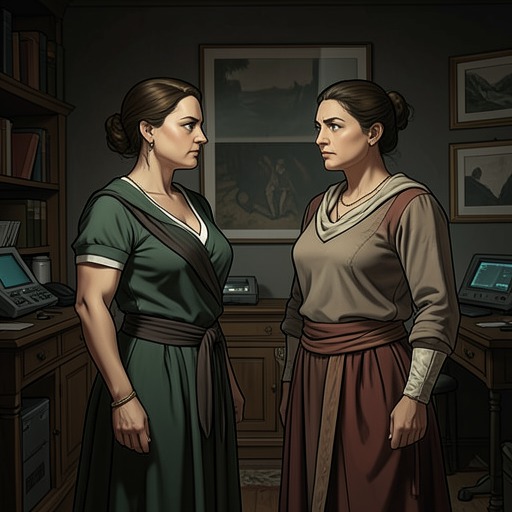
The physical arrangement of one visit makes that unease visible. Clarissa is resting; Elizabeth enters quietly and stands beside her, while Kilman remains just outside the partly open door, listening from the landing. The threshold separates mother and daughter’s private encounter from Kilman’s watchful attachment. Elizabeth does not make a dramatic declaration or resolve the competing claims upon her. Her stillness leaves the scene suspended between intimacy, surveillance, and the mother’s sense that she cannot fully know her child.
At tea with Kilman, Elizabeth’s restraint becomes an action. She sits upright, says she wants nothing more, and looks for her white gloves under the table. Kilman, who genuinely loves her, cannot bear the prospect of her leaving and opens and closes her large hand on the table. Elizabeth nevertheless feels that the visit has become flat and would like to go. Kilman says she has not quite finished, but the episode ends with Elizabeth’s desire to leave clearly registered. Their closeness is real, yet it does not cancel Elizabeth’s own judgment or entitlement to end the visit.
Leaving the Room
Elizabeth waits in Victoria Street for an omnibus and considers that she need not go home immediately. She likes being outdoors and chooses to travel farther. The change of setting matters: rather than returning directly to the household or remaining within Kilman’s orbit, she gives herself time and space in the city. Her well-cut clothes make her visible in public, but the passage follows her as a moving observer and decision-maker, not merely as an object being judged.
On the omnibus, London presents a range of possible kinds of work. Elizabeth thinks that she likes people who are ill and recalls Kilman’s assertion that every profession is open to women of her generation. She imagines becoming a doctor, a farmer, or, if necessary, entering Parliament. These are possibilities rather than settled plans. Her thoughts connect care for the sick with ambitions that would place her in professional and public life, including work with animals and responsibility for land and other people.
The city helps give those possibilities shape. Somerset House, with its imposing grey appearance and sense of people working, appeals to her; the busy Strand seems different from Westminster. Churches passing through the urban scene also enter her attention. Elizabeth’s interest in these surroundings is not simply a continuation of Kilman’s religious influence: the passage presents her as responding to work, institutions, and the prospect of a profession in her own right. The route becomes a space in which ideas can develop without yet becoming commitments.
Characterization and Narrative Role
Elizabeth’s character is conveyed through a contrast between stillness and motion. In the house she stands quietly while others interpret her—Clarissa wondering about her seriousness, Kilman reluctant to release her, and Peter Walsh recalling her entrance and thinking she looks queer. Once she leaves, the narrative follows her attention outward, from the omnibus to the buildings and activities of central London. That shift does not prove that she has escaped family influence, but it gives her a perspective and a trajectory beyond the room in which others have been watching her.
Her appearance also attracts descriptions that risk turning her into an image: Clarissa compares her to a hyacinth, and the city passage associates her with youthful, natural forms. Yet Elizabeth’s practical choices interrupt this aesthetic framing. She searches for her gloves, decides to go out, considers destinations, and imagines work. The tension between being seen as beautiful or mysterious and acting on ordinary preferences gives her brief narrative movement its force.
Elizabeth’s future remains unresolved. The text supplies no final profession, rejection of her family, or definitive break with Kilman. Instead, her independence appears in modest but concrete choices: she wants to leave tea, waits for public transport, extends her journey, and considers several kinds of work. These actions make her neither a completed rebel nor merely the object of Clarissa’s maternal concern. She stands at an opening: still shaped by family, class, and religious association, but beginning to picture a life organized by her own interests.