Hugh Whitbread
Mrs DallowayHugh Whitbread is a long-standing acquaintance of Clarissa Dalloway and a familiar presence in the social world of London. A court-connected gentleman who has spent fifty-five years among the upper reaches of English society, he is defined by polished manners, visible respectability, and a habit of attending to surfaces. Yet the novel complicates that portrait: Hugh’s dutiful kindness to his mother and his practical assistance to Lady Bruton sit beside Peter Walsh’s impatience with his social deference and self-display.
Identity and Social Position
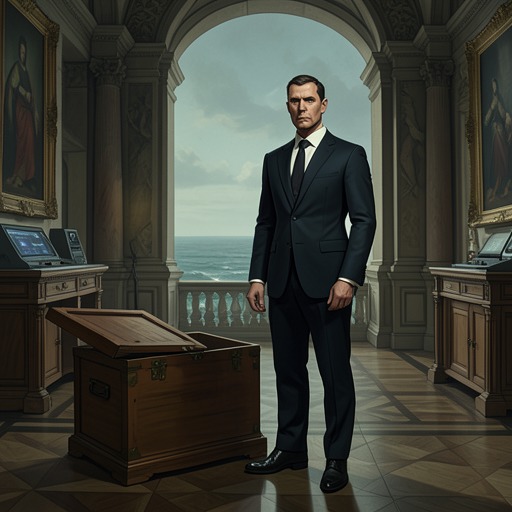
Hugh enters Clarissa’s morning walk in the Park carrying a dispatch box stamped with the Royal Arms, an emblem that makes his relation to official and courtly life visible before he speaks. He greets Clarissa extravagantly, as an old friend known since childhood, and asks where she is going. Their encounter places him within her familiar London network, while his dress and bearing suggest a man at ease around institutions and status.
His connection to the Court is more than a passing social ornament. Hugh has obtained a minor post there, looks after the King’s cellars, and is associated with knee-breeches and lace ruffles. His life is described as having floated for decades on the cream of English society: he has known prime ministers, and his affections are understood to be deep. The juxtaposition between this exalted social setting and the modest scale of his post gives his position a gently comic disproportion.
Hugh’s reputation is not reducible to ceremonial display. Though he has held no important office and taken part in none of the great movements of his time, he is credited with small reforms: improving public shelters and protecting owls in Norfolk. He also writes letters to The Times appealing for funds and urging the public to protect and preserve, clear litter, abate smoke, and stamp out immorality in parks. These causes are modest in scale, but they show an earnest civic side to the man whom others can dismiss as merely ornamental.
Clarissa’s View and Their Long Acquaintance
Clarissa’s thoughts about Hugh are affectionate but not uncritical. She sometimes feels schoolgirlish and inadequate beside him, yet remains attached to him partly because she has known him all her life. Richard Dalloway is nearly driven mad by Hugh, and Peter Walsh has never forgiven Clarissa for liking him; Clarissa remembers these judgments but rejects Peter’s harshest verdict.
At Bourton, Peter had treated Hugh as inferior and nearly ridiculous. Clarissa recalls that Hugh would give up shooting when his old mother asked him to, or take her to Bath, without complaint. To her, this is evidence of real unselfishness, not simply the manners of an English gentleman. Peter’s description of Hugh as having no heart or brain is, in Clarissa’s memory, one of Peter’s intolerable excesses. She allows that Peter could be impossible, but still remembers him as adorable to walk with on a morning like this; the recollection holds old affection and old disagreement together rather than resolving either.
Clarissa’s defense of Hugh also reveals how differently people read his manners. She can see his respect for aristocracy and conventional forms, but she regards his attentiveness to his mother as proof that there is more to him than performance. Hugh is therefore a point of friction in Clarissa’s remembered relationships: her liking for him survives Peter’s contempt, while Richard’s irritation underscores that her social circle contains incompatible assessments of the same man.
Surface, Manners, and Peter Walsh’s Judgment
Peter’s perspective turns Hugh into a figure of social satire. He recalls Sally Seton’s attack on Hugh during an argument at Bourton about women’s rights. Sally said that Hugh represented what she found most detestable in British middle-class life and held him responsible for the condition of poor girls in Piccadilly. Hugh, the perfect gentleman, was horrified. Peter remembers the episode as evidence that Sally saw through the respectability Hugh embodied, while Hugh’s shock exposes how little he expected his own social position to be challenged in that way.
Peter’s broader portrait is less generous than Clarissa’s. Hugh is preoccupied with appearance, and Peter imagines that he ought to have been a duke or might marry a royal princess. Hugh’s reverence for the British aristocracy is, even in Clarissa’s account, unusually natural and sublime. Peter also recalls the fuss surrounding Hugh’s possessions: linen cupboards, pillowcases, old oak furniture, and pictures that visitors are expected to admire. The detail makes social distinction feel less like abstract rank than a practiced ritual of display, in which objects and polished manners invite attention.
That satire has limits. Clarissa insists that Hugh is a dear and unselfish man, remembering his care for his mother and his attention to family obligations, including his aunts’ birthdays. The novel does not require either judgment to erase the other. His solicitude can be genuine, while his conventional bearing and attachment to status remain open to criticism. The contrast between Clarissa’s personal knowledge and Peter’s cutting social analysis makes Hugh’s character legible from more than one angle.
Public Usefulness and the Letter for Lady Bruton
Hugh’s most substantial practical contribution occurs at Lady Bruton’s lunch, where he helps turn her tangled thoughts into a formal letter. When papers are brought to the table, he takes out a silver fountain pen that has served him for twenty years. He has shown it to its makers, who told him it should never wear out; its durable perfection seems to Richard Dalloway to reflect the sentiments Hugh expresses. The pen’s age and condition become part of Hugh’s self-presentation, but it is also the instrument through which he proves useful.
Hugh writes carefully in capital letters, circles them in the margin, and reshapes Lady Bruton’s material into grammatical prose fit for the editor of The Times. Richard believes the draft contains padding and conventional grand language; Hugh, by contrast, proceeds slowly and persistently, proposing modifications out of consideration for people’s feelings. His tact and patience give Lady Bruton’s ideas a form that she believes the newspaper may respect. He cannot guarantee publication, but expects to meet someone at luncheon, and his connections offer a possible route onward.
The episode joins Hugh’s social fluency to concrete service. His habits may appear fussy or deferential, yet they enable him to perform a task Lady Bruton needs done. The scene also sharpens the novel’s contrast between public language and private judgment: Hugh’s measured drafting is persuasive to Lady Bruton, while Richard hears empty rhetoric. Hugh’s value here lies neither in commanding political authority nor in originating the argument, but in patiently converting another person’s intentions into an acceptable public form.
The Party and Narrative Significance
Later, at Clarissa’s evening party, Hugh appears near the Prime Minister, moving around the precincts of power as if on duty. Peter sees him there, grown fatter and whiter, and regards him as a privileged but secretive figure. The apparent secrets he guards are, in Peter’s telling, only scraps of court gossip dropped by a footman and soon destined for the newspapers. The scene repeats the gap between Hugh’s aura of access and the triviality Peter assigns to what that access contains.
Hugh’s part in the novel is made through recurrence rather than a private crisis or decisive transformation. He is first encountered in the Park as Clarissa’s old friend, recalled at Bourton through competing memories, shown helping Lady Bruton with her letter, and seen again among the party’s elevated guests. Across these settings, he connects private acquaintance to courtly and public society. His familiar manners can signify considerate duty to Clarissa, social complacency to Sally, and empty snobbery to Peter; his small reforms and practical help complicate any single verdict.
As a character, Hugh is recognizable through a stable cluster of traits—polish, loyalty, convention, and attentiveness to rank—but the novel makes that apparent simplicity productive. The same conduct can be read as kindness or performance, and the same social competence as useful service or superficiality. His presence thus gives the story a recurring measure of how private character is judged through public manners, and how a person’s genuine acts can coexist with the limitations of the world he represents.