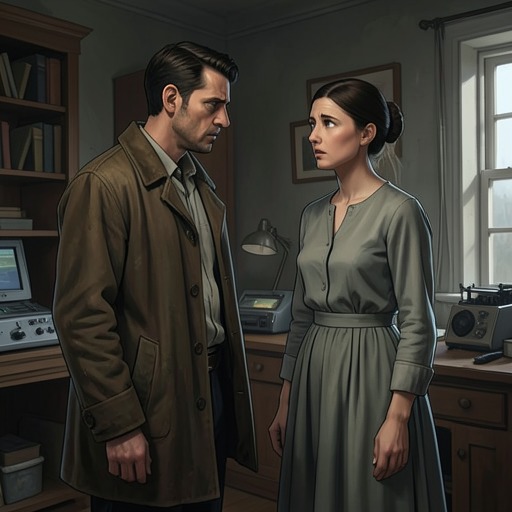
Lucrezia Warren Smith
Mrs DallowayLucrezia Warren Smith, usually called Rezia, is Septimus Warren Smith’s Italian wife and closest companion during his worsening mental distress. She becomes both his practical caregiver and the witness to what medical authority cannot or will not understand: she knows his suffering at close range, yet her requests for help leave her feeling abandoned. Her brief return to laughter with him makes their intimacy visible even as the care system closes around them.
Identity and Introduction
The narrative introduces Rezia as a little Italian woman with large eyes and a sallow, pointed face, walking with Septimus through London. When traffic stops around a motor car outside Mulberry’s shop, Septimus is frightened by the crowd’s attention and the pattern on the car’s blinds; Rezia, too, looks at the car and wonders whether the Queen is inside. The scene places her beside him in the shared public world, but their perceptions are already diverging: what attracts her curiosity becomes part of his mounting terror.
Rezia’s marriage is the central relationship through which she is portrayed. She measures her own situation against Septimus’s withdrawal, trying to reach him while recognizing that he can no longer respond to her as he once did. Her wedding ring, which slips from her thinned hand, becomes a concrete sign of the strain and physical cost she associates with their life together. When she tells Septimus that she has put the ring in her purse, he interprets its removal as proof that their marriage is over; the same gesture thus carries sharply different meanings for the two of them.
Caregiving and Isolation
Rezia’s care is marked by the difficulty of finding anyone to whom she can speak plainly. She cannot sit beside Septimus when he stares past her and makes the surrounding world seem terrifying. To her mother, she can say only that he has been working too hard; she feels unable to tell anyone else, even Septimus. She longs for relief from the burden but also insists that she cannot be happy without him. Her conflicted thoughts register neither simple rejection nor uncomplicated devotion, but the isolation of loving someone whose experience has become inaccessible.
The streets repeatedly sharpen that isolation. A child’s distress and the kindness of a man who gives the child his watch to play with make Rezia wonder why she and Septimus must endure their own suffering. Later, she gives chance encounters meanings because she is so unhappy. An old woman singing in the street makes her feel, for a moment, that all will be well; Rezia takes comfort in the prospect of seeing Sir William Bradshaw and believes he will cure Septimus. Her hope is specific and provisional, built from the ordinary signs around her rather than confidence in a system she already knows.
Rezia’s isolation also has a social dimension: she wants to tell kind strangers that she is unhappy, but cannot bring herself to do so. She is left to interpret Septimus’s condition privately and to manage the practical demands of seeking help. The narrative sets this unseen labor against the apparent ordinariness of the couple crossing the city. Nothing about them necessarily alerts a passer-by to the depth of Septimus’s distress or to the burden Rezia carries beside him.
Seeking Help and Medical Authority
When Septimus speaks to himself, Rezia asks what he is saying and is terrified by his apparent distance from her. She sends Agnes to fetch Dr. Holmes, describing her husband as mad. Yet her plea for assistance does not give her control over what happens next. At Sir William Bradshaw’s consultation, she tries to defend Septimus, assuring the doctor that he has done nothing wrong. Bradshaw asks whether Septimus has threatened to kill himself, then presents the case as one requiring a long period of rest in a country home, away from Rezia. He calls the problem a lack of a sense of proportion rather than madness and tells her that there is no alternative.
The interview demonstrates how little room Rezia has to shape the decision. Bradshaw speaks to her privately, explains the proposed arrangement, and says he will make the arrangements and inform her later. She is left with no further question to ask—not because her fears have been resolved, but because the doctor’s authority has defined the available choices. Afterwards she feels that she asked for help and was deserted. The proposed treatment is presented to her as care, but its separation of husband and wife intensifies the very helplessness she sought to escape.
That conflict becomes immediate when Rezia hears Dr. Holmes downstairs and fears he has come to see Septimus. She goes down to stop him, insisting that he will not see her husband. Holmes identifies himself as a friend, but pushes past her. Rezia’s attempt to hold the boundary of the home fails; Septimus hears the exchange upstairs and understands that Holmes is coming. The contrast between her protective intent and the doctor’s physical access makes the couple’s loss of privacy and control tangible.
Marriage, Work, and Brief Intimacy
For all the anguish between them, Rezia and Septimus retain moments of shared attention. She watches him smile while he lies on the sofa, though his happiness unsettles her because his behavior has become difficult to recognize as ordinary married life. His writing fills a table drawer with thoughts about war, Shakespeare, discoveries, and the claim that there is no death. He sometimes changes direction in mid-thought, listening for something new; Rezia records what he says, turning his speech into writing even when she cannot make sense of all of it. In this work she is at once witness, helper, and the person left to preserve fragments of his experience.
A small hat provides a different kind of connection. Rezia explains that Mrs. Filmer’s married daughter, Mrs. Peters, chose it, and Septimus calls it an organ-grinder’s monkey’s hat. Rezia adds a rose to it, and the two laugh together. She is delighted because they have not laughed like that for weeks, and because their private joke belongs to them in a way outsiders would not understand. The episode gives their marriage a moment of mutual recognition: Septimus’s humor reaches her, and her contribution to the hat extends the joke rather than merely recording his words.
The relief does not last, but it is not insignificant. Rezia’s happiness at the shared laughter shows what remains possible between them before another attempt at intervention threatens their privacy. She continues to care about small domestic obligations and the people who have helped them: Mrs. Filmer has given her grapes, and Rezia wants to express gratitude. Such details place her in a network of everyday dependence and kindness, even as the couple’s larger crisis makes that ordinary life precarious.
The Final Crisis and Narrative Significance
As Holmes approaches, Rezia leaves Septimus to go downstairs and prevent the doctor from entering. The separation is brief but decisive: she is occupied with trying to protect him, while Septimus, hearing the approach, faces the crisis alone. His thoughts turn to the window and to the fear of being taken by Holmes or Bradshaw. Rezia’s absence is therefore not an abandonment of him; it is the consequence of a protective action that cannot stop the intrusion. The evidence establishes the immediate circumstances of the crisis without making Rezia responsible for its outcome.
Rezia’s part in the story makes the limits of care visible. She observes Septimus’s changes, tries to find words for her distress, seeks help, defends him to Bradshaw, and attempts to bar Holmes from the room. Each action arises from attachment, yet none gives her the power to determine how the doctors treat Septimus or to secure the privacy she wants for their marriage. Her experience reveals the cost of a system in which medical judgment displaces the testimony of the person living closest to the patient.
At the same time, the shared joke over the hat complicates any account of the marriage as nothing but illness and burden. Rezia remembers Septimus’s wit and takes joy in a moment when they can laugh together, even while fear and separation press in around them. Her role is thus not merely to witness his distress: through her practical efforts, silences, memories, and brief moments of companionship, the narrative gives the crisis its intimate human scale.